Introduzione
Baseball and softball players frequently experience overuse injuries due to repetitive throwing, batting, and fielding motions. Tendonitis, particularly in the elbow and shoulder, is one of the most common musculoskeletal issues in these athletes. Tendinopathy arises when repetitive microtrauma exceeds the tendon’s capacity for repair, leading to inflammation, collagen disorganization, and localized pain. Managing tendonitis effectively is critical to maintaining performance and preventing chronic dysfunction. CO₂ cryotherapy, a non-invasive cooling modality, has emerged as a potential adjunct therapy to address inflammation, reduce discomfort, and support tissue recovery in athletes. This article explores tendonitis in baseball and softball players, the science behind CO₂ cryotherapy, and its practical implications for training and rehabilitation.
1. Understanding Tendonitis in Throwing Athletes
1.1 Anatomy and Biomechanics of the Elbow and Shoulder Tendons
Baseball and softball players rely heavily on the upper extremity’s dynamic tendon structures, particularly the rotator cuff and the common flexor/extensor tendons of the elbow. The repetitive overhead motion subjects these tendons to tensile and compressive forces that can disrupt collagen alignment over time. Microtears may accumulate faster than the tendon’s intrinsic repair capacity, leading to pain and reduced function. Biomechanical factors, such as improper throwing mechanics, overuse, and inadequate recovery periods, exacerbate tissue stress. Understanding tendon anatomy and load distribution allows athletes, trainers, and clinicians to identify vulnerable areas and apply targeted interventions to reduce progression from acute inflammation to chronic tendinopathy.
1.2 Common Types of Tendonitis in Baseball and Softball
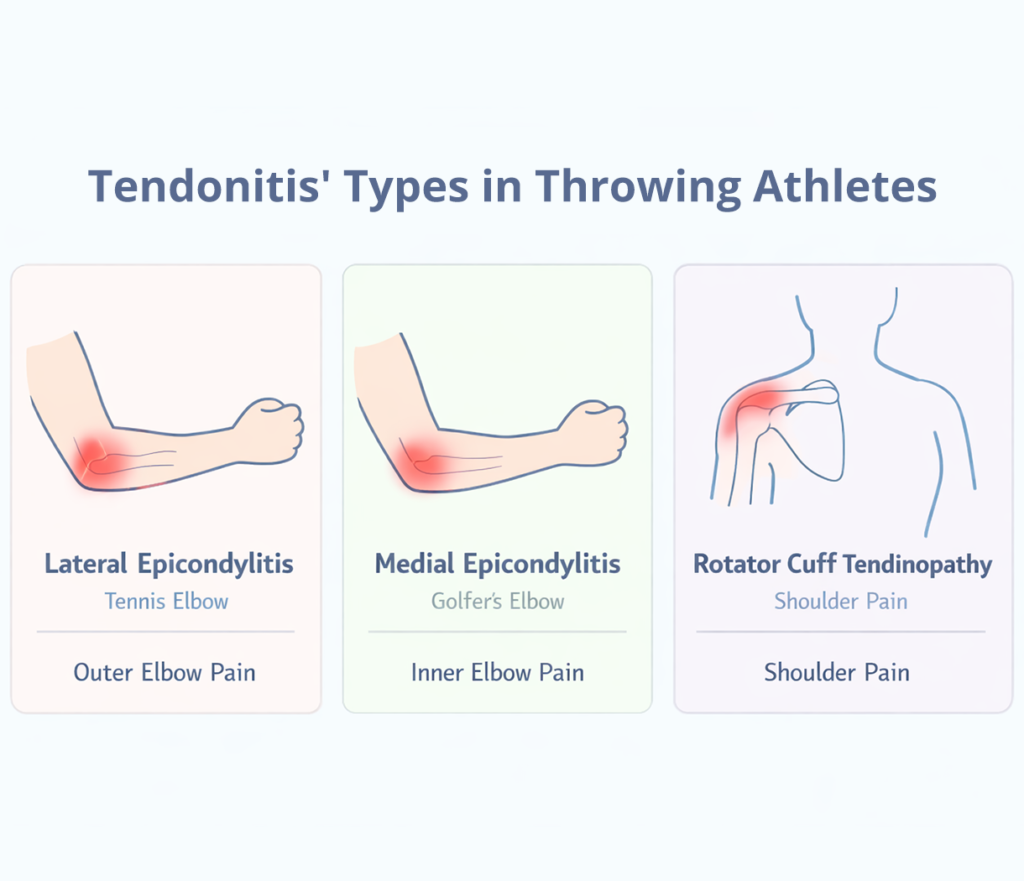
Throwing athletes are prone to lateral epicondylitis, medial epicondylitis, and rotator cuff tendinopathy. Lateral epicondylitis involves degeneration of the extensor carpi radialis brevis tendon, producing pain on the outer elbow. Medial epicondylitis affects the flexor-pronator mass on the inner elbow. Rotator cuff tendinopathy usually impacts the supraspinatus tendon, often presenting with anterior or lateral shoulder pain during overhead activity. The prevalence of these conditions varies with age, position, and training intensity. Recognizing the specific tendon affected is crucial for implementing effective prevention strategies and optimizing therapeutic interventions, including the use of cryotherapy.
1.3 Risk Factors for Tendon Overuse
Multiple factors contribute to tendon overuse injuries in throwing athletes. High-frequency pitching, repetitive batting, inadequate warm-up, muscular imbalances, and insufficient rest increase tendon load beyond physiological limits. Extrinsic factors, such as playing surface, equipment, and seasonal workload, also influence injury risk. Additionally, intrinsic factors including age, tendon vascularity, and previous injury history determine susceptibility to chronic tendinopathy. Awareness of these risk factors enables targeted prevention programs, which can be complemented by adjunct therapies like CO₂ cryotherapy to manage early inflammation and reduce downtime.
2. The Science Behind CO₂ Cryotherapy
2.1 What is CO₂ Cryotherapy?
CO₂ cryotherapy involves applying high-velocity carbon dioxide gas at subzero temperatures to specific body areas. Unlike ice packs or cold water immersion, CO₂ gas cools tissue rapidly without causing significant wetness or discomfort. The rapid cooling induces vasoconstriction followed by reactive vasodilation, enhancing local blood flow and nutrient delivery upon rewarming. At the cellular level, cryotherapy can modulate inflammatory mediators, reduce edema, and support tissue homeostasis. For tendonitis, CO₂ cryotherapy may decrease nociceptor sensitivity, lower pro-inflammatory cytokine activity, and promote conditions conducive to tendon repair, offering a non-invasive adjunct to conventional rehabilitation.
2.2 Evidence Supporting CO₂ Cryotherapy in Tendon Management
Research on CO₂ cryotherapy and low-level cold therapies demonstrates potential benefits in reducing pain and enhancing functional recovery for musculoskeletal injuries. Studies indicate that localized cooling can alleviate post-exercise tendon discomfort and accelerate return to activity. While clinical trials specifically in baseball and softball players are limited, evidence from broader athletic populations suggests improvements in pain perception, edema control, and localized circulation. Cryotherapy may also positively influence collagen remodeling during tendon healing by controlling excessive inflammatory responses, providing a safe and adjunctive modality for managing tendon overuse injuries.
3. Practical Applications for Baseball and Softball Athletes
3.1 Targeted Application for Elbow and Shoulder Tendonitis
Localized CO₂ cryotherapy can be applied directly to inflamed tendon regions, such as the lateral or medial elbow and the rotator cuff insertion sites. Sessions typically last several minutes, with the therapist carefully monitoring tissue response to avoid overcooling. By targeting the affected tendons, CO₂ cryotherapy helps control pain, reduce swelling, and create optimal conditions for tendon adaptation. Athletes can benefit from sessions immediately after intense throwing or batting activities to manage acute microtrauma, potentially reducing cumulative tendon stress and improving overall functional recovery.
3.2 Integration with Training and Rehabilitation
CO₂ cryotherapy should complement structured rehabilitation, including progressive loading, strength training, and movement re-education. Cold therapy can be strategically scheduled post-activity to mitigate inflammation while allowing subsequent training sessions to maintain tendon conditioning. Clinicians often combine cryotherapy with eccentric tendon exercises and flexibility programs to optimize outcomes. The integration of CO₂ cryotherapy allows athletes to maintain consistent training loads while minimizing downtime from tendon discomfort, supporting both short-term performance and long-term tendon health.
3.3 Considerations and Safety
While CO₂ cryotherapy is generally safe, proper protocol adherence is critical. Overexposure may lead to superficial cold burns or discomfort. Contraindications include open wounds, acute infections, or hypersensitivity to cold. Trained professionals must evaluate each athlete’s condition, adjust treatment duration, and monitor tissue response. Awareness of contraindications, athlete-specific factors, and timing relative to training ensures that CO₂ cryotherapy provides therapeutic benefits without compromising safety.
FAQ
Q1: Can CO₂ cryotherapy completely heal tendonitis?
No, CO₂ cryotherapy is an adjunctive therapy that helps manage pain and inflammation but should be combined with rehabilitation exercises for full recovery.
Q2: How long should each CO₂ cryotherapy session last?
Typical sessions last between 2–5 minutes, depending on the targeted area and athlete tolerance, always supervised by a professional.
Q3: Is CO₂ cryotherapy suitable for all baseball and softball players?
It is generally safe for most athletes, but contraindications such as open wounds, acute infections, or cold hypersensitivity must be considered.
Q4: How soon after training should CO₂ cryotherapy be applied?
Immediate post-activity application is recommended for acute inflammation, while sessions can be adjusted based on the athlete’s recovery needs.
Q5: Can CO₂ cryotherapy be combined with other treatments?
Yes, it is most effective when combined with targeted strengthening, stretching, and movement retraining programs.
Conclusione
Tendonitis is a common overuse injury in baseball and softball players, affecting performance and long-term tendon health. CO₂ cryotherapy offers a safe, non-invasive approach to manage pain, reduce inflammation, and support recovery when integrated with structured rehabilitation and training strategies. By targeting inflamed tendons and complementing evidence-based conditioning programs, athletes can maintain performance while minimizing downtime and promoting long-term musculoskeletal resilience.
Riferimenti
Bjordal, J. M., et al. A Systematic Review of Low Level Laser Therapy with Location‑Specific Dosage for Pain Reduction. Journal of Clinical Laser Medicine & Surgery.
https://pubmed.ncbi.nlm.nih.gov/16253361
Leeder, J., et al. Cold Water Immersion and Cryotherapy in the Management of Exercise-Induced Tendon and Muscle Injuries. British Journal of Sports Medicine.
https://bjsm.bmj.com/content/49/20/1331
Bleakley, C., et al. The Use of Ice in the Treatment of Acute Soft-Tissue Injury: A Systematic Review of Randomized Controlled Trials. American Journal of Sports Medicine.
https://pubmed.ncbi.nlm.nih.gov/19892890
Broatch, J. R., et al. Post-Exercise Cryotherapy: Physiological Responses and Applications for Performance and Recovery. Sports Medicine.
https://link.springer.com/article/10.1007/s40279-018-0871-8
Local Cryotherapy. CO₂ Cryotherapy Services and Athletic Recovery.