
Introduzione
The first few weeks on a hospital unit bring a steep learning curve for any new nurse. Long shifts, unfamiliar routines, and the physical demands of patient care all come at once. Among the biggest challenges that new nurses face—often without warning—is acute low back strain. The repetitive motions of lifting, turning, and repositioning patients place sudden stress on a spine that has not yet adapted to the mechanical loads of clinical work. Many new graduate nurses experience a back injury within their first year, and those who do often struggle to complete shifts or face extended time away from work. For new nurses recovering from an acute back strain, CO₂ cryotherapy offers a non-invasive, drug‑free approach that may help reduce discomfort, manage swelling, and support a faster return to the floor.
1. The Hidden Risk of the First Year
The transition from nursing school to clinical practice brings not only new responsibilities but also new physical demands. Many new graduate nurses enter the workforce with limited practical experience in patient handling, and the sudden increase in physical load makes the first months of practice a high‑risk period for acute back injuries.
1.1 How Common Is Acute Back Strain in New Nurses?
Low back pain is widely recognized as a leading occupational health issue in nursing. Among nursing students, research shows that the prevalence of low back pain increases dramatically from around 41% before nursing school to 75% during clinical training. Once these students become new graduate nurses, the problem does not disappear. Studies tracking nurses from entry into nursing school through their early careers found that 54% of nursing students reported back pain during their first year of school, 57% reported it during their first year as a nurse, and by the fifth year of practice, the figure rose to 64%. For many new nurses, acute back strain occurs within the first year on the job, often within the first few months.
1.2 Why the First Months Are Particularly Vulnerable
Several factors make new graduate nurses especially susceptible to acute back strain. First, patient handling techniques that were practiced in simulation labs or under close supervision in clinical rotations become real‑world responsibilities without the same level of oversight. The body mechanics that protect the lower back—keeping the load close, bending at the knees, avoiding twisting—are easy to forget during a busy shift when a patient suddenly needs repositioning. Second, new nurses often work on units where patient acuity is high and staffing ratios may not provide adequate support. Third, the muscles of the lower back and core have not yet been conditioned to handle the repetitive loads of a full nursing shift. This combination of technique gaps, high demands, and unprepared tissues creates a situation where an acute strain can happen from a single awkward lift or from cumulative fatigue over several consecutive shifts.
2. Understanding Acute Low Back Strain
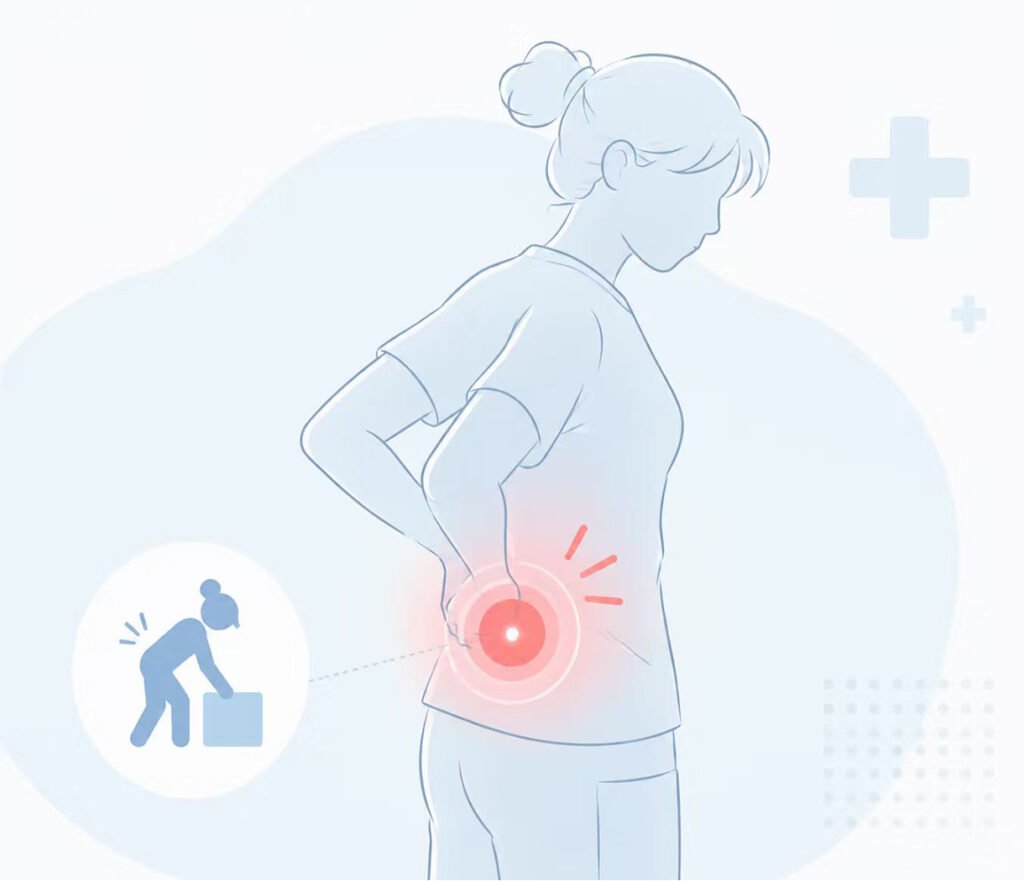
An acute low back strain involves damage to the muscles, tendons, or ligaments of the lumbar spine. This type of injury occurs when tissue is loaded beyond its current capacity, often in a single event such as lifting a patient with poor body mechanics, twisting while bearing weight, or catching a patient who begins to fall. The onset is typically sudden, and the affected individual can often identify the specific moment when the injury happened.
2.1 Tissue Changes and Symptoms
When a muscle or ligament in the lower back becomes strained, small tears develop in the collagen fibers that give the tissue its strength. These microtears trigger a localized inflammatory response, which causes the familiar signs of an acute injury: pain, swelling, muscle spasm, and reduced range of motion. The pain may be sharp at the moment of injury and then settle into a persistent ache. Muscle spasm often follows as the body attempts to splint the injured area, a protective mechanism that can actually prolong discomfort by keeping the muscles in a constant state of contraction. Movement becomes difficult, and activities such as bending, lifting, or even rolling over in bed can provoke sharp pain.
2.2 The Challenge of Recovery for Working Nurses
Recovering from an acute low back strain is harder for a nurse than for someone in a desk job. A nurse cannot simply rest until the pain disappears—shifts must be covered, patients need care, and time off may not be readily available. Returning to work too soon, however, risks prolonging the injury or causing a recurrence. The challenge lies in finding a way to manage the pain and inflammation associated with the strain while continuing to perform essential job functions.
3. How CO₂ Cryotherapy Works for Acute Back Strain
CO₂ cryotherapy uses pressurized carbon dioxide gas directed through an applicator to deliver localized cooling directly to the injured area. Unlike ice packs, which require prolonged contact and leave the skin wet, CO₂ cryotherapy provides a dry, precise cold stream that reaches the target tissue within seconds.
3.1 The Thermal Shock Response
When the cold CO₂ gas contacts the skin over the lower back, it rapidly lowers the surface temperature. The body interprets this rapid cooling as a thermal shock and responds with a series of physiological adjustments. First, blood vessels in the treated area constrict—a process called vasoconstriction. This helps reduce local blood flow to the injured tissue, which can limit the formation of edema and control excessive inflammation. Within seconds to minutes after the cold stimulus stops, the blood vessels then dilate more widely than before, a phase known as reactive hyperemia. This rebound effect increases circulation to the treated area, delivering fresh oxygen and nutrients while carrying away metabolic waste products that accumulate in strained muscle tissue.
3.2 Effects on Nerve Signaling and Pain
Cold temperature also influences how nerves transmit pain signals. Specialized cold receptors in the skin activate faster than pain receptors, effectively competing for neural pathways. This competition helps explain why cold application often produces a numbing effect without any medication. Additionally, cold slows nerve conduction velocity, meaning pain impulses travel more slowly along nerve fibers. For a nurse recovering from an acute low back strain, this temporary reduction in pain signaling can provide a period of improved comfort that allows for easier movement during the workday.
3.3 Muscle Relaxation and Reduced Spasm
The muscles of the lower back often go into spasm after an acute strain, a protective response that can become a problem in its own right. Sustained contraction reduces blood flow to the muscle and keeps the tissue in a shortened, tense state. CO₂ cryotherapy may help interrupt this spasm cycle by reducing nerve activity at the motor end plate—the site where nerves signal muscles to contract. With less neural drive to the spastic muscles, the tissue can relax, allowing for improved mobility and reduced discomfort.
4. Using CO₂ Cryotherapy for Acute Recovery
For a new nurse who has experienced an acute back strain, timing and consistency matter when using CO₂ cryotherapy. The goal is not to mask pain so that unsafe activity can continue, but rather to support the body‘s natural healing processes while the nurse returns to function as safely as possible.
4.1 When to Apply
The best time to use CO₂ cryotherapy for an acute back strain is soon after the injury occurs or at the end of a shift when the lower back feels tight and inflamed. Early application may help modulate the acute inflammatory response before it becomes excessive. Applying cryotherapy after a shift, rather than before, allows the treatment to address the accumulated load from patient handling without masking warning signals that the nurse needs to heed during work. A typical session targeting the lumbar region lasts several minutes, with the applicator moving continuously over the affected area.
4.2 What to Expect
Most nurses describe the sensation of CO₂ cryotherapy as intensely cold but not painful. The feeling is often described as a dry, tingling cold that passes quickly as the applicator moves. Unlike ice, there is no wetness or dripping. After the session, the treated area may feel temporarily numb, and many nurses report reduced muscle tightness and improved ability to move comfortably. The effects are not permanent—the relief may last from a few hours to most of a day. For this reason, regular application over several days often provides more consistent support than a single treatment.
4.3 Combining with Other Recovery Strategies
CO₂ cryotherapy works best as part of a broader approach to acute back strain. New nurses should continue to use proper body mechanics during patient handling, even when the pain has subsided. Gentle movement within a pain‑free range helps maintain joint mobility and prevents stiffness. Staying well hydrated supports tissue repair, and adequate sleep gives the body time to heal.
5. Practical Tips for New Nurses Protecting Their Back
Preventing a first back injury is always better than recovering from one. New nurses can take several practical steps to reduce their risk of acute low back strain.
5.1 Body Mechanics That Matter
The fundamentals of safe patient handling apply in every shift. Keep the patient as close to your body as possible before lifting. Bend at the hips and knees, not at the waist. Avoid twisting your torso while bearing weight—pivot your feet instead. Raise the bed to a comfortable working height before providing care. Use assistive devices such as slide sheets, transfer belts, or mechanical lifts whenever available. These techniques reduce the mechanical load on the lumbar spine and distribute forces across stronger muscle groups.
5.2 Building Strength and Endurance
A strong core and stable lower back handle physical demands better than weak ones. New nurses can benefit from simple conditioning exercises performed on days off, such as planks, bird‑dogs, and gentle back extensions. Building endurance in the muscles that support the spine reduces the risk of fatigue‑related injury during long shifts. However, it is important to start these exercises gradually and avoid any movement that provokes sharp pain.
5.3 Listening to Early Warning Signs
The best habit a new nurse can develop is paying attention to the first signs of back strain—a dull ache that does not go away, stiffness that lasts into the next day, or a sensation of tightness after a particular patient handling task. Addressing these early signals with rest, gentle movement, and supportive measures such as cryotherapy can prevent a minor irritation from becoming a full‑blown injury that requires time away from work.
FAQ
Q1: How soon after an acute back strain can I use CO₂ cryotherapy?
You can use it within the first day or two after the injury, as long as the skin over the treated area is intact. Applying cold early may help manage the inflammatory response.
Q2: How many sessions does a new nurse typically need for an acute strain?
The number varies. Some nurses notice improvement after one or two sessions, while others benefit from daily application for several days. Consistency matters more than frequency.
Q3: Can I use CO₂ cryotherapy during a shift?
It is best used after a shift, when the lower back feels tight and inflamed. Using it before a shift could mask pain signals that help you avoid unsafe movements.
Q4: Is CO₂ cryotherapy safe to use alongside other treatments?
Yes. It works well with rest, gentle movement, and proper body mechanics. It does not interfere with medications or other therapies.
Q5: Will CO₂ cryotherapy prevent future back injuries?
No. It supports recovery from an existing acute strain but does not replace proper body mechanics, strength training, or safe patient handling techniques.
Conclusione
The first months of a nursing career bring excitement, learning, and significant physical demands. For many new graduate nurses, an acute low back strain becomes an unexpected obstacle during this transition. The combination of high patient handling loads, developing body mechanics skills, and unprepared back muscles creates a situation where injury can happen quickly. CO₂ cryotherapy offers a non‑invasive, drug‑free option that works through thermal shock, vasoconstriction followed by reactive vasodilation, modulation of nerve signaling, and muscle relaxation. When used alongside proper body mechanics, gentle movement, and attention to early warning signs, CO₂ cryotherapy may help new nurses recover more comfortably from an acute back strain and stay on the floor doing the work they trained to do.
Riferimenti
Hospital‑based clinical training and low back pain in nursing students
https://pubmed.ncbi.nlm.nih.gov/40855485
Low back pain among nurses: a follow‑up beginning at entry to nursing school
https://pubmed.ncbi.nlm.nih.gov/15910263
La crioterapia con anidride carbonica idrata il recupero immediato della funzione muscolare dalla fatica neuromuscolare.
https://pubmed.ncbi.nlm.nih.gov/39533652
Effectiveness of Local Cryotherapy Treatment with the Use of Carbon Dioxide and Liquid Nitrogen Among Patients with Low Back Pain Syndrome
https://www.semanticscholar.org/paper/126f5bfb43c139c1b1bbadd489179058322edddb
Crioterapia localizzata: Sollievo mirato per una guarigione più rapida
https://www.localcryotherapy.com/localized-cryotherapy-targeted-relief-for-faster-healing.html/