Introduzione
A soccer player plants their foot to change direction, and suddenly their ankle rolls inward. They hit the ground, grabbing their foot, unable to put weight on it. The clock is running, and the medical team has only minutes to assess and treat the injury. Traditional sideline treatment calls for ice packs, but they take fifteen to twenty minutes to cool the tissue effectively. That is time the athlete does not have. CO₂ cryotherapy changes the sideline game by delivering intense cold in just three to five seconds, allowing medical staff to start treatment immediately and get players back on their feet faster.
1. Understanding Acute Ankle Sprains in Sports
Ankle sprains are among the most common injuries in sports. Knowing what happens inside the joint during a sprain helps explain why rapid cold application matters so much.
1.1 What Happens When You Roll Your Ankle
An ankle sprain occurs when the foot twists inward or outward beyond its normal range of motion. This movement stretches or tears the ligaments that hold the ankle bones together. The lateral ankle sprain, where the foot rolls inward, is the most common type. It damages the anterior talofibular ligament, calcaneofibular ligament, and posterior talofibular ligament. The severity ranges from mild stretching (grade I) to complete tears (grade III).
1.2 The Inflammatory Cascade
Within seconds of the injury, the body starts an inflammatory response. Damaged cells release chemical signals that attract immune cells to the area. Blood vessels dilate, causing swelling and redness. Fluid leaks from the vessels into the surrounding tissue, creating edema. While some inflammation is necessary for healing, excessive swelling can delay recovery and prolong pain. The key to effective sideline management is to control this inflammatory cascade before it gets out of hand.
1.3 Why Time Matters Most
The first few minutes after an ankle sprain are critical. The inflammatory response builds rapidly, and swelling can peak within the first hour. Once swelling has fully developed, it becomes much harder to control. Treatment applied in the first thirty seconds can limit the inflammatory response significantly. Treatment applied ten minutes later may only provide pain relief without reducing the total amount of swelling. This timing advantage is why sideline medical teams need tools that work in seconds, not minutes.
2. How CO₂ Cryotherapy Works for Acute Injuries
CO₂ cryotherapy uses pressurized carbon dioxide gas to create an intense cooling effect on the skin surface. For sideline use, this technology offers unique advantages over traditional ice.
2.1 The Speed Difference
Traditional ice packs take fifteen to twenty minutes to cool tissue to therapeutic temperatures. The cold must penetrate through the skin, fat, and muscle to reach the injured ligaments. CO₂ cryotherapy works differently. When pressurized CO₂ gas expands rapidly, it drops skin temperature from normal down to near freezing in just three to five seconds. This rapid cooling triggers immediate physiological responses that help control inflammation before it fully develops.
2.2 The TRPM8 Pathway
Your skin contains millions of temperature sensors called TRPM8 channels. These channels detect cold temperatures and send signals to your nervous system. The intense cold from CO₂ therapy activates these channels powerfully, sending strong signals to the spinal cord and brain. These signals can override pain signals coming from the injured ankle, providing almost immediate pain relief. The same pathway also triggers reflexive changes in blood vessels that help control swelling.
2.3 Maintaining Blood Flow While Cooling
Ice packs cause blood vessels to narrow, reducing blood flow to the injured area. This helps limit swelling, but it also reduces oxygen delivery to the tissues that need it for healing. CO₂ therapy produces a different pattern. The initial cold causes vasoconstriction, but the effect is brief. As the tissue naturally rewarms after treatment, blood vessels expand and blood flow increases. This reactive hyperemia brings oxygen and nutrients to the injured area while still providing the benefits of early cold application. Research has shown that CO₂ treatment does not reduce blood volume in the way that ice does.
2.4 Practical Sideline Application
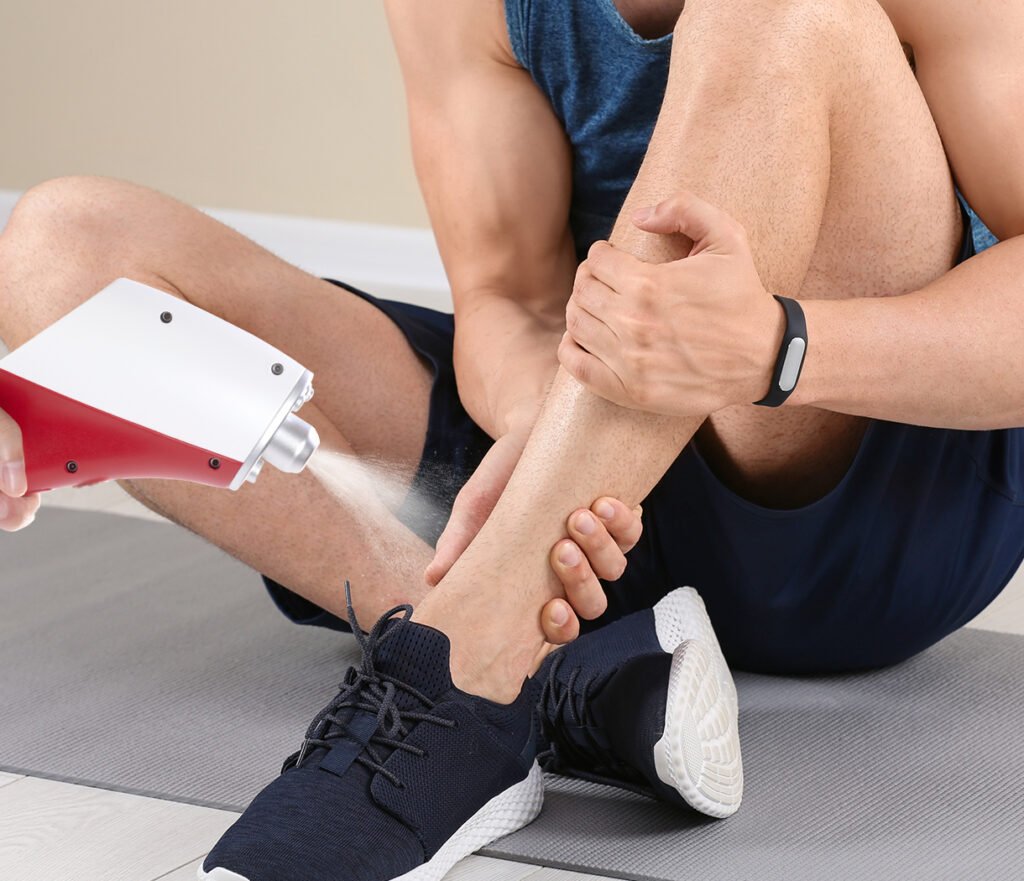
The device is portable and easy to use on the sideline. The medical trainer holds the CO₂ handpiece several inches from the injured ankle and activates short bursts of pressurized gas. The athlete feels an intense cold rush that lasts only seconds. The trainer can repeat the application over the affected area, covering the lateral ligaments from multiple angles. The entire treatment takes less than one minute, allowing the athlete to be evaluated, treated, and moved off the field without delaying the game significantly.
3. What the Research Says About CO₂ and Ice
Scientific studies have compared CO₂ cryotherapy to traditional ice for various outcomes. The evidence supports CO₂ as a viable alternative, particularly when speed of application matters.
3.1 Muscle Function Recovery
A 2024 study in the Journal of Sports Sciences examined how CO₂ hydrate cryotherapy affected muscle function after fatigue. The researchers found that CO₂ treatment restored peak knee extensor power to ninety-five percent of baseline values thirty-five minutes after exercise. Ice treatment only restored power to between eighty-two and eighty-nine percent. This difference matters for athletes who need to perform again the same day or within a short recovery window.
3.2 Blood Flow Preservation
The same study measured blood volume in the treated muscles. The CO₂ group showed no reduction in blood volume compared to resting values. The ice group showed significantly lower blood volume, indicating prolonged vasoconstriction. This suggests that CO₂ therapy provides the benefits of cold application without the downside of reducing blood flow to the recovering tissues. For acute ankle sprains, this could mean less swelling with better tissue oxygenation.
3.3 Pain Relief in Older Adults
A clinical study of patients with an average age of nearly eighty-four years found that high-pressure CO₂ cryotherapy significantly reduced both acute and chronic pain. Acute pain scores dropped from fifty-two millimeters on a visual analog scale to thirteen millimeters after four treatments. Chronic pain scores dropped from forty-five to thirteen millimeters. The majority of these patients had musculoskeletal pain, similar to the ligament pain experienced in ankle sprains.
3.4 Duration of Effect
Research on knee arthritis found that two CO₂ treatments given eight hours apart reduced synovial inflammation and pain for a full twenty-four hours. This suggests that a single sideline treatment may provide relief that lasts through the game and into the post-game evaluation period. Athletes can be assessed, treated, and monitored without the pain returning immediately.
4. Sideline Protocol for CO₂ Cryotherapy
For medical teams considering adding CO₂ cryotherapy to their sideline equipment, understanding the proper protocol ensures safe and effective use.
4.1 Immediate Assessment
As soon as the athlete goes down, the medical team should assess the injury. Determine if the ankle can bear weight. Check for deformity, severe swelling, or point tenderness over bone, which might indicate a fracture rather than a sprain. If a fracture is suspected, the ankle should be splinted, and the athlete should not bear weight. For suspected sprains without fracture, CO₂ cryotherapy can begin immediately while the athlete is still on the field.
4.2 Application Technique
Position the CO₂ handpiece approximately four to six inches from the skin over the most tender area of the ankle. Activate the device in short bursts, moving it slowly across the lateral aspect of the ankle. Cover the area from the tip of the fibula down to the base of the fifth metatarsal. The entire application should take twenty to thirty seconds. The athlete will feel intense cold, but the sensation fades quickly after each burst.
4.3 Post-Treatment Management
After CO₂ application, the ankle should be wrapped with an elastic bandage for compression. The athlete should be assisted off the field without bearing weight if possible. Ice can be applied later for continued cold therapy if needed, but the critical window for limiting inflammation has already been addressed. The athlete should be evaluated for return to play using standard criteria, including ability to bear weight, range of motion, and stability testing.
4.4 When to Avoid CO₂ Cryotherapy
Certain conditions make CO₂ cryotherapy inadvisable on the sideline. Open wounds or abrasions over the treatment area should be covered or avoided. Athletes with Raynaud’s phenomenon or other cold hypersensitivity disorders may react poorly. Severe peripheral artery disease requires caution. If the athlete has a known history of cold urticaria, alternative treatments should be used. For most otherwise healthy athletes with an acute ankle sprain, CO₂ cryotherapy is a safe and appropriate option.
5. Why Pro Teams Are Making the Switch
Professional sports teams have limited time to get injured players back on the field. Every minute counts, and traditional treatments often take too long.
5.1 Speed of Application
An ice pack takes fifteen minutes to reach therapeutic temperature. During those fifteen minutes, the inflammatory cascade is already building. By the time the ice is removed, significant swelling may have already developed. CO₂ cryotherapy works in seconds. The athlete can be treated, wrapped, and moved off the field in under two minutes. This speed allows medical staff to focus on diagnosis and treatment planning rather than waiting for a cold pack to work.
5.2 Sideline Practicality
Ice packs require storage and management. They melt and need replacement. CO₂ devices run on small canisters that last for multiple applications. The device is handheld and lightweight, easy to carry in a medical bag to the sideline. There is no need for a freezer or ice machine nearby. This portability makes CO₂ cryotherapy practical for outdoor sports where access to facilities may be limited.
5.3 Player Compliance
Athletes often resist ice application because the cold becomes increasingly uncomfortable over fifteen minutes. They may ask to remove the ice early, reducing its effectiveness. CO₂ therapy delivers intense cold in short bursts that are over before they become unbearable. Athletes tolerate the treatment better and do not complain about the duration. This better compliance means the treatment is actually delivered as intended.
5.4 Return-to-Play Advantage
The ultimate goal of sideline treatment is to return athletes to play safely when appropriate. CO₂ cryotherapy may shorten the time between injury and return by controlling inflammation more effectively. While no athlete should return to play with an unstable ankle or severe pain, those with mild sprains may benefit from the rapid pain relief and reduced swelling that CO₂ provides. The faster an athlete can be evaluated and treated, the sooner the decision about return to play can be made.
FAQ
Q: Does CO₂ cryotherapy hurt?
A: Most athletes describe an intense cold rush that lasts only seconds. It is not painful, though the sensation is strong. The bursts are short enough to be tolerable.
Q: How soon after an ankle sprain should CO₂ cryotherapy be applied?
A: As soon as possible. The first thirty seconds to one minute after injury are critical for limiting the inflammatory response. Sideline application should begin immediately after assessing for fracture.
Q: Is CO₂ cryotherapy safe for all athletes?
A: For most healthy athletes with acute ankle sprains, yes. Athletes with cold hypersensitivity disorders, Raynaud’s phenomenon, or open wounds over the treatment area should use alternative treatments.
Q: How long does the pain relief last?
A: Research on similar cold applications shows effects lasting several hours. For acute injuries, the primary benefit is limiting inflammation, which provides longer-term pain reduction.
Q: Can CO₂ cryotherapy replace ice entirely?
A: CO₂ is excellent for immediate sideline treatment, but ice can still be used afterward for continued cold therapy. Many medical teams use both, with CO₂ for the critical first minute and ice for subsequent recovery.
Q: How many bursts are needed for an ankle sprain?
A: Typically five to ten short bursts over twenty to thirty seconds, covering the lateral ankle ligaments from the fibula down to the base of the fifth metatarsal.
Q: Does insurance cover sideline CO₂ cryotherapy?
A: Most professional and collegiate sports teams purchase their own equipment. For individual athletes, coverage varies. Many sports medicine clinics offer CO₂ therapy as a paid service.
Conclusione
Every second counts when an athlete goes down with an ankle sprain. The inflammatory cascade starts immediately, and swelling can peak within the first hour. Traditional ice packs take fifteen to twenty minutes to reach therapeutic temperatures, time that allows inflammation to build. CO₂ cryotherapy delivers intense cold in just three to five seconds, triggering rapid physiological responses that help control swelling and reduce pain. By activating the TRPM8 cold receptors and preserving blood flow to the injured area, this technology offers a sideline solution that works with the body’s natural responses rather than against them. For sports medicine professionals looking to improve their acute injury management, CO₂ cryotherapy represents a practical, evidence-based addition to the sideline toolkit.
Riferimenti
- Effects of CO2 Hydrate Cryotherapy on Neuromuscular Fatigue Recovery After High-Intensity Exercise. Journal of Sports Sciences.
https://pubmed.ncbi.nlm.nih.gov/39620379/ - High-pressure carbon dioxide therapy for acute and chronic orthopaedic pain in geriatric patients. PubMed.
https://pubmed.ncbi.nlm.nih.gov/17172037/ - Topical therapy with compressed CO2 in sports medicine. German Journal of Sports Medicine.
https://www.germanjournalsportsmedicine.com/archive/2025/4/topical-therapy-with-compressed-co2-in-sports-medicine/ - Cryotherapy for Acute Ankle Sprains: A Review of Current Evidence. National Center for Biotechnology Information.
https://pubmed.ncbi.nlm.nih.gov/26768220/