Introduzione
A yoga or Pilates practice builds strength, flexibility, and body awareness. But for many practitioners, the very postures that form the foundation of these disciplines—Downward Facing Dog, Plank, Chaturanga, and various weight bearing poses—place the wrists in a position of hyperextension. The hands bear the full weight of the body, the wrists bend backward beyond their neutral alignment, and the small joints and tendons of the wrist absorb tremendous force. Over time, this repetitive loading can irritate the dorsal soft tissues, compress the carpal tunnel, and strain the tendons that cross the wrist joint. For practitioners who have tried modifying their practice without lasting relief, CO₂ cryotherapy offers a non invasive, drug free approach that may help manage wrist discomfort and support recovery between sessions.
1. Understanding Wrist Hyperextension in Yoga and Pilates
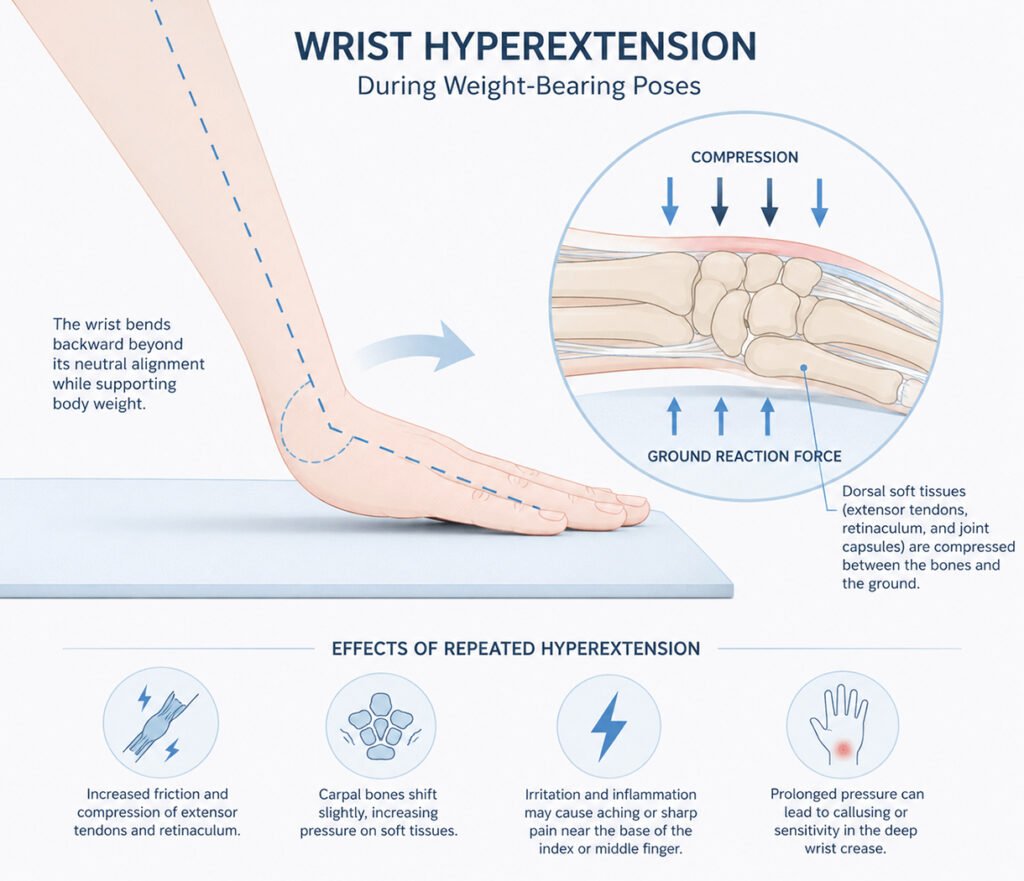
The wrist joint balances remarkable mobility with reasonable stability, but it was not primarily designed to bear the full weight of the human body for extended periods. In weight bearing poses, the wrist assumes a position of hyperextension—bent backward beyond its neutral alignment—while supporting a significant portion of body weight. This repeated loading pattern can create mechanical and biological changes in the dorsal aspect of the wrist.
1.1 The Anatomy Under Pressure
When the wrist hyperextends during weight bearing, the carpal bones shift slightly, and the soft tissues on the dorsal side become compressed between the bony structures and the ground. The extensor tendons, their retinaculum, and the joint capsules all experience increased friction and compression. Prolonged or repetitive loading in this position can irritate these tendons, leading to aching or sharp sensations localized near the base of the index or middle finger. The deep crease of the wrist may also show signs of prolonged pressure, with the skin becoming calloused or sensitive to touch.
1.2 Why Some Practitioners Experience More Discomfort
Not everyone who practices yoga or Pilates develops persistent wrist discomfort, but certain anatomical variations and practice habits increase susceptibility. Individuals with hyperflexible joints may extend their wrists beyond the range that their supporting ligaments can comfortably manage, placing additional strain on the capsule and tendons. Practitioners who attend multiple classes daily without sufficient recovery time may experience cumulative microtrauma that exceeds the tissues’ adaptive capacity. Additionally, a bony protuberance at the base of the index or middle finger metacarpal—a carpal boss—can press against overlying extensor tendons under repeated hyperextension loading, producing pain during or after weight bearing poses.
2. How CO₂ Cryotherapy Works for Wrist Overload
CO₂ cryotherapy delivers a stream of pressurized carbon dioxide gas directly to the skin over the affected area. The gas exits the device at very low temperatures, creating a dry, pressurized flow. Within seconds, the skin surface temperature drops significantly, triggering a thermal shock response from the body.
2.1 Vasoconstriction and Reduced Swelling
When the cold gas touches the wrist, it rapidly lowers the temperature of the skin and underlying tissues. This triggers vasoconstriction, a narrowing of blood vessels, which reduces blood flow to the area and helps limit the accumulation of inflammatory fluid. By decreasing local edema, the pressure on the median nerve and surrounding tendons can temporarily lessen, providing relief from numbness, tingling, and aching.
2.2 Reactive Hyperemia and Improved Circulation
After the cold stimulus ends, the blood vessels dilate more than their original size in a phase called reactive hyperemia. This rebound effect brings fresh oxygen and nutrients to the compressed nerves and tendons while flushing out metabolic waste products that contribute to fatigue and stiffness. For a yoga or Pilates practitioner, this improved circulation can mean a faster return of fine motor precision and reduced morning stiffness after a session.
2.3 Modulating Inflammation and Relaxing Muscles
The cold reduces inflammatory mediator activity and relaxes hypertonic muscles, providing relief from soreness caused by repetitive weight bearing tasks. By modulating the inflammatory environment within the wrist, CO₂ cryotherapy helps the body transition from a chronic, unresolved state toward a more constructive recovery phase. The therapy also influences nerve signaling, providing analgesic effects that allow practitioners to move more comfortably during their next session.
3. What Practitioners Can Expect from CO₂ Cryotherapy
For yoga and Pilates practitioners considering CO₂ cryotherapy, understanding the typical course of treatment helps set realistic expectations.
3.1 The Treatment Experience
A localized CO₂ cryotherapy session targeting the wrist lasts only a minute or two per area. The practitioner directs the applicator at the bare skin of the wrist and palm, moving it in sweeping motions to ensure even cooling. Most people describe the sensation as intensely cold but not painful—a dry, tingling cold that passes quickly as the applicator moves. The treatment leaves no moisture behind, so the wrist stays dry throughout and after the session.
3.2 Timing and Frequency
Practitioners often use cryotherapy at the end of a practice session to help their wrists recover overnight. Some prefer a session before a class to reduce discomfort during weight bearing poses. A common supportive routine includes two or three sessions per week, though the exact frequency depends on symptom severity and practice demands. The effects are not permanent, so regular use tends to provide more consistent relief than occasional application.
3.3 Combining with Practice Modifications
CO₂ cryotherapy works most effectively when practitioners also adjust how they load their wrists during practice. Using wedges or blocks to reduce the angle of wrist extension, distributing weight across the entire hand rather than concentrating it on the heel of the palm, and incorporating wrist strengthening exercises can all complement the effects of cryotherapy. The goal is not to eliminate weight bearing entirely but to create a mechanical environment that gives the irritated tissues a chance to recover.
4. Supporting Wrist Health Alongside Cryotherapy
Cryotherapy provides targeted relief, but maintaining wrist health requires attention to practice habits and daily routines.
4.1 Warm Up and Cool Down Routines
A few minutes of gentle wrist circles, flexion extension movements, and light stretching before practice can improve tissue pliability. After practice, simply shaking out the hands or applying a cool compress helps signal the tissues that the loading period has ended. Practitioners who rush from the last pose to the next task without this transition may carry residual tension into their daily activities.
4.2 Strengthening Supporting Muscles
Strong forearms and hands take some load off the wrist joint itself. Simple exercises such as wrist curls with light resistance, finger extensions using rubber bands, and eccentric loading of the extensor muscles can build resilience. Practitioners should introduce these exercises gradually, avoiding sharp pain. Over several weeks, improved muscular support can reduce the amount of force transmitted through the dorsal wrist structures during weight bearing poses.
4.3 Listening to Early Signals
The most useful habit is paying attention to the first signs of discomfort. A mild ache that resolves after practice may not be cause for concern, but pain that lingers into the next day or worsens with each class deserves attention. Practitioners who modify their hand placement, using fists instead of flat palms, or shifting to forearm planks temporarily, can often prevent a minor irritation from becoming a chronic limitation.
FAQ
Q1: Is CO₂ cryotherapy painful for wrist hyperextension injuries?
Most practitioners describe a very cold sensation that is intense but not painful. The applicator moves continuously, so no single spot stays cold for more than a moment.
Q2: How many sessions does a practitioner typically need?
Some practitioners use cryotherapy after every practice session during demanding periods, while others reserve it for days when discomfort feels particularly limiting. A typical supportive protocol may include two to three sessions per week.
Q3: Can I use CO₂ cryotherapy along with wrist braces or exercises?
Yes. Cryotherapy complements bracing, stretching, and ergonomic adjustments. It does not replace these measures but works alongside them.
Q4: How soon after a session will I feel less wrist discomfort?
Many practitioners notice reduced tightness and soreness within minutes after the session. The analgesic effects begin quickly, while deeper tissue recovery continues over the following hours.
Q5: Can CO₂ cryotherapy prevent wrist injuries from returning?
Cryotherapy helps manage existing symptoms and supports tissue recovery. However, maintaining good alignment during practice, regular strengthening, and attention to early warning signs remain important for long term wrist health.
Conclusione
Yoga and Pilates practitioners devote themselves to building strength, flexibility, and mindfulness. Yet the very postures that form the foundation of these practices—weight bearing through hyperextended wrists—can create persistent discomfort on the back of the hand. Wrist overload arises from repeated compression and friction between dorsal soft tissues and underlying bony structures. For practitioners who have tried modifications without lasting relief, CO₂ cryotherapy offers a non invasive, drug free option that works through vasoconstriction, reactive hyperemia, and modulation of inflammation. When combined with sensible practice adjustments, gradual strengthening, and attention to early warning signs, CO₂ cryotherapy may help practitioners maintain the wrist comfort they need to continue sharing the benefits of yoga and Pilates.
Riferimenti
CO₂ Cryotherapy for Surgeon Hand and Wrist Strain
https://www.localcryotherapy.com/co₂-cryotherapy-surgeon-wrist-strain.html
How CO₂ Cryotherapy Heals Hand and Wrist Tendonitis
https://www.localcryotherapy.com/how-co₂-cryotherapy-heals-hand-and-wrist-tendonitis.html
Il dolore al polso vi blocca? Provate la crioterapia con CO2!
https://www.localcryotherapy.com/wrist-pain-holding-you-back-try-co2-cryotherapy.html
CO₂ Cryotherapy for Recovery During Long Experiments
https://www.localcryotherapy.com/co₂-cryotherapy-lab-fatigue-recovery.html
CO₂ Cryotherapy for Wheelchair Athlete Upper Limb Recovery
https://www.localcryotherapy.com/co₂-cryotherapy-wheelchair-athlete-upper-limb-recovery.html