Introduzione
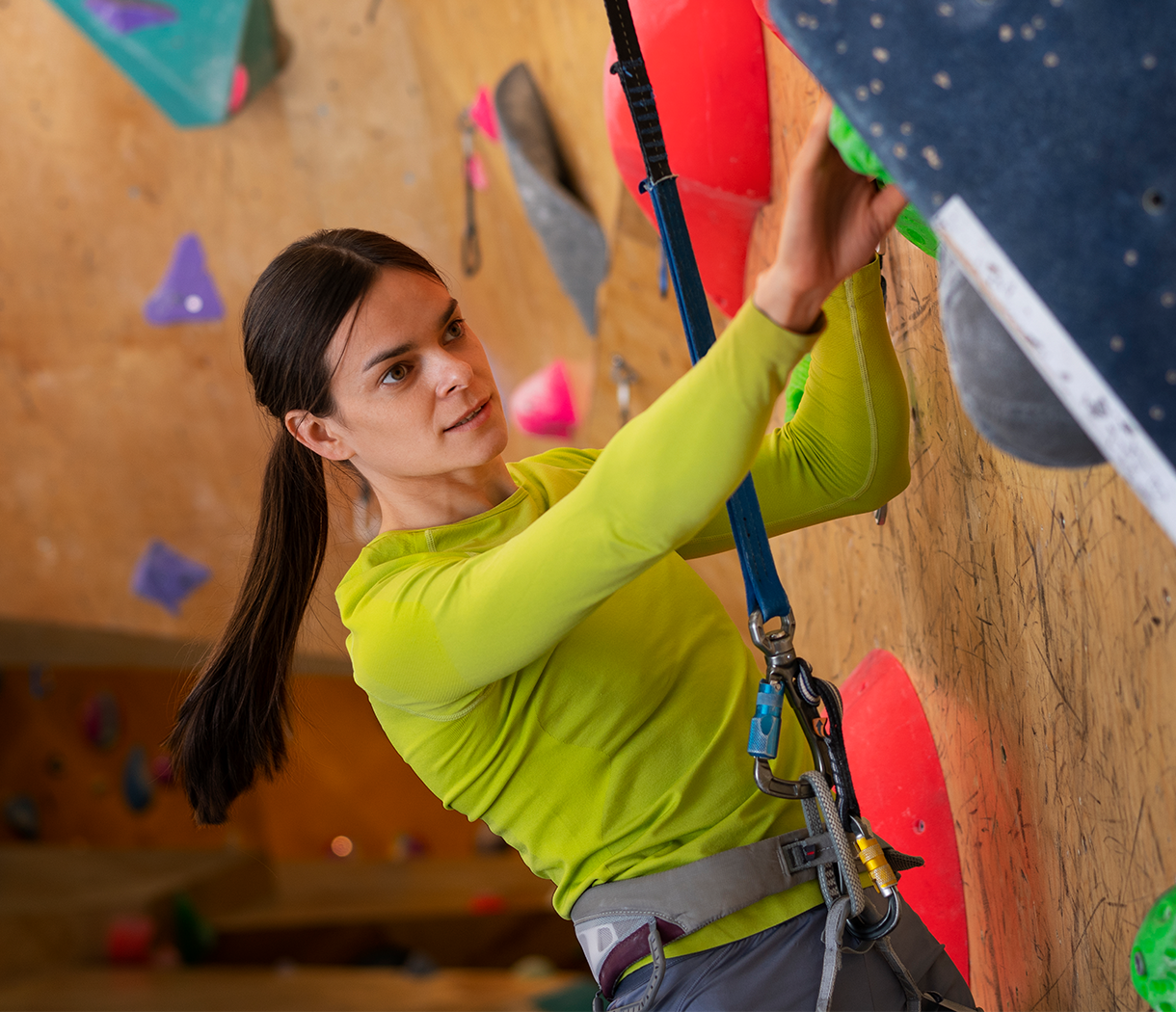
Rock climbing places unusual demands on the hands and forearms. Climbers repeatedly grip small holds, maintain finger tension, stabilize the wrist, and control body weight through relatively small contact points. Over a long climbing session, this combination can leave the finger flexors, forearm muscles, and wrist structures feeling tight, fatigued, or uncomfortable. Repeated gripping can also contribute to localized soreness that becomes more noticeable after climbing or during recovery. CO₂ Cryotherapy offers a localized cooling approach that may help relieve temporary discomfort and support post-climbing recovery when incorporated into an appropriate recovery routine.
1. Why Does Rock Climbing Place So Much Stress on the Fingers and Forearms?
Rock climbing requires more than general upper-body strength. The hands and forearms constantly adjust grip force, maintain finger position, and stabilize the wrist while the climber moves between holds. Understanding these demands helps explain why localized discomfort can develop even when the climber does not experience a clear acute injury.
1.1 Repetitive Finger Gripping Creates Localized Stress
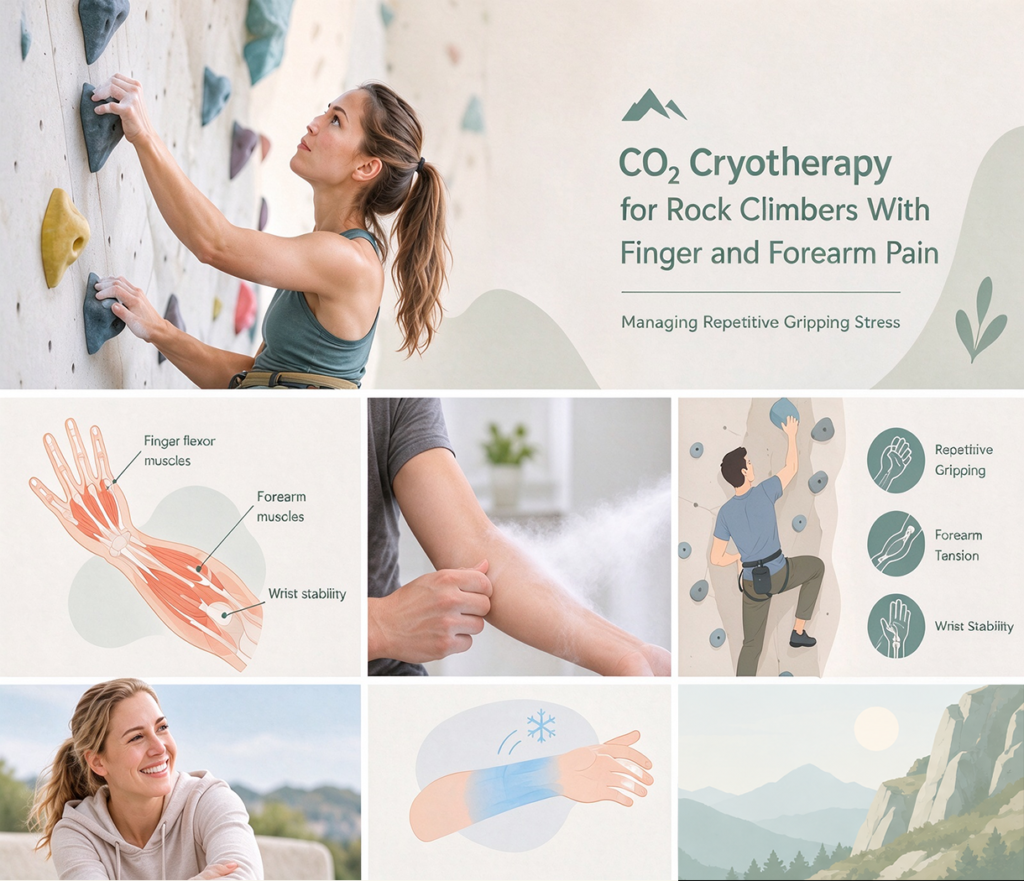
Small climbing holds often require sustained or repeated finger flexion. The flexor digitorum profundus and flexor digitorum superficialis contribute to finger flexion, while other intrinsic and extrinsic muscles help maintain grip control.
When climbers repeatedly contract these muscles, local fatigue can accumulate. Crimping, pinching, and other high-tension grips can place additional demands on the finger flexor system, especially when a climbing session includes many difficult routes or repeated attempts.
1.2 Forearm Muscles Work Continuously During a Climb
The forearm does not simply generate grip strength. It also helps control the wrist and transfer force between the hand and upper limb. During climbing, the forearm muscles may alternate between strong contractions and sustained low-level tension.
As fatigue develops, the muscles may feel tight or heavy, and localized soreness can become more noticeable after the session. This response often reflects the cumulative physical demand of climbing rather than one isolated movement.
1.3 Wrist Stability Connects Grip Strength With Upper-Limb Control
The wrist provides an important link between the fingers and the rest of the upper limb. Climbers need sufficient wrist stability to maintain efficient force transfer while reaching, pulling, and repositioning the hand.
When the forearm becomes fatigued, maintaining consistent wrist positioning may become more difficult. This can change how force moves through the hand and forearm, making recovery and appropriate load management particularly important.
2. What Can Cause Finger and Forearm Discomfort After Climbing?
The source of climbing-related discomfort can vary. Muscle fatigue, repetitive loading, grip intensity, and inadequate recovery can all contribute to symptoms. For that reason, climbers benefit from understanding the difference between normal post-exercise soreness and persistent or worsening discomfort.
2.1 Finger Flexor Fatigue After Repeated Grip Loading
Finger flexor fatigue often develops after prolonged gripping or repeated high-intensity attempts. The sensation may appear as general forearm tightness or as more localized discomfort around the palm-side forearm and fingers.
Long sessions with limited rest can increase this effect. Climbers who frequently train finger strength or spend extended periods on steep routes may also place greater demands on these tissues.
2.2 Forearm Tightness Can Build Across a Climbing Session
Forearm tightness can become particularly noticeable during sessions that involve many consecutive climbs. Continuous gripping reduces the opportunity for the muscles to fully relax between movements.
As the session progresses, climbers may notice reduced grip endurance, a feeling of fullness in the forearm, or soreness after finishing. These sensations highlight the importance of recovery between climbing sessions.
2.3 Repeated Loading Can Affect More Than One Structure
Finger and forearm discomfort does not always come from a single muscle. Tendons, muscle tissue, connective tissue, and joint structures can all experience mechanical stress during climbing.
Because several structures contribute to grip function, persistent symptoms deserve appropriate assessment rather than assuming that every type of climbing pain represents simple muscle soreness.
3. How Can CO₂ Cryotherapy Fit Into Climbing Recovery?
Once the physical demands of climbing are clear, localized cooling provides another way to approach temporary post-activity discomfort. CO₂ Cryotherapy uses pressurized carbon dioxide to create rapid cooling at a targeted area, allowing practitioners to focus on specific regions rather than applying cooling broadly across the entire limb.
3.1 What Is CO₂ Cryotherapy?
CO₂ Cryotherapy uses pressurized CO₂ gas to produce localized cooling at the skin surface. The rapid temperature change creates a strong cold stimulus that can temporarily reduce the sensation of discomfort in the treated area.
For climbers, this localized approach can be useful when soreness centers around a specific part of the forearm, wrist, or hand. The goal is not to treat the underlying cause of every climbing-related condition, but to help manage localized discomfort as part of a broader recovery strategy.
3.2 Why Targeted Cooling Matters for Climbers
Climbing-related discomfort often concentrates in relatively small anatomical regions. A climber may feel soreness along the finger flexor muscles, near the wrist, or in a specific area of the forearm.
Targeted cooling allows the practitioner to focus on the area that needs attention rather than cooling the entire upper limb. This approach also makes it easier to adjust the treatment area according to the climber’s symptoms and recovery goals.
3.3 Temperature Control Supports More Consistent Application
CO₂ Cryotherapy systems can provide controlled cooling while allowing the practitioner to monitor the treatment area. A system with real-time temperature monitoring can help maintain a more consistent application and reduce unnecessary exposure to excessive cold.
This controlled approach matters when treating smaller anatomical areas such as the fingers, wrist, or forearm, where the treatment target remains relatively localized.
4. From Finger Fatigue to Whole-Arm Recovery
Although the hands often receive the most attention in climbing, finger performance depends on the entire upper-limb kinetic chain. A recovery strategy therefore works better when it considers the fingers, forearms, wrists, and surrounding muscles together.
4.1 The Forearm and Wrist Work as a Functional Unit
The finger flexors and wrist stabilizers work together during gripping. When one area becomes fatigued, another area may compensate to maintain hand control.
For this reason, recovery should not focus exclusively on the fingers. A broader approach can consider forearm muscle tension, wrist mobility, grip endurance, and overall upper-limb workload.
4.2 Different Grip Styles Create Different Demands
Crimping, open-hand gripping, pinching, and undercling positions place different demands on the fingers and forearms. A climber who repeatedly trains one grip pattern may place concentrated stress on particular tissues.
Understanding these differences can help climbers vary training demands and avoid excessive repetition of the same high-load grip. It also gives practitioners useful context when evaluating localized discomfort.
4.3 Recovery Starts With Managing Training Load
CO₂ Cryotherapy can complement recovery, but it should not replace sensible training progression. Rest intervals, climbing volume, grip intensity, sleep, hydration, and strength conditioning all influence how the body responds to repeated climbing stress.
When discomfort continues despite appropriate recovery, professional evaluation can help determine whether the symptoms reflect simple fatigue or a more specific musculoskeletal problem.
5. Building a Smarter Recovery Approach for Climbers
A useful recovery strategy connects localized symptom management with the demands of the next climbing session. Rather than focusing only on post-climbing soreness, practitioners can consider the climber’s training volume, grip patterns, symptom location, and recovery capacity.
5.1 Match the Recovery Approach to the Symptom Location
Finger discomfort, forearm tightness, and wrist soreness may have different contributing factors. A focused assessment can help identify which region experiences the greatest load during climbing.
Once the target area becomes clearer, localized CO₂ cooling may provide a practical way to address temporary discomfort in that region while the climber continues with appropriate recovery measures.
5.2 Consider the Depth and Size of the Treatment Area
The forearm contains multiple muscle compartments, while the fingers and wrist contain smaller anatomical structures. Treatment therefore requires attention to the size and location of the target area.
CO₂ Cryotherapy systems designed for localized application can direct cooling toward specific regions. The practitioner can adjust the application according to the area being addressed rather than treating the entire arm uniformly.
5.3 Combine Localized Cooling With Active Recovery
The most useful recovery strategy often combines different approaches. Gentle mobility, progressive strengthening, appropriate rest, and gradual return to climbing can work alongside localized cooling.
For climbers, the goal should remain functional recovery: maintaining healthy movement, managing training load, and preparing the fingers and forearms for future climbing demands.
FAQ
Can CO₂ Cryotherapy help with climbing-related finger pain?
It may help relieve temporary localized discomfort and support recovery after climbing. Persistent finger pain requires appropriate professional assessment.
Is CO₂ Cryotherapy suitable for forearm soreness after climbing?
It can be used as a localized cooling approach for temporary post-exercise soreness when appropriate for the individual and treatment area.
Can climbers use CO₂ Cryotherapy for wrist discomfort?
Localized cooling may help manage temporary wrist discomfort, but the underlying cause should be considered if symptoms continue or worsen.
Does CO₂ Cryotherapy replace rest after climbing?
No. Rest, appropriate training volume, mobility, strengthening, and gradual progression remain important parts of climbing recovery.
Why do climbers often experience forearm tightness?
Repeated gripping keeps the finger flexors and wrist stabilizers active for extended periods. High grip intensity and insufficient recovery can increase feelings of tightness and fatigue.
Conclusione
Rock climbing places repeated demands on the finger flexors, forearm muscles, and wrist stabilizers, making localized fatigue and post-climbing discomfort relatively common concerns. CO₂ Cryotherapy provides a targeted cooling option that may help relieve temporary discomfort and support recovery when applied appropriately. By combining localized cooling with sensible training progression, adequate rest, mobility work, and strength conditioning, climbers can take a more comprehensive approach to managing the physical demands of repeated gripping and prepare for future climbing sessions.
Riferimenti
Anatomy, Shoulder and Upper Limb
https://www.ncbi.nlm.nih.gov/books/NBK537238
The Physiology of Rock Climbing
https://pubmed.ncbi.nlm.nih.gov/17585013
Finger Flexor Strength and Climbing Performance
https://pubmed.ncbi.nlm.nih.gov/20549142
Cold and Compression Therapy for Musculoskeletal Recovery
https://pubmed.ncbi.nlm.nih.gov/26704809
LocalCryotherapy CO₂ Cryotherapy System