Introduzione
A sudden twist, an awkward landing, or an unexpected collision during exercise can leave a muscle or joint feeling painful and swollen. The first 24–48 hours after a minor sports injury often raise important questions: Is the discomfort typical muscle soreness, or could it indicate a more significant injury? What role can cold therapy play, and when should someone seek professional evaluation? CO₂ cryotherapy offers a form of localized cooling that may help manage discomfort in selected situations. However, its effects depend on the type and severity of the injury, the cooling method, and individual health factors. Understanding the body’s early response to injury, the differences between cooling technologies, and the limits of cryotherapy can help readers make more informed decisions without overlooking signs that require medical attention.
1. What Happens to the Body After a Sports Injury?
To understand the role of localized cooling, it helps to recognize how the body responds to an injury. Pain and swelling can occur after relatively minor tissue damage, but similar symptoms may also accompany more serious conditions.
1.1 Muscle Strains, Sprains, and Bruises
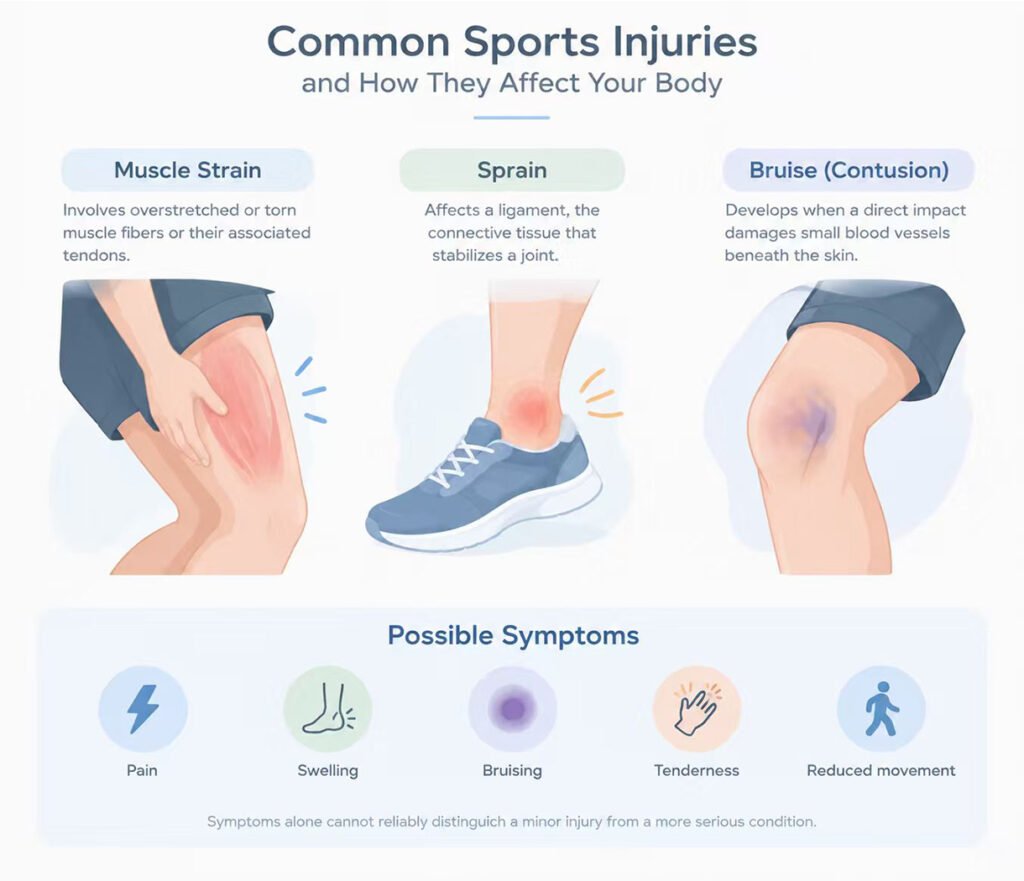
Sports injuries affect different tissues. A muscle strain involves overstretched or torn muscle fibers or their associated tendons. A sprain affects a ligament, the connective tissue that stabilizes a joint. A contusion, commonly called a bruise, develops when a direct impact damages small blood vessels beneath the skin.
These injuries may cause localized pain, tenderness, swelling, bruising, or reduced movement. However, symptoms alone cannot reliably distinguish a minor injury from a fracture, significant ligament tear, or other condition. The injury mechanism and the person’s ability to use the affected area also matter.
1.2 Why Pain and Swelling May Develop
After tissue damage, the body initiates an inflammatory response. Blood vessels and immune signaling pathways contribute to the movement of fluid and immune cells into the affected area. This process supports the body’s response to injury, although it can also contribute to tenderness, swelling, and temporary limitations in movement.
Pain can also arise when damaged tissues stimulate peripheral nociceptors, specialized sensory nerve endings that detect potentially harmful stimuli. The nervous system processes these signals and produces the experience of pain. Therefore, reducing the sensation of pain does not necessarily mean the underlying tissue has healed.
With this distinction in mind, cold therapy should be viewed primarily as a potential tool for short-term symptom management rather than proof that an injury is resolving.
2. Why the First 24–48 Hours Matter
The early period after an injury is important because symptoms can change as the body’s response develops. During this time, the main priority is to understand the severity of the injury and avoid actions that could worsen it.
2.1 Recognizing Common Early Symptoms
Mild soft-tissue injuries may cause localized tenderness, modest swelling, bruising, or discomfort when moving the affected area. Some symptoms appear immediately, while others become more noticeable over several hours.
The pattern matters as much as the intensity. Pain that steadily worsens, swelling that increases significantly, or an inability to bear weight or use a limb normally may indicate a more substantial injury. A person should not assume that an injury is minor simply because the initial pain feels manageable.
2.2 Why Symptom Relief Is Not the Same as Recovery
Cold exposure can temporarily reduce the perception of pain by lowering tissue temperature and slowing sensory nerve conduction. This effect may make the injured area feel more comfortable for a period of time.
However, temporary pain relief does not confirm that muscle fibers, ligaments, tendons, or other structures have recovered. Returning to intense exercise too soon may place additional stress on injured tissue, particularly when reduced sensation makes it harder to judge discomfort accurately.
For this reason, symptom improvement should not serve as the only indicator of readiness to resume activity. Functional ability, the injury’s severity, and appropriate professional guidance also matter.
3. How Does CO₂ Cryotherapy Work After a Sports Injury?
Once the early response to injury is understood, the next question is how cooling may influence symptoms. Cryotherapy refers broadly to the controlled use of cold for a specific purpose, but different delivery methods do not produce identical effects.
3.1 Localized Cooling and Physiological Responses
Localized cryotherapy lowers the temperature of the targeted area. Depending on the cooling method and exposure, this may reduce local blood flow through vasoconstriction and temporarily decrease sensory nerve conduction. These changes can contribute to short-term pain relief.
The depth and duration of cooling vary with the device, application method, tissue characteristics, and exposure conditions. Surface cooling does not automatically mean that deeper muscle or joint structures reach the same temperature.
Evidence for cryotherapy also requires careful interpretation. A 2024 critical review of cryotherapy for sports-related soft-tissue injuries found that its effects on pain may be useful in selected circumstances, but evidence that it directly improves tissue regeneration or long-term recovery remains limited. Cooling should therefore complement appropriate injury assessment rather than replace it.
3.2 CO₂ Cryotherapy Compared With Ice Packs
Traditional cold therapy often uses ice packs, cold gel packs, or ice-water applications. CO₂ cryotherapy uses carbon dioxide to produce localized cooling through a specialized delivery system. Depending on the equipment, the application process and cooling characteristics can differ from those of a conventional cold pack.
The two approaches should not be treated as interchangeable. Temperature, exposure pattern, application distance, tissue contact, and the operator’s technique can all affect the experience and potential risks. A CO₂ device also requires attention to its specific operating requirements.
Neither method guarantees faster healing. The most appropriate option depends on the injury, the intended outcome, individual risk factors, and the characteristics of the cooling method.
3.3 CO₂ Cryotherapy and Laser Therapy Are Different Technologies
Although both may appear in discussions of recovery technologies, CO₂ cryotherapy and laser therapy work through different physical mechanisms. CO₂ cryotherapy uses controlled delivery of carbon dioxide to cool a localized area, whereas laser therapy delivers optical energy to tissue.
Low-level laser therapy, also known as photobiomodulation, uses specific wavelengths of light to influence biological processes. It does not rely on the same cooling mechanism as CO₂ cryotherapy. Evidence and safety considerations for one modality should not automatically be applied to the other.
Understanding this distinction helps readers evaluate product descriptions and medical claims more accurately. When discussing a localized CO₂ cryotherapy device, the relevant considerations include its cooling mechanism, application method, intended use, and risks associated with cold exposure.
4. Important Safety Considerations During Early Injury Recovery
Even when an injury appears minor, the type of tissue involved and the person’s medical history can influence whether localized cooling is appropriate. A careful approach also helps prevent temporary symptom relief from masking a more serious problem.
4.1 When CO₂ Cryotherapy May Not Be Appropriate
Cold exposure can cause tissue damage if the temperature, application method, or exposure is inappropriate. People with impaired skin sensation, reduced peripheral circulation, cold hypersensitivity, or certain vascular conditions may face additional risks and should obtain professional advice before using cryotherapy.
Open wounds, damaged skin, and areas with uncertain injuries also require careful assessment. A suspected fracture or significant ligament injury should not be managed solely through cooling. CO₂ systems can produce intense localized cold, so correct equipment operation and appropriate training are important.
Because different devices deliver cooling in different ways, a protocol developed for an ice pack should not automatically be transferred to a CO₂ cryotherapy system.
4.2 Warning Signs That Need Medical Evaluation
Certain symptoms warrant prompt medical attention rather than continued self-management. These include severe or rapidly increasing pain, substantial swelling, visible deformity, an inability to bear weight, or a joint that feels markedly unstable. Numbness, new weakness, or changes in skin color or temperature also deserve attention.
Seek urgent medical care if a suspected injury involves an open fracture, loss of circulation, or another serious complication. A clinician can assess whether imaging or additional evaluation is necessary.
It is particularly important not to use cooling to conceal symptoms and continue playing. An early assessment can help identify injuries that require a different approach and reduce the risk of further damage.
5. Understanding Recovery Beyond the First Two Days
Although the first 24–48 hours receive considerable attention, recovery does not follow a fixed timetable. The type of injury, its severity, the person’s health, and the demands of the sport all influence the process.
5.1 Returning to Activity Requires More Than Less Pain
A person may feel less discomfort before the injured tissue has regained its normal capacity. Returning to sport usually involves considering movement, strength, balance, joint stability, and tolerance for sport-specific demands.
For example, a person recovering from an ankle sprain may need to regain balance and confidence during directional changes, while someone with a muscle strain may need to rebuild strength and tolerate progressively greater loads. A sports medicine professional or physical therapist can help determine appropriate progression when needed.
Localized cooling may form part of a broader comfort-management approach, but it cannot replace rehabilitation exercises, gradual activity progression, or an assessment of functional readiness.
5.2 A Balanced Approach to CO₂ Cryotherapy
CO₂ cryotherapy may help some people manage localized discomfort, but its value depends on the situation and the way the technology is used. It should not be presented as a guaranteed method for reducing swelling, accelerating tissue repair, or preventing complications after every sports injury.
A balanced recovery plan starts with recognizing the injury’s possible severity, protecting the affected area from further harm, and seeking medical evaluation when symptoms suggest more than a minor problem. Appropriate activity management and rehabilitation may then support a gradual return to normal function.
The goal is not simply to make pain disappear as quickly as possible. It is to manage symptoms responsibly while allowing the injury to be assessed and the recovery process to progress safely.
FAQ
1. Can CO₂ cryotherapy help after a minor sports injury?
It may help manage localized discomfort in selected situations, but its effects vary and it does not guarantee faster healing.
2. Is CO₂ cryotherapy the same as using an ice pack?
No. Both provide cooling, but their delivery methods and cooling characteristics differ.
3. Should I use cryotherapy during the first 24–48 hours?
The appropriate approach depends on the injury and the cooling method. Seek professional advice when the injury is uncertain or symptoms are significant.
4. Can cryotherapy heal a muscle strain or ligament sprain?
It should not be described as a cure. It may provide temporary symptom relief, while tissue recovery depends on the injury and appropriate care.
5. Can I return to exercise once the pain decreases?
Not necessarily. Reduced pain does not confirm that the injured tissue has recovered enough for sport.
6. When should I seek medical attention?
Seek prompt evaluation for severe or worsening pain, significant swelling, deformity, inability to bear weight, numbness, or new weakness.
Conclusione
The first 24–48 hours after a sports injury can be an important period for recognizing symptoms and deciding whether professional assessment is necessary. CO₂ cryotherapy offers localized cooling that may help manage discomfort in selected circumstances, but it cannot establish the severity of an injury or guarantee tissue healing. Understanding the differences between CO₂ cryotherapy, conventional cold therapy, and laser-based photobiomodulation helps set realistic expectations. By prioritizing injury assessment, respecting individual safety considerations, and returning to activity based on function rather than pain alone, readers can make more informed decisions about localized cooling and broader sports recovery.
Riferimenti
- Cryotherapy for Treating Soft Tissue Injuries in Sport Medicine: A Critical Review
https://pubmed.ncbi.nlm.nih.gov/39237265
- Clinical Practice Guidelines for Pain Management in Acute Musculoskeletal Injury
https://pmc.ncbi.nlm.nih.gov/articles/PMC6485308
- Management of Acute Injuries (Sprains and Strains): PRICE Guidelines
- 2024 American Heart Association and American Red Cross Guidelines for First Aid
https://cpr.heart.org/en/resuscitation-science/2024-first-aid-guidelines
- Subcutaneous and Intramuscular Hemodynamics and Oxygenation After Cold-Spray Application as Monitored by Near-Infrared Spectroscopy