
Introducción
Women’s health has increasingly shifted from symptom-focused treatment toward a more holistic, systems-based approach. Current research makes it clear that hormonal balance depends not only on the endocrine system, but also on inflammation levels, nervous system regulation, circulation, metabolic health, and chronic stress exposure.Within this evolving landscape, CO₂ cryotherapy has emerged as a non-invasive, localized therapeutic modality that supports multiple physiological systems involved in hormonal regulation.
Unlike whole-body cryotherapy, CO₂ cryotherapy delivers targeted cold stimulation using pressurized carbon dioxide gas, inducing controlled vascular and neurological responses. These responses may improve microcirculation, reduce inflammatory burden, and promote autonomic nervous system balance. This article explores how CO₂ cryotherapy may indirectly support women’s hormonal balance across different life stages, while also addressing its relevance in stress management, sleep quality, physical recovery, and integrative wellness care.
1. Understanding CO₂ Cryotherapy in Women’s Health
To understand the potential role of CO₂ crioterapia in hormonal balance, it is essential to first examine its physiological foundation and clinical applications.
1.1 What Is CO₂ Cryotherapy?
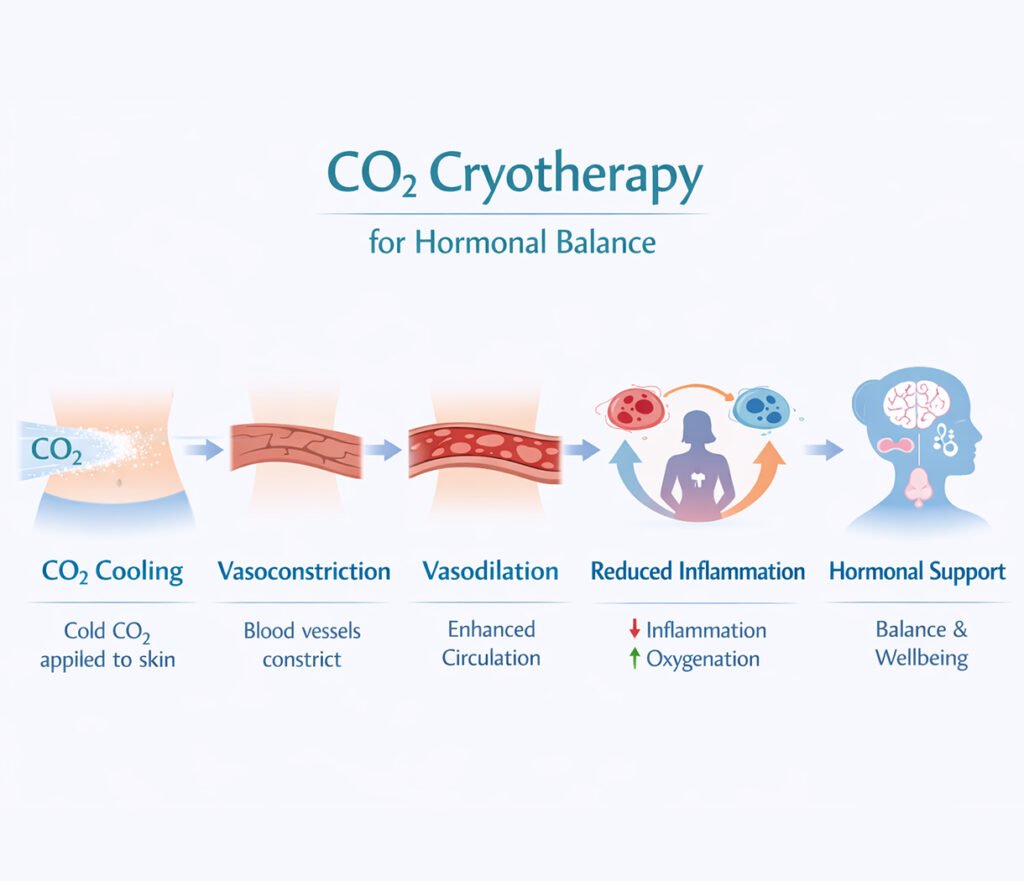
CO₂ cryotherapy is a localized cold-based physical therapy that applies pressurized carbon dioxide gas to the skin surface, rapidly lowering tissue temperature. This rapid cooling triggers a short phase of vasoconstriction, followed by reactive vasodilation during rewarming. The resulting increase in blood flow enhances tissue oxygenation, nutrient delivery, and metabolic waste removal.
Clinically, cryotherapy is used to support inflammation control, pain modulation, soft tissue recovery, and neuromuscular regulation. Compared with traditional ice application, this cryotherapy offers greater temperature control and reduced risk of deep tissue cold injury. It is also distinct from laser therapy (photobiomodulation), which acts at the cellular level via mitochondrial stimulation. In integrative settings, these modalities are often used together to optimize tissue healing and functional outcomes.
1.2 Why CO₂ Cryotherapy Is Gaining Attention Among Women
Women experience cyclical hormonal fluctuations that influence pain sensitivity, inflammatory response, and stress resilience. As a result, many seek therapeutic options that support physiological balance without relying solely on pharmacological interventions. This cryotherapy addresses this need by offering a targeted, customizable, and non-invasive approach that can be adapted to individual symptoms and life stages.
Its ability to focus on specific regions—such as the lower abdomen, lumbar spine, joints, or muscle groups—makes it particularly relevant for women experiencing hormone-related discomfort, musculoskeletal strain, or stress-induced symptoms.
2. CO₂ Cryotherapy and Hormonal Balance Mechanisms
Hormonal balance is maintained through complex interactions between the endocrine, nervous, immune, and vascular systems.
2.1 The Role of Inflammation in Hormonal Imbalance
Chronic low-grade inflammation is increasingly recognized as a contributor to hormonal dysregulation. Pro-inflammatory cytokines, including interleukin-6 (IL-6) and tumor necrosis factor-alpha (TNF-α), can interfere with estrogen and progesterone receptor signaling. Over time, this interference may manifest as menstrual irregularities, fatigue, mood disturbances, insulin resistance, or thyroid dysfunction.
Inflammation also disrupts communication along the hypothalamic–pituitary–ovarian (HPO) axis and the hypothalamic–pituitary–adrenal (HPA) axis. By improving microcirculatory dynamics and facilitating the removal of inflammatory mediators, this cryotherapy may help create a physiological environment more conducive to hormonal stability.
2.2 How CO₂ Cryotherapy May Support Hormonal Regulation
CO₂ cryotherapy does not directly stimulate hormone production; instead, it influences supportive regulatory pathways. Cold exposure activates the sympathetic nervous system, initiating a controlled stress response. This is followed by a parasympathetic rebound phase, which promotes recovery and homeostasis.
Through this mechanism, it may help modulate cortisol dynamics, enhance endorphin release, and support autonomic balance. Improved circulation further enhances tissue responsiveness to hormonal signals, allowing endocrine systems to function more efficiently under reduced inflammatory and stress-related load.
3. Benefits of CO₂ Cryotherapy for Women at Different Life Stages
Hormonal needs and challenges evolve throughout a woman’s life, and CO₂ cryotherapy may provide stage-specific support.
3.1 CO₂ Cryotherapy for Premenstrual Symptoms (PMS)
Premenstrual syndrome is commonly associated with pelvic discomfort, lower back pain, bloating, and emotional sensitivity. These symptoms are influenced by hormonal fluctuations, localized inflammation, and fluid retention.
When applied to the lower abdomen or lumbar region, this therapy may improve circulation, reduce tissue congestion, and ease neuromuscular tension. Additionally, cold-induced activation of endogenous analgesic pathways can reduce pain perception, making it a supportive option for managing PMS-related discomfort.
3.2 CO₂ Cryotherapy for Menopause and Perimenopause
During perimenopause and menopause, declining estrogen levels contribute to vasomotor instability, sleep disruption, joint discomfort, and metabolic changes. Inflammatory processes and oxidative stress often amplify these symptoms.
CO₂ cryotherapy may help support vascular regulation and autonomic balance, potentially reducing the intensity of heat-related discomfort and musculoskeletal inflammation. In integrative care models, it is frequently combined with nutritional strategies, movement therapy, and laser-based treatments addressing urogenital health.
3.3 Postpartum Recovery and Women’s Physical Wellness
Postpartum recovery involves hormonal recalibration alongside musculoskeletal and connective tissue healing. Common challenges include pelvic discomfort, lower back strain, and persistent inflammation.
Under professional guidance, healthcare providers can incorporate this cryotherapy into postpartum rehabilitation programs to improve circulation, reduce localized inflammation, and promote tissue recovery, all while keeping physical stress to a minimum.
4. CO₂ Cryotherapy for Stress, Sleep, and Emotional Wellbeing
Hormonal health is closely tied to psychological stress and sleep quality.
4.1 Stress Reduction and Cortisol Management
Chronic stress elevates cortisol levels, which can suppress reproductive hormone activity and disrupt thyroid and metabolic function. CO₂ cryotherapy’s controlled cold exposure promotes adaptive stress responses, encouraging nervous system resilience rather than chronic activation.
The post-treatment parasympathetic response may contribute to emotional regulation, improved focus, and reduced perceived stress, all of which are essential for maintaining hormonal equilibrium.
4.2 Improving Sleep Quality Naturally
Sleep plays a critical role in regulating hormones such as melatonin, cortisol, and insulin. Dysregulated sleep cycles can perpetuate hormonal imbalance.
By supporting nervous system relaxation and thermal regulation, CO₂ cryotherapy may enhance sleep onset and depth. When integrated with evidence-based sleep hygiene practices, it can form part of a comprehensive, non-pharmacological sleep support strategy.
5. CO₂ Cryotherapy in Women’s Fitness and Active Lifestyles
5.1 Muscle Recovery for Active Women
Regular physical activity supports hormonal health, yet insufficient recovery can increase inflammatory load and cortisol production. CO₂ cryotherapy aids recovery by reducing delayed-onset muscle soreness (DOMS) and improving circulation, allowing women to maintain training consistency without excessive physiological stress.
5.2 Injury Prevention and Performance Support
Localized cryotherapy is widely used in sports and rehabilitation contexts to support soft tissue integrity and reduce injury risk. For physically active women, CO₂ cryotherapy offers a recovery-focused approach that complements strength training, flexibility work, and performance optimization.
6. Why CO₂ Cryotherapy Appeals to Women Seeking Integrative Wellness
6.1 Evolving Wellness Preferences
There is growing interest in personalized, evidence-informed, and non-invasive health solutions. This therapy aligns with this shift by addressing underlying physiological processes rather than isolated symptoms.
6.2 Convenience, Customization, and Safety
Sessions are typically brief, require minimal downtime, and can be tailored to individual goals. When administered by trained professionals, CO₂ cryotherapy demonstrates a favorable safety profile, making it suitable for long-term wellness integration.
PREGUNTAS FRECUENTES
Is CO₂ cryotherapy safe for women?
Yes, when performed by trained professionals, CO₂ cryotherapy is generally safe and well tolerated, with minimal and temporary side effects.
Can CO₂ cryotherapy help with hormonal balance?
CO₂ cryotherapy does not directly change hormone levels, but it may support hormonal balance indirectly by reducing inflammation, improving circulation, and regulating stress responses.
Is CO₂ cryotherapy suitable during menopause?
It can be used as a supportive therapy to help manage inflammation, stress, and physical discomfort commonly experienced during menopause, as part of an integrative wellness approach.
How often should CO₂ cryotherapy be used?
Frequency varies based on individual needs, but many people start with regular sessions and adjust to maintenance treatments over time.
Conclusión
CO₂ cryotherapy does not replace medical hormone therapies, but it offers meaningful supportive benefits through inflammation modulation, nervous system regulation, and circulatory enhancement. When incorporated into a comprehensive wellness strategy, it may help women better navigate hormonal transitions and maintain physiological balance across life stages.
Referencias
Cryotherapy and Inflammation: A Systematic Review of the Literature
https://www.ncbi.nlm.nih.gov/pmc/articles/PMC4258944
Effects of Whole-Body Cryotherapy on Recovery Following Exercise-Induced Muscle Damage
https://journals.plos.org/plosone/article?id=10.1371/journal.pone.0207135
What Is the Biochemical and Physiological Rationale for Cold Therapy in Sports Recovery?
https://bjsm.bmj.com/content/44/3/179
Inflammation and Endocrine Regulation
https://academic.oup.com/edrv/article/30/5/575/2354680
Cold Exposure, Stress Response, and Sleep Regulation
https://www.sciencedirect.com/science/article/pii/S108707921930064X