مقدمة
Athletes constantly search for strategies that can enhance performance while minimizing injury risk. Traditional warm-ups—dynamic stretches, light jogging, or resistance exercises—prepare muscles and joints for competition, but emerging technologies now offer complementary approaches. One such method is CO₂ cryotherapy, a localized or whole-body cold gas exposure designed to stimulate circulation, enhance tissue readiness, and potentially boost neuromuscular activation before athletic events. While cold therapy has traditionally been associated with post-exercise recovery, recent studies and professional applications highlight its potential as a pre-event performance enhancer. This article explores the science, applications, and practical considerations of CO₂ cryotherapy as part of an advanced warm-up routine.
1. Understanding CO₂ Cryotherapy
Before diving into its application for pre-event warm-ups, it’s essential to understand the fundamentals of CO₂ cryotherapy and how it differs from traditional cold exposure techniques.
1.1 What is CO₂ Cryotherapy?
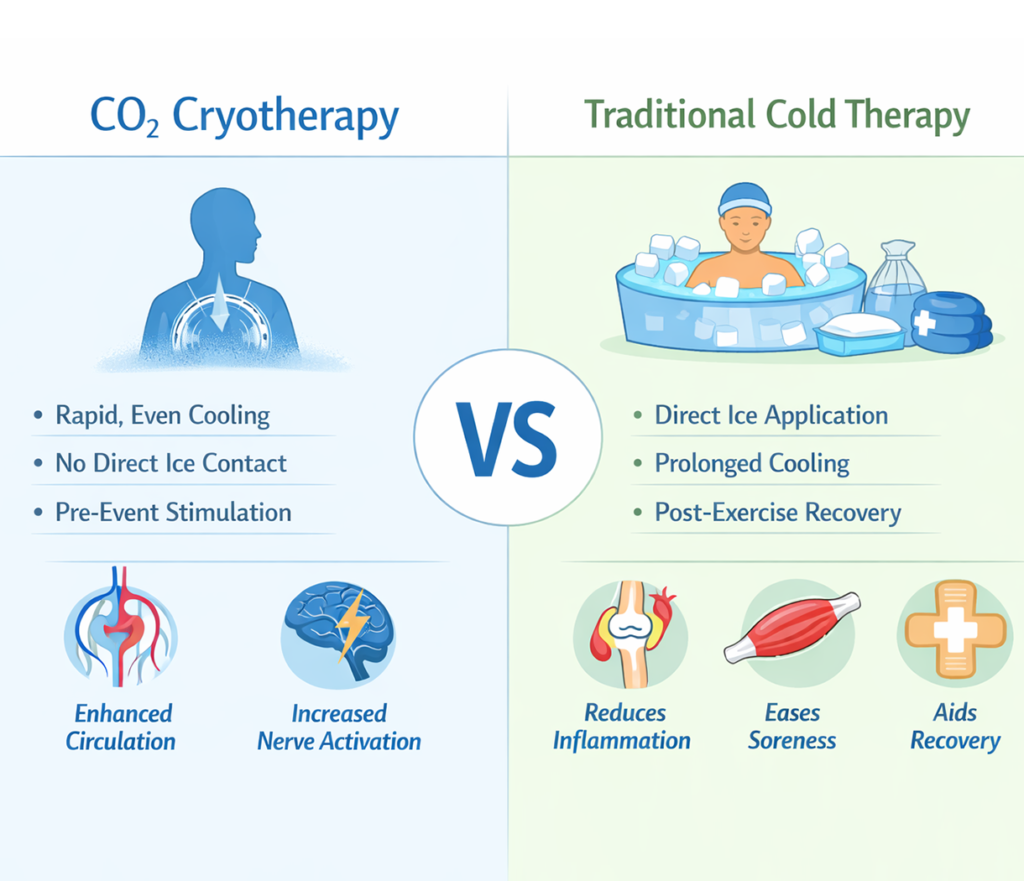
CO₂ cryotherapy involves the application of carbon dioxide gas at extremely low temperatures to targeted areas of the body. Unlike ice baths or cold packs, CO₂ can provide a uniform, rapid cooling effect without the discomfort of direct contact with ice. The gas induces localized vasoconstriction followed by vasodilation, promoting enhanced circulation and potential neuromuscular readiness. Athletes may experience improved proprioception and reduced perceived muscle stiffness, which can contribute to more efficient movement patterns during competition.
1.2 How CO₂ Cryotherapy Differs from Traditional Cold Therapy
Traditional cold therapy, such as ice packs or immersion in ice water, primarily focuses on reducing inflammation and alleviating soreness post-exercise. CO₂ cryotherapy, however, leverages controlled cold exposure before activity to stimulate physiological responses, including improved tissue oxygenation, increased nerve signaling efficiency, and temporary analgesia. These mechanisms aim to prepare the body for optimal performance rather than recovery alone.
2. The Science Behind Pre-Event Cold Exposure
Cold exposure triggers a cascade of physiological responses that can influence athletic readiness and performance.
2.1 Circulatory and Metabolic Effects
When exposed to CO₂ cryotherapy, the body initially constricts superficial blood vessels (vasoconstriction) and then promotes reactive hyperemia—a surge in blood flow—once the exposure ends. This process may help warm deeper tissues, increase oxygen delivery to muscles, and flush metabolic byproducts, priming the musculoskeletal system for action. Enhanced circulation also supports more efficient energy utilization during explosive or endurance-based events.
2.2 Neuromuscular Activation and Reaction Time
Cold stimulation can influence the neuromuscular system by enhancing motor unit recruitment and nerve conduction velocity. Pre-event cryotherapy may contribute to faster reflexes and improved coordination, particularly in sports requiring rapid changes of direction, precise timing, or high-intensity bursts. The cold stimulus signals the central nervous system, potentially optimizing muscle fiber readiness.
2.3 Psychological Effects and Focus
Athletes often report heightened alertness and mental readiness following brief cold exposure. CO₂ cryotherapy may trigger endorphin release, reduce perceived tension, and provide a psychological edge before competition. Mental preparedness is as crucial as physical readiness, especially in high-stakes events.
3. Target Athletes and Sport Scenarios
CO₂ cryotherapy is suitable for a range of athletes and competitive scenarios, from endurance events to high-intensity court or field sports.
3.1 Sprinters and Short-Distance Track Athletes
Sprinters rely on explosive muscular power and rapid neuromuscular responses. Pre-event CO₂ cryotherapy may help reduce muscle stiffness and optimize fiber recruitment, allowing for a more efficient start and acceleration phase. Brief localized cold exposure targeting the lower limbs can be integrated with dynamic warm-ups to maximize readiness without inducing muscular inhibition.
3.2 Team Sport Players
Soccer, basketball, and hockey players experience repeated bursts of high-intensity activity interspersed with brief recovery periods. Pre-game cryotherapy may support joint flexibility, reduce the risk of minor strains, and enhance overall reaction times. Localized treatment of knees, shoulders, or hamstrings can be particularly beneficial for multi-directional movements.
3.3 Endurance Athletes
Long-distance runners, cyclists, and triathletes may also incorporate CO₂ cryotherapy as part of a pre-event strategy. The circulatory boost can help maintain energy efficiency and delay the onset of perceived muscle fatigue. While endurance events prioritize pacing, starting with optimized tissue readiness can improve early performance and reduce cumulative strain.
4. How CO₂ Cryotherapy Integrates with Traditional Warm-Ups
To maximize effectiveness, pre-event CO₂ cryotherapy is typically combined with conventional warm-up protocols rather than replacing them.
4.1 Dynamic Stretching and Mobility Exercises
Dynamic movements that target major muscle groups remain essential. CO₂ cryotherapy can complement these exercises by temporarily reducing stiffness, allowing a greater range of motion during stretches. The combination enhances both flexibility and muscle activation simultaneously.
4.2 Progressive Activation Drills
Incorporating sport-specific drills after cold exposure can optimize neuromuscular readiness. Athletes may perform short sprints, agility drills, or plyometric exercises to ensure that muscle fibers and nervous system signals are fully primed for competition.
4.3 Timing Considerations
The benefits of CO₂ cryotherapy for pre-event warm-up are time-sensitive. Cold exposure should be brief, typically ranging from 1–3 minutes per targeted area, followed immediately by active warm-up exercises. This timing ensures that the physiological effects—enhanced circulation, nerve activation, and alertness—are present at the start of competition.
5. Safety and Practical Considerations
While CO₂ cryotherapy is generally safe for healthy athletes, certain precautions are essential to ensure optimal outcomes.
5.1 Contraindications
Athletes with cold hypersensitivity, cardiovascular conditions, or nerve damage should consult a medical professional before engaging in CO₂ cryotherapy. Pre-event exposure may exacerbate existing health issues if not carefully managed.
5.2 Professional Supervision
Supervision by trained staff ensures proper application, exposure time, and targeted areas. Professional oversight helps prevent overexposure, which could lead to temporary numbness or skin irritation.
5.3 Integration into Team Protocols
Teams or coaching staff should integrate CO₂ cryotherapy into established pre-event routines, ensuring that exposure complements rather than replaces essential warm-up exercises. Scheduling, consistency, and monitoring athlete feedback are crucial for safe adoption.
الأسئلة الشائعة
Q1: Can CO₂ cryotherapy replace traditional warm-ups?
No. It is a complementary method designed to enhance physiological readiness, not a substitute for stretching, dynamic drills, or sport-specific preparation.
Q2: How long before the event should I use CO₂ cryotherapy?
Typically, exposure is brief (1–3 minutes per area) immediately before or during the last phase of warm-up to maximize circulatory and neuromuscular benefits.
Q3: Is CO₂ cryotherapy safe for all athletes?
Most healthy athletes can safely use it, but those with cardiovascular issues, cold intolerance, or nerve conditions should consult a healthcare professional.
Q4: Can it improve mental focus before competition?
Yes. Many athletes report increased alertness and reduced perceived tension due to endorphin release and sensory stimulation.
الخاتمة
CO₂ cryotherapy represents a promising tool for athletes seeking to enhance pre-event readiness, combining circulatory stimulation, neuromuscular activation, and psychological alertness. By integrating short, targeted cold exposures with conventional dynamic warm-ups, athletes across disciplines—from sprinters to endurance competitors—can potentially optimize performance and reduce injury risk. While scientific research continues to expand, current applications highlight CO₂ cryotherapy’s role as a safe, complementary, and innovative approach to modern athletic preparation when supervised appropriately.
المراجع
LocalCryotherapy – CO₂ Cryotherapy Services and Applications
https://www.localcryotherapy.com/
Costello JT, Baker PR, Minett GM. Whole-body cryotherapy (extreme cold air exposure) for preventing and treating muscle soreness after exercise in adults. Cochrane Database Syst Rev. 2015;2015(9):CD010789.
https://www.cochranelibrary.com/cdsr/doi/10.1002/14651858.CD010789.pub2/full
Bleakley CM, Davison GW. Cryotherapy and inflammation: evidence and mechanisms. Br J Sports Med. 2010;44(7):490–493.
https://bjsm.bmj.com/content/44/7/490
Leeder J, Gissane C, van Someren K, Gregson W, Howatson G. Cold water immersion and recovery from strenuous exercise: a meta-analysis. Br J Sports Med. 2012;46(4):233–240.
https://bjsm.bmj.com/content/46/4/233
Costello JT, Donnelly AE. Effects of whole-body cryotherapy (-110°C) on proprioception and muscular performance. Eur J Appl Physiol. 2010;109(6):1137–1147.