
Введение
Early postoperative inflammation is a normal biological response following surgical procedures, yet excessive swelling and discomfort during this phase can interfere with mobility, rehabilitation progress, and patient confidence. In modern rehabilitation environments, localized temperature-controlled cooling technologies such as CO₂ cryotherapy are increasingly discussed as supportive tools for managing early inflammatory responses after surgery. By delivering rapid, targeted cooling without prolonged tissue exposure, CO₂ cryotherapy aligns with clinical strategies aimed at improving comfort, supporting circulation balance, and facilitating safer early-stage recovery planning.
1. Understanding Early-Stage Postoperative Inflammation
Early inflammatory responses play an essential role in tissue healing, but careful management is often necessary to prevent complications that may delay rehabilitation.
1.1 The Biological Purpose of Early Postoperative Inflammation
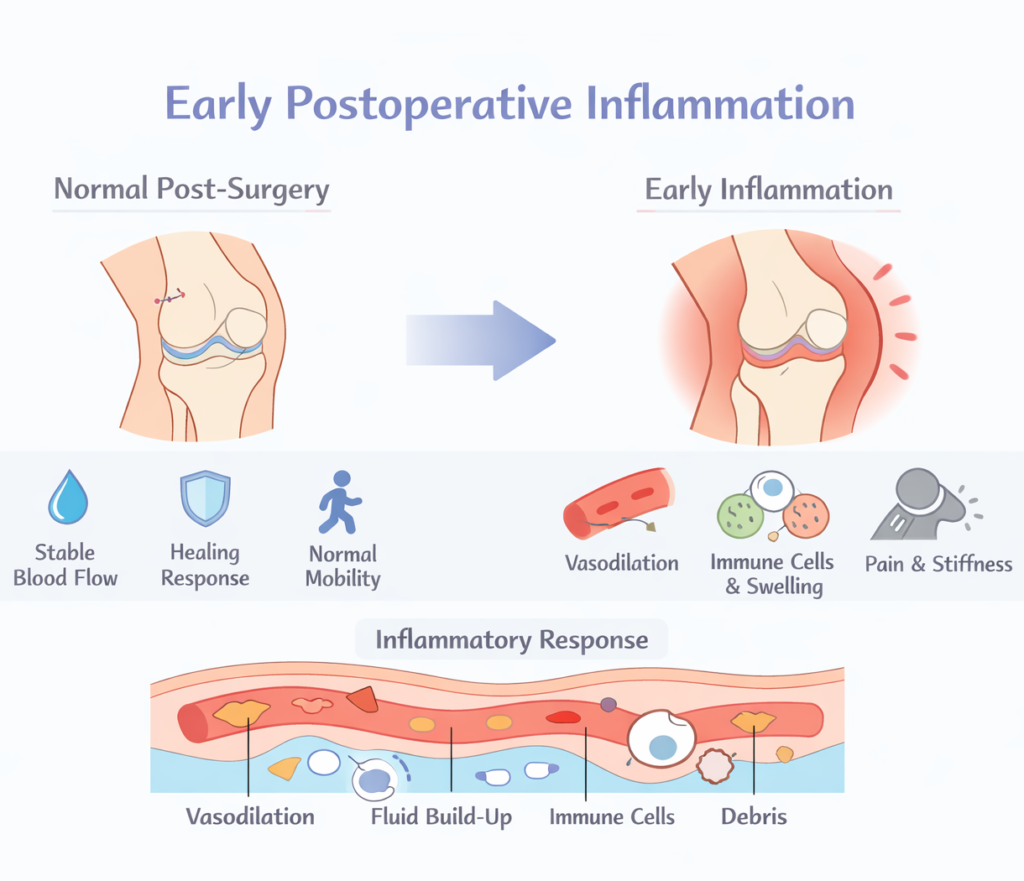
Following surgical intervention, the body activates a controlled inflammatory cascade designed to protect the affected region and initiate tissue repair processes. Vasodilation increases blood flow to the surgical area, allowing immune cells, oxygen, and nutrients to reach injured tissues efficiently. This early response supports debris removal and prepares the environment for cellular regeneration.
Although inflammation is necessary for healing, excessive or prolonged inflammatory activity may increase discomfort and restrict movement. Managing this balance is a key objective during early rehabilitation planning. Clinicians therefore often incorporate localized cooling strategies as part of structured postoperative care approaches that aim to maintain physiological healing responses while limiting secondary complications related to swelling and tissue sensitivity.
1.2 Common Clinical Signs Observed During the Early Recovery Phase
Patients recovering from orthopedic or soft-tissue procedures frequently experience visible swelling, warmth around the surgical site, and temporary stiffness that limits functional movement. These symptoms typically occur within the first several days following surgery and reflect the body’s protective response to tissue trauma.
Localized edema can place mechanical pressure on surrounding structures, including nerves and connective tissues, sometimes increasing discomfort during early mobilization exercises. Managing these symptoms effectively supports improved tolerance for rehabilitation activities. Care teams often evaluate the extent of swelling and sensitivity regularly during this stage to ensure that supportive interventions remain aligned with recovery goals and do not interfere with natural healing mechanisms.
1.3 Why Early Inflammation Management Supports Rehabilitation Outcomes
Controlling excessive swelling during the early postoperative period helps create a more favorable environment for progressive rehabilitation. When inflammation remains within manageable levels, patients are often better able to begin guided movement sooner, which supports circulation and reduces the risk of joint stiffness.
Improved comfort during early recovery can also enhance patient engagement with rehabilitation programs. Confidence in movement plays a critical role in functional recovery, particularly following orthopedic procedures. For this reason, clinicians frequently explore targeted cooling technologies as part of integrated postoperative support strategies designed to maintain mobility readiness while respecting tissue healing timelines.
2. Principles of CO₂ Cryotherapy in Postoperative Care Settings
Localized CO₂ cryotherapy represents an evolution of traditional cold therapy approaches used in rehabilitation medicine.
2.1 How CO₂ Cryotherapy Delivers Rapid Localized Cooling
CO₂ cryotherapy systems apply controlled bursts of carbon dioxide at very low temperatures directly to targeted anatomical areas. This rapid cooling effect produces immediate surface temperature reduction without requiring prolonged exposure times typically associated with ice-based therapies.
Short-duration cooling cycles allow clinicians to address localized inflammatory responses efficiently while minimizing risks related to excessive tissue cooling. Because treatment can be precisely directed to the surgical region, surrounding tissues remain less affected compared with conventional cold pack applications. This precision supports the use of CO₂ cryotherapy in structured rehabilitation environments where localized symptom management is preferred over generalized cooling approaches.
2.2 Physiological Effects of Targeted Cooling on Surgical Tissues
Controlled cooling influences several physiological mechanisms associated with early inflammatory responses. Reduced local temperature contributes to temporary vasoconstriction, which may help limit excessive fluid accumulation in surrounding tissues during the acute recovery phase.
Cooling also affects sensory nerve signaling pathways, potentially supporting improved comfort during early rehabilitation exercises. In addition, localized cryotherapy may influence metabolic activity within inflamed tissues, helping maintain an environment that supports balanced recovery responses. These mechanisms explain why temperature-controlled cooling strategies remain a common component of postoperative rehabilitation planning across multiple clinical settings.
2.3 Advantages Compared with Conventional Ice-Based Cooling Methods
Traditional ice packs have long been used in postoperative care, yet they present several practical limitations in controlled rehabilitation environments. Temperature inconsistency, moisture exposure, and extended application durations may reduce treatment efficiency or patient comfort.
CO₂ cryotherapy systems provide consistent temperature delivery with shorter application times and improved targeting accuracy. Because the cooling effect is localized and controlled, clinicians can adapt treatment strategies more precisely to individual recovery needs. These characteristics make CO₂ cryotherapy increasingly relevant in structured rehabilitation protocols designed to support early inflammatory management without interfering with functional recovery progression.
3. Clinical Applications Across Different Surgical Recovery Pathways
Localized cryotherapy is often integrated into recovery planning for a variety of orthopedic and soft-tissue procedures.
3.1 Supporting Recovery After Arthroscopic Procedures
Minimally invasive arthroscopic surgeries frequently produce localized swelling despite reduced incision size compared with open surgical techniques. Managing early inflammation in these cases supports improved joint mobility during the initial rehabilitation phase.
Targeted CO₂ cryotherapy allows clinicians to address peri-articular swelling efficiently without exposing surrounding tissues to prolonged cooling. Maintaining mobility readiness during this stage is particularly important for preventing joint stiffness and supporting circulation within healing structures.
3.2 Managing Soft-Tissue Surgical Inflammation
Procedures involving ligaments, tendons, or muscle tissues often produce temporary inflammatory responses that influence early functional performance. Localized swelling may affect joint mechanics and increase sensitivity during therapeutic movement sessions.
CO₂ cryotherapy offers a controlled method for addressing localized inflammatory activity in these cases. By supporting comfort and reducing mechanical pressure around healing tissues, targeted cooling interventions can contribute to improved tolerance for early rehabilitation exercises. This benefit is especially relevant in structured recovery environments where gradual movement progression plays a critical role in long-term outcomes.
3.3 Assisting Early Recovery Following Joint Stabilization Procedures
Joint stabilization surgeries frequently require careful management of postoperative swelling to maintain safe movement progression during rehabilitation. Excessive inflammation can temporarily limit range-of-motion exercises and delay functional recovery timelines.
Localized CO₂ cryotherapy supports clinicians in maintaining an environment that encourages controlled movement introduction during early recovery stages. Because cooling is applied directly to affected structures, treatment can be adjusted to match individual rehabilitation protocols. This flexibility allows cryotherapy technologies to complement broader postoperative recovery strategies focused on preserving joint function while respecting tissue healing requirements.
4. Integrating CO₂ Cryotherapy into Early Rehabilitation Planning
Temperature-controlled localized cooling technologies are most effective when incorporated within structured rehabilitation frameworks.
4.1 Supporting Comfort During Early Mobilization Sessions
Early mobilization plays a central role in preventing complications such as joint stiffness and circulation impairment after surgery. However, inflammation-related discomfort may reduce patient willingness to participate in guided movement exercises.
CO₂ cryotherapy can be introduced as a supportive measure before or after rehabilitation sessions to improve comfort levels during movement initiation. Improved tolerance for early activity contributes to more consistent participation in therapy programs.
4.2 Enhancing Patient Confidence During the Initial Recovery Phase
Confidence in movement is often overlooked but remains a critical component of postoperative rehabilitation success. Patients experiencing excessive swelling or sensitivity may hesitate to engage fully in recommended exercises.
By helping manage localized inflammatory responses, targeted cryotherapy can support a more comfortable transition into early rehabilitation stages. Increased confidence in movement readiness encourages patients to follow structured recovery plans more consistently, supporting improved engagement with therapeutic interventions designed to restore function gradually and safely.
4.3 Supporting Multimodal Rehabilitation Strategies in Clinical Settings
Modern rehabilitation environments frequently combine multiple supportive modalities to address the complex physiological responses associated with surgical recovery. Temperature-controlled cryotherapy technologies are often considered alongside manual therapy, guided exercise progression, and circulation-supportive interventions.
Within these integrated care frameworks, CO₂ cryotherapy serves as a localized symptom-management tool that complements broader recovery strategies. Its adaptability across different surgical pathways makes it a valuable component of multidisciplinary rehabilitation planning focused on improving patient comfort and supporting safe early-stage recovery progression.
Заключение
Managing early postoperative inflammation is an essential component of structured rehabilitation planning following orthopedic and soft-tissue procedures. CO₂ cryotherapy offers a targeted, temperature-controlled cooling approach that supports localized swelling management, improves comfort during early mobilization, and complements multidisciplinary recovery strategies. When integrated appropriately within clinical rehabilitation programs, localized cryotherapy technologies can contribute to safer recovery environments that promote functional progress while respecting the body’s natural healing processes.
Ссылки
Bleakley CM, Costello JT, Glasgow PD. Should athletes return to sport after applying ice? A systematic review of the effect of local cooling on functional performance.
https://bjsm.bmj.com/content/46/3/173
Hubbard TJ, Denegar CR. Does Cryotherapy Improve Outcomes With Soft Tissue Injury?
https://pubmed.ncbi.nlm.nih.gov/16757664/
Knight KL. Cryotherapy in Sport Injury Management.
https://journals.humankinetics.com/view/journals/ijspp/2/1/article-p20.xml
Swenson C, Swärd L, Karlsson J. Cryotherapy in sports medicine.
https://pubmed.ncbi.nlm.nih.gov/12688876/
Merrick MA. Secondary Injury After Musculoskeletal Trauma: A Review and Update.
https://pubmed.ncbi.nlm.nih.gov/16526810/
Algafly AA, George KP. The effect of cryotherapy on nerve conduction velocity, pain threshold and pain tolerance.
https://pubmed.ncbi.nlm.nih.gov/16326712/
Nadler SF et al. Continuous low-level heat wrap therapy vs cryotherapy for acute low back pain.
https://pubmed.ncbi.nlm.nih.gov/14642569/
American Academy of Orthopaedic Surgeons (AAOS). Cold Therapy After Surgery.