소개
You have had the meniscus surgery. Your surgeon says the procedure went well. Weeks later, you are still struggling to straighten your knee fully, and your thigh feels noticeably thinner than the other side. This frustrating reality — persistent joint stiffness accompanied by visible quadriceps muscle wasting — is a common experience after meniscus procedures. The pain and swelling that follow surgery trigger a protective reflex that shuts down the quadriceps muscle, leading to rapid atrophy. Breaking out of this self‑perpetuating cycle of stiffness and weakness is a central challenge of post‑operative rehabilitation. CO₂ cryotherapy offers a non‑invasive, dry, and rapid way to help control post‑surgical inflammation and manage pain. By reducing these primary drivers of muscle inhibition, it helps create the conditions necessary for patients to engage more effectively in the therapeutic exercises that are essential for restoring normal knee function.
1. The Interconnected Challenge of Stiffness and Muscle Atrophy After Meniscus Surgery
Post‑operative stiffness and quadriceps weakness are not separate problems; they are two sides of the same coin. Each one worsens the other, creating a downward spiral that can extend recovery for months. Understanding how these two factors interact is the first step toward designing a smarter rehabilitation strategy.
1.1 How Surgery Triggers a Protective Spiral
When a surgeon operates on the knee, the body responds with predictable inflammation. This swelling directly limits knee flexion and extension, as the joint capsule cannot bend fully when filled with fluid. More consequentially, this inflammation activates a powerful neural reflex that affects the quadriceps muscle. This reflex, originating from the inflamed joint, sends a constant signal to the spinal cord that effectively reduces the activation of the quadriceps. This is not a matter of willpower; it is a hardwired protective mechanism. The quadriceps, which is essential for walking, stair climbing, and standing from a chair, becomes weak and unresponsive.
1.2 Why Early Stiffness Leads to Long‑Term Muscle Wasting
When the quadriceps fails to activate properly, it begins to lose mass at a noticeable rate. Patients who have undergone knee surgery often experience persistent quadriceps weakness for months or even years after the procedure. The stiff knee further complicates rehabilitation. A patient who cannot bend or straighten the knee adequately cannot perform the basic exercises — like straight leg raises or gentle knee bends — needed to rebuild strength. This creates a vicious cycle: the knee remains stiff because the muscle is weak, and the muscle remains weak because the knee is too stiff for effective exercise.
1.3 The Rehab Stalemate That Frustrates Patients
The consequences of this cycle extend far beyond muscle loss. A patient who cannot fully straighten their knee may walk with a limp for an extended period. The inability to bend the knee deeply enough to squat or descend stairs normally leads to compensation patterns that can place extra stress on the hip or back. The psychological toll is also significant; many patients become discouraged, feeling that their surgery has somehow failed. What is actually failing is the body‘s ability to calm the initial inflammatory response that is perpetuating neural inhibition of the quadriceps and chronic joint capsule stiffness. Breaking this stalemate requires a rehabilitation approach that directly targets the underlying inflammation and pain.
2. How CO₂ Cryotherapy Targets the Drivers of the Stiffness-Atrophy Cycle
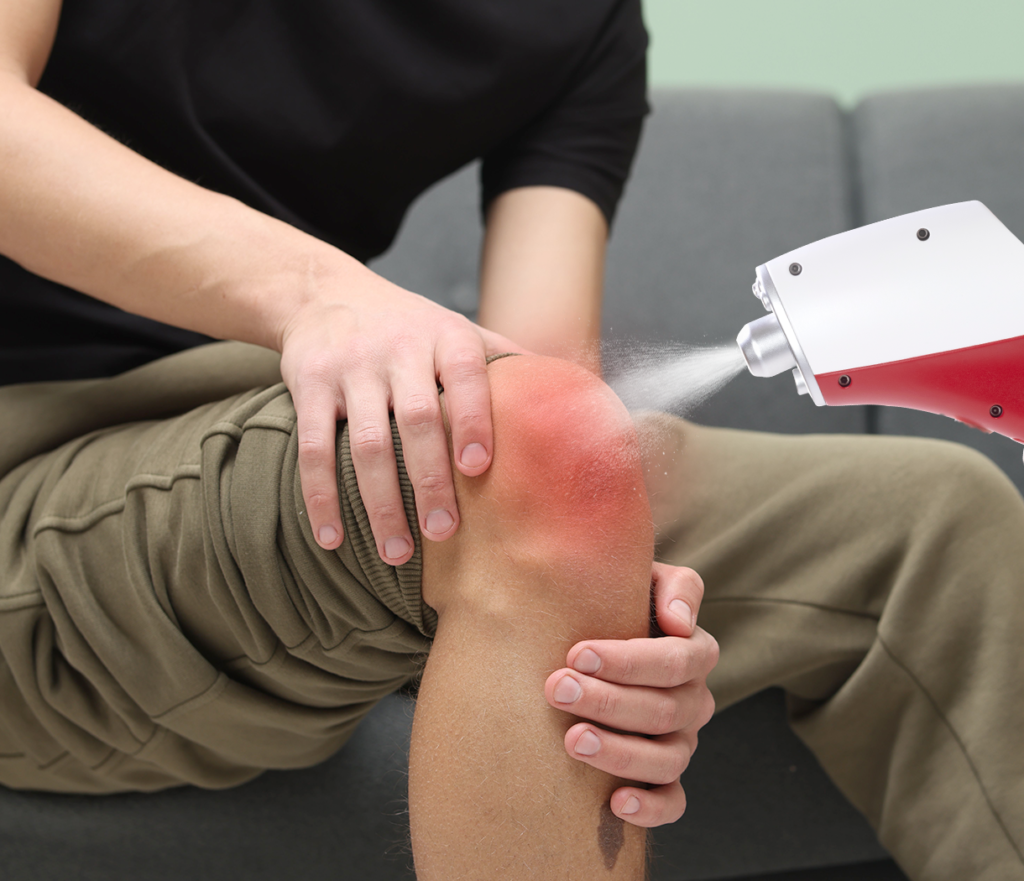
CO₂ cryotherapy is not the same as laying a gel ice pack on your knee. This technology uses compressed carbon dioxide gas to deliver intense, dry cooling to a precisely targeted area. Its mechanisms are specifically suited to interrupt the post‑operative cycle of inflammation, pain, and muscle shutdown.
2.1 Reducing Post‑Surgical Swelling and Joint Capsule Tension
The most immediate benefit of CO₂ cryotherapy after meniscus surgery is the rapid reduction of swelling inside the joint. When the high‑pressure cold gas stream is applied to the knee, it quickly lowers the temperature of the skin and underlying tissues. This intense cold causes local blood vessels to narrow, which immediately decreases fluid leakage into the joint space. The result is a noticeable reduction in the puffiness that prevents full knee extension and flexion. A joint that is less swollen has more room to move, allowing patients to perform passive range‑of‑motion exercises with significantly less discomfort.
2.2 Modulating Pain Signaling to Support Quadriceps Activation
The neural reflex that inhibits the quadriceps is driven by pain signals originating in the inflamed joint. CO₂ cryotherapy directly interacts with this process. The powerful cold stimulus acts on the nerves in the skin and superficial tissues, sending a competing signal to the spinal cord that can help override the continuous pain message coming from the knee. This effect, sometimes described by clinicians as a neural “reset,” temporarily reduces the inhibitory drive on the quadriceps. After a brief CO₂ session, many patients find that they can contract their thigh muscle more easily and with less discomfort than before.
2.3 The Dry, Non‑Contact Advantage for Recent Incisions
Traditional ice packs are often impractical in the early weeks after surgery. The incision site must stay dry to prevent infection, and the weight of an ice pack can cause discomfort. CO₂ cryotherapy delivers cooling without any physical contact. The gas stream is applied from a short distance, so there is no pressure on the wound, no moisture to wet the bandage, and no risk of disturbing the healing incision. This makes it possible to start targeted cooling much earlier in the recovery timeline, when inflammation is at its peak but the knee is most vulnerable.
3. Bridging the Gap Between Immobilization and Active Rehabilitation
One of the biggest challenges after meniscus surgery is the transition from the early period of protected immobilization to the later phase of active strengthening. CO₂ cryotherapy helps smooth this transition by making the middle phase of recovery more tolerable.
3.1 Using Cold Therapy Before Exercise to Reduce Stiffness
Many patients find that their knee is stiffest at the beginning of a rehabilitation session. This initial stiffness can make it hard to perform even simple movements. Using CO₂ cryotherapy for a brief period before exercise can help reduce this morning‑ or session‑starting stiffness. The cold reduces intra‑articular swelling and temporarily lowers pain perception, allowing the patient to move the knee through a greater range of motion with less guarding. A few seconds of targeted cooling on the front and sides of the knee can make the difference between a frustrating rehab session and a productive one.
3.2 Using Cold Therapy After Exercise to Calm Flare‑Ups
Therapeutic exercise is essential for rebuilding quadriceps strength, but it inevitably provokes some inflammation. After a session of straight leg raises, heel slides, or stationary cycling, the knee may feel warm and achy. Applying CO₂ cryotherapy after exercise helps calm this post‑activity response. The rapid cooling reduces the acute inflammatory flare that can otherwise discourage a patient from continuing with their home program. By managing post‑exercise discomfort, CO₂ therapy supports consistent participation in rehabilitation, which is the single most important factor for a good outcome.
3.3 Breaking the Pain Cycle Without Medication
Many patients worry about relying on pain medications for weeks after surgery. Opioids have side effects, and even over‑the‑counter anti‑inflammatories can cause stomach issues when used for a long time. CO₂ cryotherapy offers a drug‑free alternative for managing the type of pain that keeps the quadriceps inhibited. By directly addressing the local inflammation and pain signals, it reduces the need for systemic medications. For patients who wish to minimize their pharmaceutical intake, this non‑pharmacological tool is especially valuable.
4. Integrating CO₂ Cryotherapy Into a Practical Post‑Meniscus Rehab Routine
Using CO₂ cryotherapy effectively does not require a complex protocol. A simple, consistent approach fits easily into a daily home rehabilitation schedule.
4.1 When to Apply Treatment During the Day
The most useful times to apply CO₂ cryotherapy are immediately before and after your prescribed exercises. A short treatment before your morning heel slides or quad sets helps loosen the joint and reduces the sharp pain that can occur with the first few repetitions. Another brief session after your exercise cools down any irritation that built up during the workout. Some patients also find that a treatment before bed helps reduce overnight stiffness, making the first steps out of bed the next morning less painful. Each session lasts only a few seconds per area, so the total time commitment is minimal.
4.2 How to Target the Knee for Best Results
The knee has several areas where swelling and pain tend to concentrate. For the stiff, post‑meniscus knee, the most important spots are the inner and outer joint lines, directly over the kneecap, and the hollow behind the knee. A brief pass of the CO₂ stream over each of these areas ensures that the entire joint capsule receives the cooling effect. Patients should apply the treatment while sitting with the leg relaxed and extended. The dry gas leaves no residue, so there is no need to wipe the skin or change clothing after the session.
4.3 Combining Cold Therapy with Gentle Movement
The best results come from using CO₂ cryotherapy as a gateway to movement, not as a substitute for it. Immediately after a treatment, the knee is temporarily less painful and less stiff. This is the ideal window to perform your prescribed exercises. The cold does not numb the knee to the point of being unsafe; rather, it just takes the edge off the sharp pain that can prevent you from bending or straightening. By pairing the cooling effect with active movement, you help your brain relearn that the knee can move safely, which gradually weakens the neural reflex that has been inhibiting your quadriceps.
5. Long‑Term Strategies for a Full Return to Activity
The goal of any meniscus rehabilitation is not just to reduce pain but to return to the activities you enjoy. CO₂ cryotherapy can support this journey even after the initial recovery phase is complete.
5.1 Managing Flare‑Ups During Return to Sport
When you start walking longer distances, climbing stairs normally, or returning to light jogging, your knee may react with temporary swelling and stiffness. These flare‑ups are normal but can be discouraging. A dose of CO₂ cryotherapy after a challenging activity helps settle the joint quickly, reducing the fear that you have damaged something. By managing these post‑activity responses, you can progress your activity level more confidently.
5.2 Preventing Chronic Joint Stiffness in the Long Term
Some patients develop a tendency toward knee stiffness that can last for months after surgery. Regular, low‑frequency use of CO₂ cryotherapy during periods of increased activity can help keep the joint capsule supple and prevent the gradual buildup of scar tissue that limits motion. A brief treatment once or twice a week, applied after a long walk or a leg workout, may be enough to maintain the range of motion you worked so hard to regain.
5.3 Listening to Your Knee and Adjusting Your Plan
Every knee recovers at its own pace. Some patients respond quickly to CO₂ cryotherapy, noticing less stiffness after the first few treatments. Others need more time. The key is to use the therapy as one tool among many, alongside exercise, rest, and good nutrition. If your knee feels particularly stiff or achy on a given day, an extra session of cold therapy can help. If it feels comfortable, you may skip a session. The flexibility of CO₂ cryotherapy allows you to tailor your recovery plan to the daily needs of your healing knee.
자주 묻는 질문
Q1: How soon after meniscus surgery can I start using CO₂ cryotherapy around my knee?
Many patients begin within the first week after surgery, once the initial bandage is secure. Always apply the gas stream to intact skin around the knee, avoiding direct contact with the incision site.
Q2: Will CO₂ cryotherapy help me regain full knee extension faster?
By reducing swelling and pain, it creates better conditions for performing extension exercises. Consistent use alongside prescribed stretches offers the best chance for regaining full motion.
Q3: How many times per day should I use CO₂ cryotherapy during rehabilitation?
Two to three sessions per day — before and after exercise, and possibly before bed — is a common and effective schedule.
Q4: Can I use CO₂ cryotherapy if I still have significant swelling months after surgery?
Yes. Even in the later stages of recovery, targeted cold can help manage persistent swelling and allow continued progress with strengthening exercises.
Q5: Is CO₂ cryotherapy safe to use on the skin around a healing incision?
Yes, as long as you direct the gas stream to intact skin surrounding the incision. The dry, non‑contact nature of the treatment means there is no moisture or pressure on the wound itself.
결론
The stiffness that keeps you from straightening your knee and the muscle wasting that makes your thigh look thin are not separate problems. They are linked by a cycle of inflammation and neural inhibition that can stall recovery for months. CO₂ cryotherapy offers a practical, non‑invasive, and drug‑free way to interrupt that cycle. By rapidly reducing swelling and modulating pain signals, it helps release the quadriceps from its protective shutdown and allows you to move your knee with less discomfort. Used strategically before and after exercise, it bridges the difficult gap between post‑operative immobilization and active rehabilitation. With consistent application, you can break the stiffness‑atrophy cycle and get back to the activities that matter to you.
참조
Local Cryotherapy. Orthopedic and Musculoskeletal Applications.
https://www.localcryotherapy.com
Local Cryotherapy. Veterinary and Equine Indications.
https://www.localcryotherapy.com/co₂-cryotherapy-one-therapy-two-species-limitless-benefits.html
Local Cryotherapy. Post‑Op and Trauma Protocol.
https://www.localcryotherapy.com/applications-orthopedic-rehabilitation-post-trauma.html
Local Cryotherapy. Athlete Recovery and Sports Performance.
https://www.localcryotherapy.com/american-athlete-local-cryotherapy-performance-recovery.html
Local Cryotherapy. How Does CO₂ Cryotherapy Work.
https://www.localcryotherapy.com/how-does-cryotherapy-work.html