소개
Snowboarding combines balance, coordination, muscular endurance, and repeated lower-body movements. After several hours on the slopes, snowboarders may notice soreness around the knees, tightness in the hips, or fatigue in the surrounding muscles. Repeated turns, deep knee flexion, uneven terrain, and maintaining a low riding position all contribute to physical demands on the lower body. Although these sensations often occur after strenuous activity, they can affect comfort and mobility during the following hours or days. CO₂ cryotherapy offers a localized cooling approach that may help ease exercise-related discomfort and support a broader recovery routine. By understanding how snowboarding affects the knee and hip regions, riders can make more informed decisions about physical recovery and the role of targeted cooling.
1. Understanding the Physical Demands of Snowboarding
Snowboarding requires continuous lower-body engagement. Unlike activities that involve mostly forward movement, riding a snowboard requires athletes to maintain balance while controlling speed and direction through coordinated movements of the hips, knees, and ankles. These demands can place considerable stress on muscles and surrounding soft tissues.
1.1 Repetitive Knee Flexion and Lower-Body Loading
One of the most noticeable physical demands of snowboarding is sustained knee flexion. Riders frequently bend their knees to maintain a stable center of gravity, absorb changes in terrain, and prepare for turns or landings. This position activates the quadriceps, hamstrings, and calf muscles throughout the riding session.
The quadriceps, particularly the vastus lateralis, vastus medialis, and rectus femoris, contribute to knee extension and lower-body stability. Meanwhile, the hamstrings help control knee movement and coordinate hip extension. Repeated contractions of these muscle groups can contribute to muscular fatigue, especially when riders spend several hours on the mountain without sufficient recovery intervals.
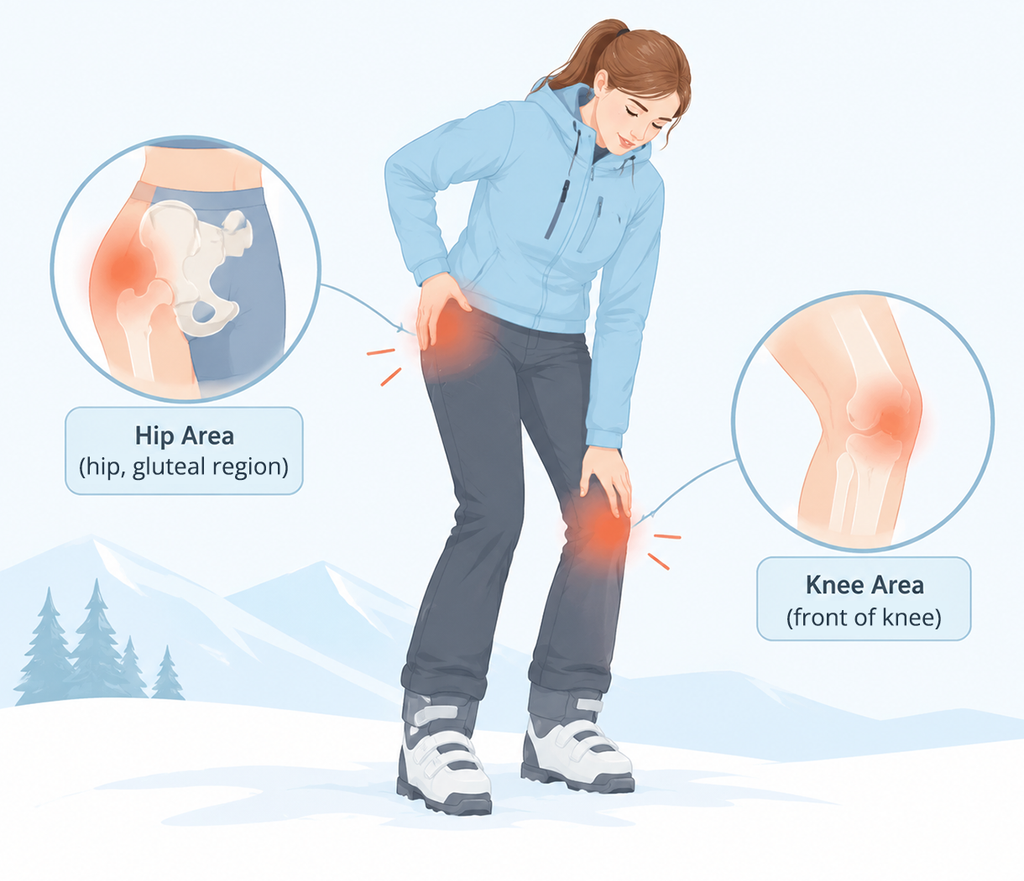
The patellofemoral joint also experiences repeated loading during knee flexion. This joint connects the patella, or kneecap, with the femur. Changes in riding posture, muscular fatigue, and repetitive loading may contribute to discomfort around the front of the knee.
1.2 Hip Rotation and Muscular Endurance
Hip movement plays an equally important role in snowboarding. Riders rely on internal and external hip rotation to control board direction, adjust their stance, and maintain balance during turns.
The gluteus maximus generates powerful hip extension, while the gluteus medius helps stabilize the pelvis during weight shifts. The hip flexors, including the iliopsoas, also remain active as riders maintain a bent-knee position.
Continuous muscular engagement can create fatigue around the hip and pelvic regions. Some snowboarders notice tightness around the gluteal muscles, lateral hip discomfort, or reduced flexibility after a demanding day.
1.3 The Combined Effect of Repeated Movement
Knee and hip function remain closely connected throughout snowboarding. When the hips become fatigued, the knees may need to compensate to maintain stability. Similarly, reduced quadriceps endurance can influence lower-body control during repeated turns.
This interaction explains why post-snowboarding soreness does not always remain limited to one anatomical area. A rider may experience knee discomfort alongside hip tightness or general thigh fatigue.
2. Common Causes of Knee and Hip Soreness After Snowboarding
Understanding the difference between ordinary exercise-related soreness and symptoms that suggest an injury is important. Although physical fatigue often develops gradually, sudden pain or noticeable joint instability requires greater attention.
2.1 Delayed-Onset Muscle Soreness (DOMS)
Delayed-onset muscle soreness, commonly known as DOMS, refers to muscular discomfort that develops after unfamiliar or strenuous physical activity. It often becomes noticeable several hours after exercise and may reach its highest intensity within approximately 24 to 72 hours.
During snowboarding, eccentric muscle contractions play an important role in controlling movement. For example, the quadriceps work eccentrically when riders bend their knees to absorb impact or maintain a low stance.
These contractions can contribute to temporary muscle soreness, stiffness, and reduced comfort during movement. The gluteal muscles, quadriceps, and hamstrings may all experience DOMS after an especially active day.
Unlike sudden traumatic pain, typical DOMS usually develops gradually and affects the muscles rather than producing pronounced joint instability.
2.2 Knee Discomfort from Repeated Loading
The knee joint absorbs and distributes forces during turns, landings, and changes in terrain. Repeated loading can increase muscular fatigue around the patellofemoral joint and surrounding soft tissues.
The quadriceps tendon, patellar tendon, and supporting structures contribute to knee function. When physical demands exceed a rider’s current conditioning level, discomfort may develop around the anterior knee or surrounding musculature.
However, sharp pain, substantial swelling, locking, or a sensation that the knee gives way should not be treated as ordinary exercise soreness. These symptoms may indicate a more significant musculoskeletal injury.
2.3 Hip Tightness and Gluteal Fatigue
The gluteal muscles remain active throughout a snowboarding session because they help control pelvic position and lower-body alignment.
Repeated hip rotation and sustained flexion may contribute to muscular fatigue around the gluteus medius, gluteus maximus, and deep hip rotators. Some riders also experience tightness around the tensor fasciae latae and iliotibial band region.
These symptoms can become more noticeable after long riding sessions, particularly when riders perform frequent turns or spend extended periods maintaining a low stance.
3. How CO₂ Cryotherapy Supports Localized Recovery
Localized cryotherapy uses controlled cooling to temporarily lower the temperature of targeted body tissues. CO₂ cryotherapy applies pressurized carbon dioxide gas to a selected treatment area, creating a rapid cooling response.
For snowboarders experiencing ordinary post-exercise soreness, this approach may offer temporary comfort around the knees, hips, and surrounding muscle groups.
3.1 The Cooling Mechanism of CO₂ Cryotherapy
CO₂ cryotherapy devices deliver pressurized carbon dioxide gas to a localized area. The rapid temperature change produces a strong cooling sensation and influences the activity of superficial sensory nerves.
Cold exposure can temporarily reduce nerve conduction velocity, which may decrease the perception of discomfort. It also produces local vasoconstriction, or narrowing of blood vessels, which changes local circulation during and shortly after cooling.
These physiological responses explain why localized cold applications can provide temporary relief from exercise-related discomfort.
However, cooling does not automatically accelerate tissue regeneration or resolve the underlying cause of joint pain. Its role should remain supportive rather than replacing appropriate rehabilitation or medical assessment.
3.2 Targeting the Knee and Surrounding Muscles
For snowboarders, the knee region represents an important area of muscular and joint loading. The quadriceps, hamstrings, and surrounding soft tissues contribute to movement control and stability.
A localized CO₂ cryotherapy device can direct cooling toward selected areas around the knee. Its targeted application allows attention to specific regions rather than requiring full-body cold exposure.
The device featured on the Local Cryotherapy website uses high-pressure CO₂ gas at approximately -78°C. Its localized cooling approach is designed for targeted application to areas such as the knees, joints, and muscles.
Appropriate treatment positioning and controlled application remain important because the extremely cold gas requires careful handling. Users should follow the manufacturer’s instructions and professional guidance rather than assuming that longer or more frequent exposure produces better results.
3.3 Supporting Hip and Gluteal Muscle Comfort
The hip region contains several large muscle groups that contribute to snowboarding performance. These include the gluteus maximus, gluteus medius, iliopsoas, and deep external rotators.
After repeated riding movements, some snowboarders experience localized muscular tightness or soreness around these structures.
CO₂ cryotherapy may provide temporary cooling and comfort when applied to appropriate superficial treatment areas. Its localized approach can complement other recovery strategies, particularly when riders want to address discomfort in specific muscle groups.
Nevertheless, the cooling application should not place excessive cold directly over sensitive structures or be used as a substitute for evaluating persistent hip or groin pain.
3.4 Red Laser Targeting and Treatment Accuracy
Accurate positioning matters when applying localized cryotherapy to different anatomical regions. The human cryotherapy device incorporates a red laser targeting feature to help guide the treatment position toward the selected area.
This feature can assist operators in maintaining a consistent application location when addressing the knee or surrounding hip muscles.
It is important to distinguish laser targeting from therapeutic laser treatment. The red laser serves as a positioning guide; it should not be described as photobiomodulation therapy or as an independent laser-based treatment for muscle or joint conditions.
The combination of targeted cooling and positioning guidance provides a more structured approach to localized application, particularly in professional sports recovery and rehabilitation environments.
4. Building a Balanced Recovery Routine After a Day on the Slopes
CO₂ cryotherapy works best as one component of a broader recovery strategy. Snowboarders should also consider physical activity levels, hydration, sleep, and muscular conditioning.
4.1 Allowing the Body to Recover Between Sessions
After an extended riding session, the lower-body muscles need adequate time to recover from repeated loading.
Gentle walking and comfortable joint movement can help riders transition away from prolonged physical activity. Low-intensity movement also allows them to observe whether stiffness gradually improves.
Riders should avoid immediately returning to demanding activity when significant soreness or fatigue remains. Adequate rest between sessions helps maintain better movement control and reduces unnecessary physical strain.
4.2 Maintaining Hip and Knee Mobility
Hip and knee mobility contribute to comfortable snowboarding movement. The hip flexors, gluteal muscles, quadriceps, and hamstrings all influence lower-body coordination.
Gentle mobility exercises can help maintain comfortable movement after riding. Hip rotations, controlled knee bends, and light stretching may form part of a general post-activity routine.
However, movement should remain comfortable. Forcing a painful joint through a larger range of motion can aggravate an existing problem.
4.3 Hydration, Nutrition, and Sleep
Physical recovery involves more than localized muscle care. Hydration supports normal physiological function, while balanced nutrition provides the energy and nutrients needed for everyday tissue maintenance.
Sleep also plays an important role in muscular recovery. During sleep, the body regulates several processes associated with tissue maintenance, nervous system function, and exercise adaptation.
Snowboarders who combine adequate rest, hydration, balanced nutrition, and appropriate activity management can establish a more consistent recovery routine.
4.4 Recognizing When Professional Assessment Is Necessary
Not all knee and hip discomfort results from muscular fatigue. Snowboarding can also involve ligament injuries, meniscal damage, tendon problems, and joint trauma.
A sudden twisting movement, awkward landing, or fall may produce an injury that requires professional evaluation.
Significant swelling, severe pain, inability to bear weight, joint locking, or repeated instability should prompt medical assessment. Cold therapy may temporarily change pain perception, but it should never be used to conceal symptoms or delay appropriate care.
5. Important Considerations When Using CO₂ Cryotherapy
Although localized cooling can support temporary comfort, its application requires appropriate equipment handling and attention to individual circumstances.
5.1 Understanding Temperature and Exposure
The CO₂ cryotherapy device uses extremely cold, pressurized gas. Because the cooling effect develops rapidly, correct positioning, treatment distance, and exposure time are essential considerations.
The manufacturer’s product information describes a treatment distance of approximately 150 ± 5 mm and includes real-time temperature monitoring. These technical features help guide application, but they do not eliminate the need for proper training and supervision.
Operators should follow the device-specific instructions and avoid prolonged exposure to one location. Excessive cooling may cause cold injury, skin irritation, or temporary sensory changes.
5.2 Considering Individual Health Conditions
Certain health conditions may increase the risks associated with localized cold exposure. These include cold hypersensitivity, Raynaud’s phenomenon, impaired peripheral circulation, reduced skin sensation, and certain vascular or neurological disorders.
Individuals with these conditions should seek professional advice before considering cryotherapy.
Operators should also inspect the treatment area and consider skin condition, sensation, and circulation before application. Any unusual reaction, excessive numbness, or persistent skin discoloration requires stopping the application and seeking appropriate assessment.
5.3 Understanding the Role of Localized Cooling
CO₂ cryotherapy may help reduce the perception of localized discomfort following strenuous activity. However, its effects depend on the individual, the application method, and the underlying cause of the symptoms.
Current sports medicine literature also highlights limitations in the evidence surrounding different cryotherapy methods. Findings from cold-water immersion or whole-body cryotherapy cannot automatically establish the effectiveness of localized pressurized CO₂ cooling.
For snowboarders, the most appropriate approach is to consider localized cooling as a supplementary comfort measure within a broader recovery plan.
자주 묻는 질문
1. Can CO₂ cryotherapy help with knee soreness after snowboarding?
It may temporarily ease discomfort around the knee by producing localized cooling and reducing pain perception. Persistent or severe knee symptoms require professional assessment.
2. Can snowboarders use CO₂ cryotherapy for hip soreness?
Localized cooling may support temporary comfort in appropriate superficial hip and gluteal muscle areas. The application should follow professional guidance and device instructions.
3. What causes knee and hip soreness after a full day of snowboarding?
Repeated knee flexion, hip rotation, eccentric muscle contractions, and prolonged muscular engagement can contribute to post-exercise soreness and fatigue.
4. Is CO₂ cryotherapy the same as whole-body cryotherapy?
No. Localized CO₂ cryotherapy directs pressurized carbon dioxide gas toward selected body areas, while whole-body cryotherapy exposes a much larger portion of the body to cold.
5. Does the red laser provide therapeutic laser treatment?
No. The red laser on the device serves as a positioning guide for localized cooling. It does not function as an independent therapeutic laser or photobiomodulation treatment.
6. Can cryotherapy replace rest and rehabilitation?
No. It may complement a recovery routine, but it cannot replace adequate rest, appropriate exercise management, or professional rehabilitation when needed.
7. When should snowboarders seek medical attention for knee or hip pain?
Sudden severe pain, substantial swelling, inability to bear weight, joint instability, or persistent symptoms should receive professional evaluation.
결론
Snowboarding places repeated physical demands on the knees, hips, and surrounding muscle groups. After a full day on the slopes, muscular fatigue and exercise-related soreness may affect comfort and mobility. CO₂ cryotherapy offers a localized cooling option that may temporarily ease discomfort around selected areas, while features such as red laser positioning and temperature monitoring support a more structured application process. When combined with adequate rest, hydration, mobility work, and appropriate physical conditioning, localized cooling can become a supplementary part of a snowboarder’s recovery routine. Understanding its benefits and limitations helps riders make informed decisions while keeping long-term joint health and physical performance in focus.
참조
- Racinais, S., et al. (2024). Cryotherapy for Treating Soft Tissue Injuries in Sport Medicine: A Critical Review.
https://doi.org/10.1136/bjsports-2024-108304
- Costello, J. T., et al. (2015). Whole-Body Cryotherapy (Extreme Cold Air Exposure) for Preventing and Treating Muscle Soreness After Exercise in Adults.
https://doi.org/10.1002/14651858.CD010789.pub2
- Cullen, M. F. L., Casazza, G. A., & Davis, B. A. (2021). Passive Recovery Strategies After Exercise: A Narrative Literature Review of the Current Evidence.
https://doi.org/10.1249/JSR.0000000000000859
- International Ski and Snowboard Federation. (2025). International Ski and Snowboard Federation Consensus Statement on Warm-Up and Cool-Down in Competitive Alpine and Freestyle Skiers and Snowboarders.
https://bmjopensem.bmj.com/content/11/2/e002351
- American Academy of Orthopaedic Surgeons. Knee Conditioning Program.
https://orthoinfo.aaos.org/en/recovery/knee-conditioning-program