Introduction
Manual therapy and localized CO₂ cryotherapy offer different approaches to musculoskeletal care. Manual therapy focuses on joint mobility, soft-tissue function, and movement, while localized cryotherapy applies controlled cooling to a specific area to help relieve discomfort. When clinicians consider both methods within an individualized rehabilitation plan, the goal is to support symptom management without overlooking the underlying movement or functional problem. Understanding how these approaches differ, how laser-assisted targeting may support precise application, and what safety factors matter can help clinicians make informed decisions about their complementary roles.
1. Understanding Manual Therapy and CO₂ Cryotherapy
Before considering how these approaches may complement each other, it is important to understand their distinct mechanisms and roles in rehabilitation.
1.1 What Is Manual Therapy?
Manual therapy is a hands-on approach used by physical therapists and other qualified healthcare professionals to address musculoskeletal symptoms and movement limitations. Techniques may include joint mobilization, soft-tissue mobilization, and selected forms of manual stretching. Depending on the patient’s condition, these techniques may help improve range of motion, reduce discomfort, and support functional movement. Clinicians typically combine manual therapy with active rehabilitation rather than relying on hands-on treatment alone.
1.2 How Does Localized CO₂ Cryotherapy Work?
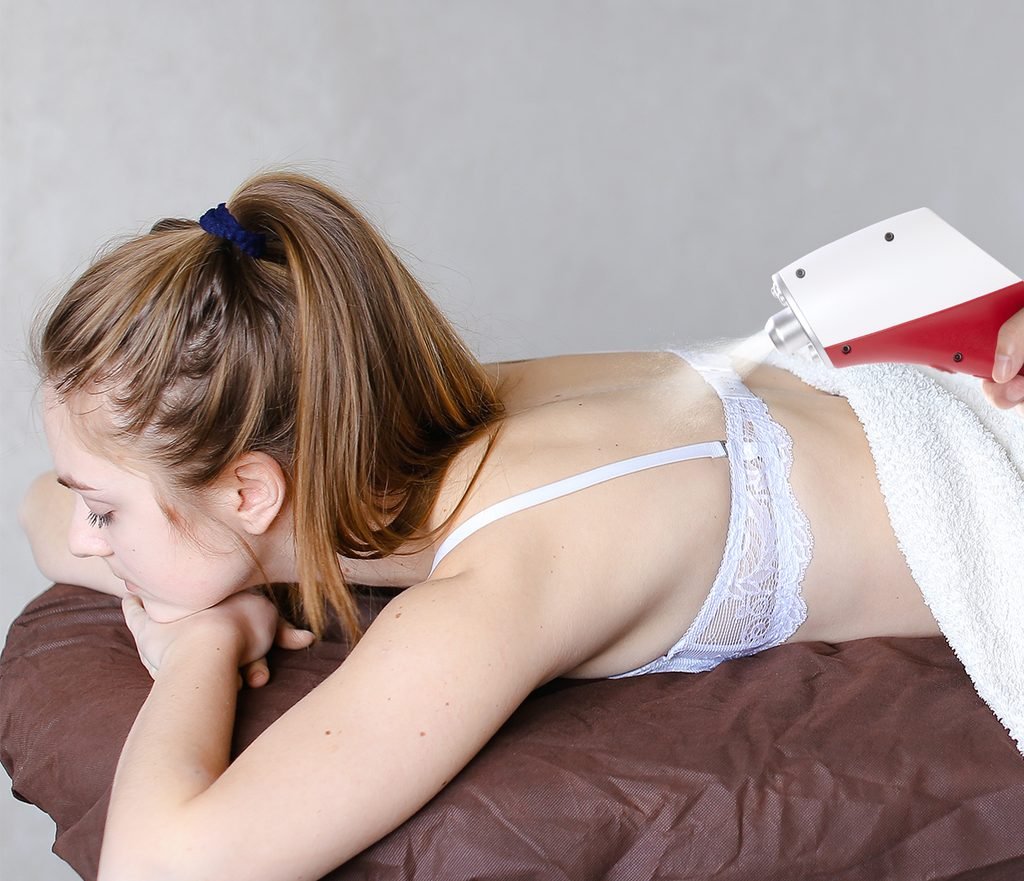
Localized CO₂ cryotherapy uses pressurized carbon dioxide gas to deliver intense cooling to a targeted area. As the gas expands, its temperature drops substantially, with some systems operating at approximately −78°C at the gas outlet. The resulting cold stimulus can influence local sensory responses and may provide temporary relief from musculoskeletal discomfort. The temperature of the gas is not the same as the temperature of the skin, however, so clinicians must follow the device’s operating instructions and monitor the treatment area appropriately.
1.3 The Role of Laser-Assisted Targeting
Some localized CO₂ cryotherapy systems incorporate a red laser pointer to help identify the intended treatment area. This visual aid can support consistent positioning and help the operator direct the cooling stream toward the selected region. The laser serves as a targeting aid rather than a therapeutic laser beam, so it should not be confused with low-level laser therapy, also known as photobiomodulation. Accurate targeting, suitable application technique, and temperature monitoring remain important components of responsible device use.
2. How These Approaches May Complement Each Other
Although manual therapy and CO₂ cryotherapy work through different mechanisms, clinicians may consider them within the same rehabilitation plan when their individual roles align with the patient’s needs.
2.1 Addressing Different Aspects of Musculoskeletal Discomfort
Manual therapy focuses on mechanical and functional factors, including joint movement, soft-tissue mobility, and movement-related symptoms. Localized cryotherapy, by contrast, primarily provides a cooling stimulus that may temporarily influence pain perception. These different functions may make the approaches complementary in selected situations. However, temporary symptom relief does not necessarily indicate tissue healing, and neither method alone addresses every cause of musculoskeletal discomfort.
2.2 Supporting a Broader Rehabilitation Strategy
A rehabilitation plan may combine hands-on techniques, therapeutic exercise, movement education, and selected physical modalities. Within this framework, localized CO₂ cryotherapy may serve as an adjunct when a clinician considers temporary symptom relief appropriate. Manual therapy can address relevant movement limitations, while exercise helps develop strength, coordination, and functional capacity. The value of the overall plan depends on the patient’s condition and response, not simply on the number of modalities included.
2.3 Why Individual Assessment Matters
Not every patient benefits from the same combination of interventions. Symptom duration, injury characteristics, skin condition, circulation, sensory function, and treatment goals can all influence clinical decisions. A clinician should also consider whether cold exposure could temporarily alter sensation in a way that affects subsequent assessment or manual techniques. Individual assessment helps determine whether combining the approaches is reasonable and whether modifications are necessary.
3. Treatment Timing, Laser Therapy, and Clinical Considerations
Once clinicians understand the roles of both approaches, they can consider how treatment timing and other physical modalities fit into an appropriate care plan.
3.1 Should CO₂ Cryotherapy Come Before or After Manual Therapy?
No single sequence applies to every patient. A clinician may consider localized cooling before a session when temporary symptom relief could support comfort, but cooling can also reduce sensation and influence the patient’s feedback during hands-on treatment. Applying cold after manual therapy may be considered in selected circumstances when short-term discomfort requires attention. The clinician should assess the patient’s response and follow the device’s instructions rather than assume that one sequence is universally superior.
3.2 How Does Low-Level Laser Therapy Differ From Laser-Assisted Targeting?
Low-level laser therapy, or photobiomodulation, uses specific wavelengths of light to interact with biological tissues. Clinicians may use it as a separate physical modality for selected rehabilitation goals. A red laser pointer on a CO₂ cryotherapy device has a different function: it indicates the target area but does not deliver the therapeutic light dose used in photobiomodulation. Understanding this distinction prevents confusion between two technologies that may appear similar at first glance.
3.3 Can Cryotherapy Be Combined With Other Rehabilitation Modalities?
Clinicians sometimes incorporate cryotherapy into broader rehabilitation programs that also include therapeutic exercise or other physical modalities. However, combining treatments requires consideration of their individual purposes, contraindications, and potential interactions. For example, a clinician should assess whether cooling-related sensory changes could affect feedback during manual therapy or interfere with another planned intervention. More modalities do not automatically produce better outcomes; each should serve a clear clinical objective.
4. Safety and Evidence-Based Decision-Making
The potential role of combined treatment must be considered alongside safety, evidence quality, and the limitations of current research.
4.1 Screening for Contraindications and Precautions
Intense localized cooling requires particular caution in people with cold hypersensitivity, Raynaud’s phenomenon, impaired peripheral circulation, reduced sensation, or compromised skin integrity. These factors can increase the risk of an adverse response or make excessive cooling harder to recognize. Clinicians should review relevant medical history, assess the treatment area, follow device-specific precautions, and stop treatment if concerning skin or sensory changes occur. Manual therapy also requires appropriate screening when the patient has an acute injury or an unexplained clinical presentation.
4.2 What Does Research Say About Combining Cryotherapy and Manual Therapy?
Research on conventional cryotherapy combined with manual therapy suggests that this approach may offer benefits in certain musculoskeletal settings. Nevertheless, the available studies vary in their patient populations, treatment protocols, and cooling methods. Findings involving ice packs or other conventional cooling methods cannot automatically establish the effectiveness of a localized CO₂ device. Current evidence therefore supports a cautious, individualized approach rather than a general claim that combining these interventions will always improve outcomes.
4.3 Setting Realistic Treatment Goals
Clinicians should focus on outcomes that matter to the patient, such as changes in discomfort, range of motion, activity tolerance, and daily function. They should also distinguish temporary pain relief from meaningful functional improvement. When a treatment plan includes localized CO₂ cryotherapy, ongoing assessment can help determine whether the modality contributes to the intended goal. If symptoms persist, worsen, or include concerning signs, further clinical evaluation may be necessary.
5. Integrating CO₂ Cryotherapy Into Modern Rehabilitation
When used thoughtfully, localized CO₂ cryotherapy can form part of a broader rehabilitation approach without replacing established clinical assessment or active treatment.
5.1 Choosing Equipment and Application Features
When evaluating a localized CO₂ cryotherapy device, clinicians should consider its targeting features, temperature-monitoring capabilities, operating instructions, and training requirements. Laser-assisted positioning may help identify the intended treatment area, while temperature monitoring can support observation of the skin’s response. These features contribute to application control, but they do not independently guarantee safety or clinical benefit. Appropriate training and adherence to the manufacturer’s instructions remain essential.
5.2 Keeping the Focus on Patient-Centered Care
The purpose of combining manual therapy with localized CO₂ cryotherapy is not to add procedures unnecessarily. Instead, clinicians should select interventions according to the patient’s presentation, treatment goals, and tolerance. Clear documentation of symptoms, skin response, sensory changes, and functional progress can help guide decisions over time. A patient-centered approach also makes it easier to modify the plan when an intervention provides limited benefit or causes an unwanted response.
Conclusion
CO₂ cryotherapy and manual therapy may play complementary roles in selected rehabilitation plans by addressing different aspects of musculoskeletal discomfort and movement. Laser-assisted targeting and temperature monitoring can support the controlled application of localized cooling, while manual therapy and active rehabilitation address broader functional goals. Because evidence for specific treatment combinations remains limited, clinicians should individualize decisions, screen for contraindications, and monitor patient response. The aim is to help relieve discomfort and support rehabilitation rather than promise a cure or replace comprehensive clinical care.
FAQ
1. Can CO₂ cryotherapy be combined with manual therapy?
Yes, clinicians may consider both approaches within an individualized rehabilitation plan when the patient’s condition and safety profile make the combination appropriate.
2. Should localized CO₂ cryotherapy be used before or after manual therapy?
There is no universally preferred sequence. Timing depends on treatment goals, patient tolerance, sensory response, and the clinician’s assessment.
3. Can combining these approaches eliminate musculoskeletal pain?
No. Localized cryotherapy may help relieve discomfort temporarily, but outcomes vary, and treatment should address the patient’s broader rehabilitation needs.
4. Who should use caution with localized CO₂ cryotherapy?
People with cold hypersensitivity, Raynaud’s phenomenon, impaired circulation, reduced sensation, or compromised skin should receive appropriate clinical assessment before treatment.
5. What should clinicians monitor during treatment?
Clinicians should observe skin condition, sensation, patient tolerance, and any unusual reactions while following device-specific instructions and safety precautions.
Références
1. Manual Therapy With Cryotherapy Versus Manual Therapy With Kinesio Taping for Males With Lumbar Discopathy: A Pilot Randomized Trial
https://pubmed.ncbi.nlm.nih.gov/28646807
2. What Is the Landscape of Evidence About the Safety of Physical Agents Used in Physical Medicine and Rehabilitation? A Scoping Review
https://pmc.ncbi.nlm.nih.gov/articles/PMC10314460
3. Effectiveness of Cryotherapy on Pain Intensity, Range of Motion, Swelling and Function in the Postoperative Care of Musculoskeletal Disorders: A Systematic Review and Meta-Analysis of Randomised Controlled Trials
https://pubmed.ncbi.nlm.nih.gov/41047148
4. Use of Cryotherapy for Managing Chronic Pain: An Evidence-Based Narrative
https://pubmed.ncbi.nlm.nih.gov/33315183
5. Electrophysical Agents—Contraindications and Precautions: An Evidence-Based Approach to Clinical Decision Making in Physical Therapy