
Introducción
The call room is quiet. The charts are finally signed. A medical resident leans back, rolls their shoulders, and feels it again — that familiar, gnawing tightness across the upper back and into the neck. The trapezius muscles have been locked for hours, carrying the weight of a pager and the strain of a high‑stakes decision. Musculoskeletal pain among young doctors is pervasive. Studies show a large majority of medical trainees experience work‑related neck discomfort. The most common response is to reach for a heating pad. But heat, while soothing, does little to address underlying inflammation. CO₂ cryotherapy offers a different path — rapid cooling that calms irritated nerves, reduces deep tissue inflammation, and leaves no lingering warmth to interfere with sleep. For the resident running on a 28‑hour shift, that difference matters.
1. Why Medical Residents Are So Vulnerable to Trapezius Pain
Young doctors spend countless hours in positions that stress the neck and shoulders. The cumulative effect on the upper trapezius is substantial.
1.1 How Long Hours Degrade Muscle Health
Medical training exposes residents to sustained postures that take a toll on the body. Cross‑sectional studies find that around 40 percent of young doctors report work‑related musculoskeletal symptoms, with neck pain the most common. When the survey window is widened to the past week, neck complaints still top the list. Among surgical residents specifically, 96 percent report pain linked to operating, and 83 percent have experienced neck pain within just the past week. These figures show that chronic trapezius strain is not an occasional nuisance — it is an occupational reality.
1.2 Unique Postural Challenges for Medical Trainees
Surgical residents spend hours looking through loupes or microscopes with the neck held in a sustained flexed and rotated position. This posture has been identified as an independent risk factor for neck symptoms. Non‑surgical trainees face their own challenges: long hours at workstations, monitors positioned too low, and the forward head posture of scrolling through electronic records. All of these contribute to elevated tension in the upper trapezius and levator scapulae. The combination of gravitational load and prolonged static activity creates ideal conditions for myofascial pain syndrome.
1.3 Why Trapezius Pain Disrupts Sleep and Recovery
The trapezius muscle does not stop hurting when the pager stops ringing. Trigger points in the upper trapezius can disturb sleep, causing residents to toss and turn. A trainee who wakes up with a stiff neck after four hours of interrupted rest is already behind before the next shift begins. Data shows that 75 percent of surgical residents seek no treatment for their work‑related pain, even though nearly half report that pain interferes with their ability to work. Without effective intervention, this cycle of fatigue, sleep disruption, and progressive sensitization leads to chronic neck disability that can last long after training ends.
2. How Traditional Heat Therapy Works and Why It Often Falls Short
The heating pad is a familiar sight in call rooms. It is inexpensive and provides immediate – if short‑lived – relief. Understanding its limits is essential.
2.1 Why Heat Feels Comforting in the Moment
When a heating pad is applied to the upper back, warmth increases local blood flow to superficial tissues. This vasodilation relaxes muscle fibers, reduces stiffness, and provides a sense of comfort. Heat also activates thermosensitive nerve fibers, which can temporarily mask pain perception through competitive inhibition. For a resident who has been hunched over a computer for six hours, that immediate relaxation is real and welcome. Heat therapy, used for short periods, can be a useful adjunct before stretching or movement.
2.2 The Core Limitation: Heat Doesn’t Stop the Inflammatory Cycle
The problem with relying on heat alone is that it does not address the underlying driver of chronic muscle tightness. Prolonged postures trigger a low‑grade inflammatory response within the muscle. Heat actually increases metabolic demand in the tissue, which can perpetuate the cycle of irritation. Moreover, muscles affected by myofascial pain respond differently to heat than normal muscles. Heat may feel good, but it does not help the tissue resolve the inflammation that triggered the pain. For lasting relief rather than transient comfort, this distinction is critical.
2.3 The Practical Downside for Overnight Shift Workers
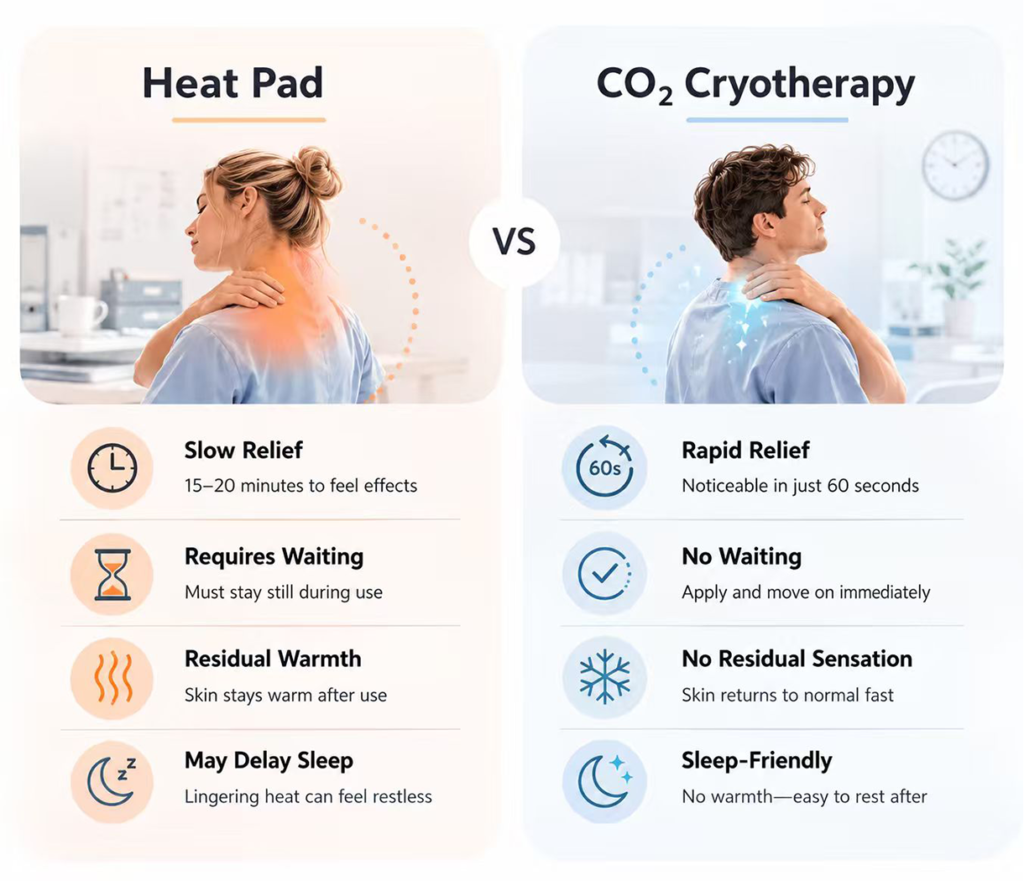
Beyond physiology, heat therapy presents logistical challenges for medical residents working overnight shifts. A heating pad requires a continuous power source, must be used while stationary, and needs fifteen to twenty minutes of uninterrupted application. For a resident who has just finished a difficult procedure and still needs to review charts, carving out that stretch of time is often unrealistic. Worse still, using heat immediately before sleep can leave the skin feeling warm and restless, making it harder to fall asleep quickly.
3. How CO₂ Cryotherapy Targets the Root of Trapezius Myofascial Pain
CO₂ cryotherapy offers a fundamentally different mechanism. Instead of passively warming tissues, it uses pressurised cold gas to trigger rapid physiological responses.
3.1 What CO₂ Cryotherapy Is and How It Affects Deep Muscle Tissue
CO₂ cryotherapy delivers a stream of extremely cold carbon dioxide gas to the skin and underlying tissues. The high‑pressure cold stream rapidly lowers the surface temperature to around four degrees Celsius within seconds. The body responds with an immediate vasoconstriction, followed by a rebound vasodilation after the cold stimulus stops. This cycle helps flush inflammatory mediators from the area, reduces nerve sensitivity, and promotes local circulation. Unlike a heat pad, CO₂ therapy does not require long application times. A typical treatment lasts only sixty seconds per area.
3.2 How Dry, Non‑Contact Cooling Helps Break the Pain‑Spasm Cycle
The mechanism behind CO₂ cryotherapy is not simply tissue cooling. The sudden temperature drop triggers a neuroreflexive response that slows the transmission of pain signals along nerve pathways. This effect can reduce the intensity of the perceived pain from a myofascial trigger point without requiring deep tissue pressure or manual manipulation. The cold also helps reduce local muscle tone, allowing the trapezius fibers to relax. Because the treatment is dry and non‑contact, there is no moisture to wet clothing or bed linens. A resident can apply a session in the call room without needing to change out of scrubs.
3.3 Why the Rapid, Brief Session Fits a Resident‘s Erratic Schedule
The most practical advantage of CO₂ cryotherapy for a medical trainee is speed. A full trapezius treatment – from setup to completion – takes under two minutes. There is no downtime, no lingering warmth or cold, and no need to stay stationary for a long period. A resident can use the therapy immediately before lying down for a short sleep break or right after a busy shift before commuting home. Unlike a heating pad that requires fifteen minutes of waiting, CO₂ cryotherapy fits between the cracks of a chaotic schedule. This ease of use means that the therapy is more likely to be used consistently.
4. Comparing Heat and CO₂ Cryotherapy for Night Shift Trapezius Pain
Both heat and CO₂ cryotherapy have roles in managing muscle discomfort, but their mechanisms and practical applications differ substantially.
4.1 Speed of Relief
Heat takes time. A heating pad must sit in place for fifteen to twenty minutes to warm the tissue thoroughly. CO₂ cryotherapy, by contrast, delivers its effect within sixty seconds. The rapid onset of neuroreflexive pain modulation means a resident can feel a difference almost immediately. For a trainee who has only ten minutes to rest before the next set of orders, that speed is invaluable.
4.2 Effect on Inflammation and Tissue Healing
Heat increases local metabolism and blood flow, which can be helpful for stiff muscles before activity. However, it does not directly reduce inflammation. CO₂ cryotherapy triggers a vasoconstriction‑vasodilation cycle that actively flushes inflammatory mediators from the treated tissue. This makes it more suitable for the low‑grade, chronic inflammation that underlies myofascial pain. Rather than just relaxing the muscle, CO₂ therapy helps the tissue resolve the irritation that caused the tightness in the first place.
4.3 Interference with Sleep
A heating pad used immediately before sleep can leave the skin feeling warm, which some people find distracting or uncomfortable. The residual warmth may delay sleep onset. CO₂ cryotherapy leaves no lingering temperature change. The skin returns to its normal thermal state within a minute after treatment. For a resident trying to fall asleep quickly in a call room bunk, avoiding that post‑heat restlessness is a real advantage.
5. Building a Practical Strategy for Trainees
Medical residents and interns cannot simply rest their way out of trapezius pain. The demands of training continue regardless of discomfort. A practical strategy combines effective pain management with the realities of shift work.
5.1 Using Heat Strategically, Not Routinely
Heat still has a place. A brief application before dynamic stretching can help prepare the trapezius for gentle movement. Used in this targeted way, heat complements rather than competes with other therapies. However, relying on heat as the sole treatment for chronic myofascial pain often leads to frustration. Residents who use heat only before exercise or after waking up, but not as a primary pain management tool, tend to get better long‑term results.
5.2 When to Reach for CO₂ Cryotherapy
The ideal time for CO₂ cryotherapy is immediately after a period of sustained posture – after finishing a long surgery, after a marathon chart‑review session, or before lying down for a short rest. The therapy can also be used preventively at the beginning of a shift to reduce baseline muscle tone. A resident who knows they will be spending hours at a microscope can apply a quick trapezius treatment beforehand to reduce the rate at which tension accumulates. Because the treatment is fast and safe, it can be used multiple times throughout a shift.
5.3 Combining Both Approaches for Best Results
Neither heat nor CO₂ cryotherapy is a standalone cure. The most effective plan for managing nocturnal trapezius tightness pairs active treatments with postural awareness and gentle stretching. Use CO₂ cryotherapy to calm acute inflammation and reduce pain after a long shift. Use heat briefly before a stretching routine to improve tissue pliability. Over time, this combined approach reduces the cumulative injury that leads to chronic neck disability. For the medical trainee who cannot afford to slow down, having a fast, effective, drug‑free option for trapezius pain is not a luxury – it is a necessity.
PREGUNTAS FRECUENTES
Q1: Can I use CO₂ cryotherapy while wearing scrubs?
Yes. The gas stream is dry and non‑contact, so it does not wet or damage clothing.
Q2: How soon after a shift should I apply CO₂ cryotherapy for best results?
Ideally within thirty minutes after the prolonged posture ends, before the muscle tension has fully set in.
Q3: Is CO₂ cryotherapy safe to use on the same area multiple times per day?
Yes. Brief treatments spaced several hours apart are well tolerated and can be repeated as needed.
Q4: Does CO₂ cryotherapy replace the need for stretching or posture correction?
No. It is a supportive tool that helps manage symptoms. Long‑term prevention still requires attention to ergonomics and movement.
Q5: Can I use both a heating pad and CO₂ cryotherapy in the same evening?
Yes, but with separation. Use cryotherapy first to reduce inflammation, then heat before stretching if needed. Avoid applying both simultaneously.
Conclusión
The late‑night trapezius tightness that follows a long shift is not just a minor annoyance. For medical residents and interns, it is a daily reminder that the body is paying a price for the intensity of training. Heating pads offer temporary comfort but do little to resolve the underlying myofascial inflammation. CO₂ cryotherapy provides a fast, dry, sleep‑friendly alternative that targets the root of the problem. A sixty‑second treatment can calm overactive nerves, reduce muscle tension, and help a tired resident fall asleep without that gnawing ache in the neck. For those running on fumes between pages, that difference is everything.
Referencias
Local Cryotherapy. CO₂ Cryotherapy for Pain Management.
https://www.localcryotherapy.com
National Library of Medicine. Musculoskeletal Pain in Medical Trainees.
https://pubmed.ncbi.nlm.nih.gov
Journal of Surgical Education. Neck Pain in Surgical Residents.
https://www.sciencedirect.com/journal/journal-of-surgical-education
Dynamic Chiropractic. Myofascial Pain in Healthcare Workers.
https://dynamicchiropractic.com
Medimarket. Dry Cold Therapy for Occupational Strain.
https://www.medimarket.com