مقدمة
Before starting a workout, many fitness enthusiasts focus on warm-ups, stretching, hydration, and mobility exercises to prepare their bodies for physical activity. In recent years, CO₂ Cryotherapy has gained attention as a localized cooling method that can be included in pre-workout routines. Unlike traditional ice applications, carbon dioxide cryotherapy uses controlled CO₂ gas to rapidly cool targeted areas of the body. This approach is commonly used by active individuals who want to support muscle readiness, comfort, and recovery habits before exercise. Localized cryotherapy combines modern cooling technology with targeted application, making it an interesting option for people who want to prepare specific areas such as the legs, shoulders, or arms before physical activity.
1. Understanding CO₂ Cryotherapy Before Exercise
Cold therapy has traditionally been associated with post-exercise recovery, but more people are exploring how localized cooling may fit into preparation routines before physical activities. Understanding the basic principles of CO₂ Cryotherapy helps explain why this technology is becoming part of modern fitness and wellness practices.
1.1 What Is CO₂ Cryotherapy?
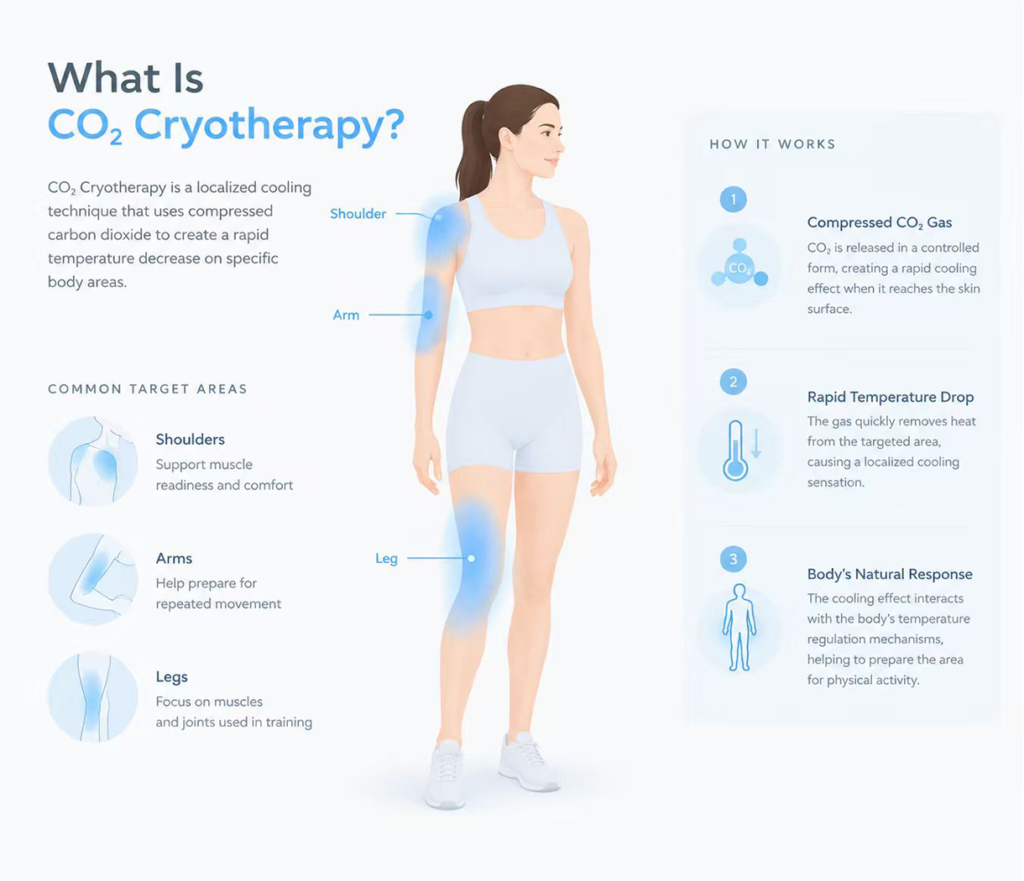
CO₂ Cryotherapy is a localized cooling technique that uses compressed carbon dioxide to create a rapid temperature decrease on specific body areas. The process focuses on targeted application rather than cooling the entire body.
When CO₂ gas reaches the skin surface, it creates an intense cooling effect that interacts with the body’s natural temperature regulation mechanisms. This localized approach allows users to focus on specific areas that experience physical demand during exercise, such as muscles, joints, and surrounding tissues.
1.2 The Difference Between Traditional Cooling and CO₂ Cryotherapy
Traditional cooling methods, such as ice packs, often require direct contact and longer application periods. CO₂ Cryotherapy provides a more targeted cooling experience through controlled gas application.
Because of its fast cooling ability, localized CO₂ Cryotherapy is often considered by athletes and active individuals who want a convenient preparation method before training sessions. The technology allows users to focus on selected areas without requiring full-body exposure.
1.3 Why Pre-Workout Cooling Has Gained Attention
Pre-workout preparation has expanded beyond traditional stretching and warm-ups. Many athletes now explore different approaches that may support physical readiness and comfort before exercise.
Research on pre-exercise cryotherapy has examined potential effects related to physical performance, neuromuscular responses, and exercise preparation. However, researchers also note that more standardized protocols are needed to fully understand the role of cryotherapy before exercise.
2. How Localized Cooling Works Before Physical Activity
To understand the role of CO₂ Cryotherapy before workouts, it is important to look at how cold exposure interacts with skin, muscles, and the body’s physiological responses.
2.1 The Relationship Between Cooling and Muscle Preparation
During exercise preparation, the body experiences changes in circulation, temperature regulation, and muscle activation. Localized cooling can influence skin temperature and create a cooling sensation in targeted areas.
CO₂ Cryotherapy focuses on specific regions instead of applying cold exposure across the entire body. This allows users to include targeted cooling as part of their individual preparation routine before physical activities.
2.2 Supporting Muscle Comfort Before Training
Before intense workouts, some individuals experience muscle tightness or discomfort from previous activities. Localized CO₂ Cryotherapy can be used as part of a broader routine that includes movement preparation, mobility exercises, and warm-up activities.
The goal is not to replace exercise preparation but to provide additional support for individuals who pay attention to muscle condition before training.
2.3 The Role of Temperature Management in Exercise Preparation
Temperature regulation plays an important role during physical activity. Cooling strategies have been explored in sports settings because changes in body temperature may influence exercise perception and comfort.
Localized cryotherapy provides another option for people who want to incorporate cooling techniques into their preparation habits, especially when focusing on specific areas exposed to repeated movement or training stress.
3. CO₂ Cryotherapy Applications for Different Workout Types
Different forms of exercise create different physical demands. As a result, users may choose localized cooling based on their training style and the areas that receive the most activity.
3.1 CO₂ Cryotherapy Before Strength Training
Strength training places repeated loads on major muscle groups, including the legs, shoulders, arms, and back. Many weight-training enthusiasts pay attention to muscle condition before beginning heavy lifting sessions.
Localized CO₂ Cryotherapy can be incorporated into preparation routines focused on areas that will experience significant movement during strength workouts. It may provide a cooling sensation that helps users feel prepared before training.
3.2 CO₂ Cryotherapy Before Cardio and Endurance Exercise
Running, cycling, and other endurance activities require continuous muscle movement over extended periods. Commonly used areas include calves, thighs, knees, and lower legs.
For endurance athletes, localized cooling may become part of a preparation routine before training sessions, especially when they want to focus on areas that experience repetitive movement.
3.3 CO₂ Cryotherapy Before High-Intensity Workouts
High-intensity interval training (HIIT), functional training, and circuit workouts often involve rapid movements and multiple muscle groups.
Because these workouts combine strength, speed, and endurance elements, some individuals use localized cooling as one part of their preparation strategy. This therapy can be applied to selected areas before exercise based on personal preference and training needs.
4. Choosing the Right Areas for Pre-Workout CO₂ Cryotherapy
The effectiveness of any preparation routine depends on understanding individual training demands. Localized cryotherapy allows users to focus on specific areas rather than applying cooling methods randomly.
4.1 Lower Body Applications Before Exercise
The lower body plays a major role in many physical activities. Runners, cyclists, and strength-training participants often focus on areas such as the quadriceps, calves, hamstrings, and knees.
Applying this therapy to selected lower-body areas before workouts may provide a refreshing cooling experience and support personal preparation routines.
4.2 Upper Body Applications Before Exercise
Upper-body training involves muscles around the shoulders, arms, elbows, and wrists. Activities such as weightlifting, boxing, and functional fitness place repeated demands on these areas.
Localized CO₂ Cryotherapy allows users to focus cooling on specific upper-body regions before training sessions.
4.3 Creating a Balanced Pre-Workout Recovery Routine
CO₂ Cryotherapy works best when combined with other healthy exercise habits. Proper warm-ups, mobility exercises, hydration, and appropriate training intensity remain important parts of physical preparation.
Rather than replacing traditional preparation methods, localized cooling can serve as an additional tool within a complete fitness routine.
5. The Future of CO₂ Cryotherapy in Fitness and Wellness
As fitness technology continues to develop, more people are exploring personalized approaches to exercise preparation. Localized CO₂ Cryotherapy represents one example of how cooling technology is becoming integrated into modern wellness routines.
5.1 Why More People Are Exploring Localized Cooling Technology
Modern fitness users often look for convenient methods that fit into their schedules. Compared with traditional cooling approaches, CO₂ Cryotherapy offers targeted application and quick temperature adjustment.
This makes it appealing for individuals who want to focus on specific body areas before or after physical activities.
5.2 Understanding the Role of CO₂ Cryotherapy in Exercise Preparation
Current discussions around pre-exercise cryotherapy focus on how cooling may influence physical readiness and exercise experience. Existing research suggests potential interest in this area, while also highlighting the need for additional investigation regarding specific performance outcomes.
For fitness enthusiasts, CO₂ Cryotherapy can be viewed as a supportive technology that complements established training practices.
الأسئلة الشائعة
What is CO₂ Cryotherapy before a workout?
It before exercise is a localized cooling method that applies carbon dioxide to selected body areas as part of a preparation routine.
Can CO₂ Cryotherapy replace a warm-up?
No. It should not replace warm-up exercises, mobility training, or other preparation methods.
Which body areas are commonly used with CO₂ Cryotherapy before workouts?
Common areas include legs, shoulders, arms, knees, and other regions involved in physical activity.
How long before a workout should CO₂ Cryotherapy be used?
Timing depends on individual routines and preferences. Many users incorporate localized cooling shortly before exercise preparation.
Is CO₂ Cryotherapy only for professional athletes?
No. Active individuals with different fitness levels may explore localized cryotherapy as part of their personal wellness routines.
الخاتمة
CO₂ Cryotherapy is becoming an increasingly discussed option in exercise preparation because it provides targeted cooling for specific body areas. From strength training to endurance workouts, localized cryotherapy allows fitness enthusiasts to include modern cooling technology alongside traditional preparation methods. While more research is needed to fully understand the long-term effects of pre-workout cryotherapy, CO₂ Cryotherapy offers an innovative approach for individuals who want to support their exercise routines with personalized recovery and wellness strategies.
المراجع
Pre-Exercise Whole- or Partial-Body Cryotherapy Exposure to Improve Physical Performance: A Systematic Review
https://pubmed.ncbi.nlm.nih.gov/34678916
Whole-Body Cryotherapy: Potential to Enhance Athlete Preparation for Competition?
https://pubmed.ncbi.nlm.nih.gov/31447697
The Effect of Local Skin Cooling Before a Sustained, Submaximal Isometric Contraction on Fatigue and Isometric Quadriceps Femoris Performance: A Randomized Controlled Trial
https://www.sciencedirect.com/science/article/pii/S0306456516303904
Effects of Air-Pulsed Cryotherapy on Neuromuscular Recovery Subsequent to Exercise-Induced Muscle Damage
https://journals.sagepub.com/doi/10.1177/0363546513490648
Carbon Dioxide Hydrate as a Recovery Tool After Fatigue of the Plantar Flexors
https://www.sciencedirect.com/science/article/pii/S0021929020303237