Введение
Trying CO₂ cryotherapy for the first time can raise a few questions: What will the cooling feel like? How does the treatment work? What should your skin look like afterward? Localized CO₂ cryotherapy uses a controlled stream of pressurized carbon dioxide gas to cool a selected area of the body. Unlike whole-body cryotherapy, this approach focuses on a specific treatment area. Some devices also include features such as red-laser-assisted targeting and real-time temperature monitoring to help guide the application process. Understanding the basic steps before, during, and after a session can make the experience more predictable. Just as importantly, knowing which sensations are expected and which reactions need attention helps first-time patients communicate with their practitioner and approach treatment with realistic expectations.
1. Understanding Localized CO₂ Cryotherapy Before Your First Session
1.1 What Is Localized CO₂ Cryotherapy?
Localized CO₂ cryotherapy delivers cold carbon dioxide gas toward a selected area rather than exposing the entire body to a cold environment. The human-use device featured on the Local Cryotherapy product page uses pressurized CO₂ gas with a stated source temperature of approximately −78°C. This describes the gas temperature at the source, not the temperature reached by the skin or deeper tissues. The actual cooling response depends on factors such as application distance, exposure, movement, treatment area, and individual skin characteristics. The purpose of localized cooling is generally to provide a short-term cold stimulus that may help manage discomfort in selected situations. It should be viewed as a possible supportive approach rather than a treatment that guarantees tissue repair or resolves an underlying condition.
1.2 How Is It Different From an Ice Pack or Whole-Body Cryotherapy?
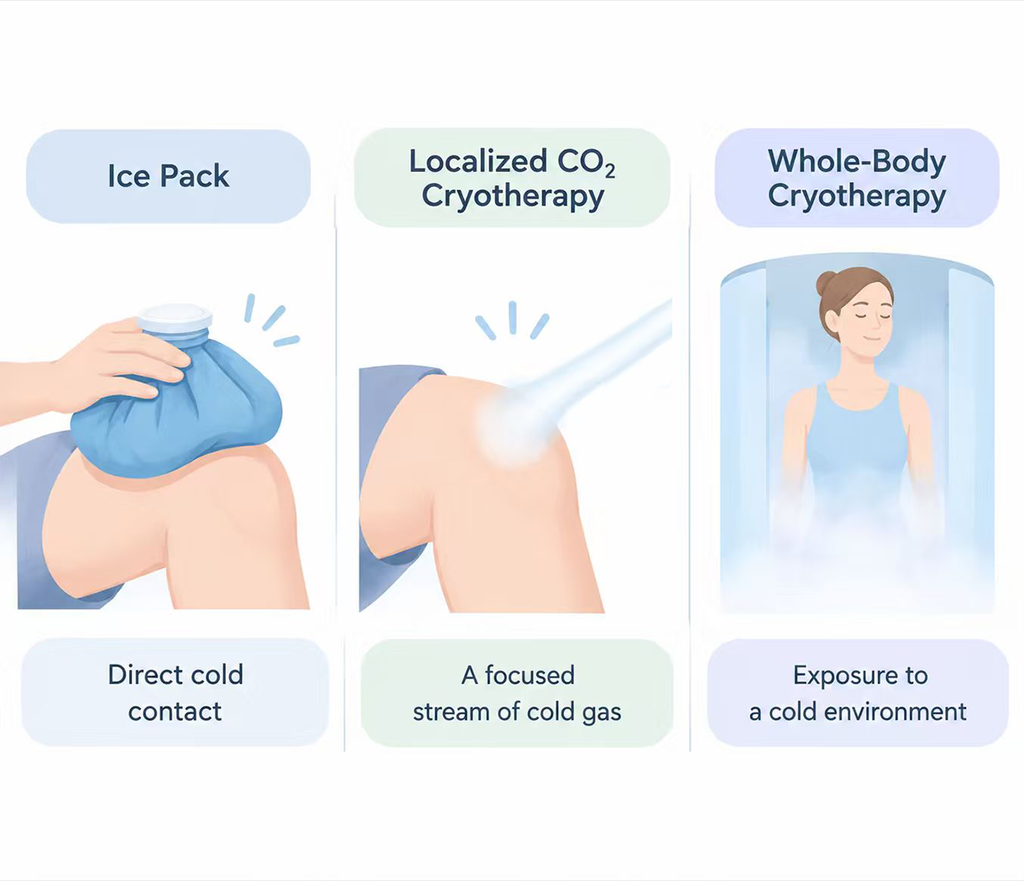
An ice pack transfers cold through direct contact with the skin, while localized CO₂ cryotherapy directs a stream of cold gas toward a selected body area. Whole-body cryotherapy, in contrast, exposes a much larger portion of the body to a cold environment. These methods differ in how they deliver cold, how the treatment area is selected, and how exposure is monitored. Localized CO₂ equipment may include a red laser pointer to help the practitioner identify the intended area and temperature sensors to display cooling information. The red laser is a positioning aid, not a therapeutic laser treatment. These device features can support the application process, but they do not establish that CO₂ cooling is more effective than other cold therapies.
1.3 What Should First-Time Patients Expect From the Treatment?
A first session usually begins with a discussion of the patient’s goals, health history, and the area of concern. The practitioner then explains the procedure, checks the skin, and determines whether localized cooling is appropriate. During treatment, the patient may notice a rapid and intense cold sensation, followed by tingling or temporary numbness. The sensation varies with the treatment area and individual cold sensitivity. A session does not need to feel unbearable to be effective, and patients should never feel pressured to tolerate excessive discomfort. The practitioner should explain how to communicate during treatment and make it clear that the application can be adjusted or stopped if the patient experiences an unusual reaction.
2. Preparing for Your First CO₂ Cryotherapy Appointment
2.1 Share Your Medical History and Skin Concerns
Before treatment, tell the practitioner about relevant medical conditions, previous cold reactions, circulation problems, and changes in skin sensation. Conditions such as Raynaud’s phenomenon, cold urticaria, peripheral vascular disease, and peripheral neuropathy may increase the risks associated with intense local cooling. Reduced sensation is particularly important because a patient may not recognize excessive cold exposure promptly. Also mention open wounds, active skin irritation, infection, recent injuries, or unexplained changes in the treatment area. A practitioner should assess these factors before deciding whether to proceed. If you are unsure whether a health condition or medication affects your suitability, seek guidance from an appropriate healthcare professional rather than relying on a general treatment description.
2.2 Prepare the Treatment Area
The selected area should be accessible so the practitioner can inspect the skin and apply the cooling stream accurately. Depending on the treatment location, you may need to adjust or remove clothing that covers the area. The skin should be clean and free from anything that could interfere with inspection or increase irritation. Tell the practitioner about recent use of topical products, skin treatments, or medications applied to the area. Avoid applying numbing products to conceal discomfort unless a healthcare professional specifically advises otherwise. Most importantly, do not attempt to prepare the area by exposing it to additional extreme cold before the appointment. The practitioner should determine whether the skin is suitable for treatment at the time of the session.
2.3 Understand the Device and Treatment Plan
A professional CO₂ cryotherapy system may combine several features to guide localized cooling. The human-use device described on the Local Cryotherapy product page delivers pressurized CO₂ at a stated source temperature of approximately −78°C. It also features red-laser-assisted targeting, real-time temperature monitoring, and a display for treatment management. The listed treatment distance is approximately 150 ± 5 mm. These specifications help explain how the equipment is designed to deliver and monitor the cooling process. They are not a substitute for practitioner training, device-specific instructions, or continuous observation. Before treatment begins, ask which area will be treated, what sensations you may experience, and how the practitioner will monitor your response.
3. What Happens During a CO₂ Cryotherapy Session?
3.1 Positioning and Initial Skin Assessment
The practitioner first positions you so the selected area remains accessible and comfortable. They should inspect the skin for irritation, damage, unusual discoloration, or other conditions that may affect treatment suitability. The treatment area and intended application points should be clearly identified before the device is activated. On systems equipped with red-laser-assisted targeting, the laser pointer helps indicate the intended location. It does not deliver the cooling effect itself. This distinction is useful for first-time patients who may otherwise confuse the targeting light with low-level laser therapy. Clear positioning also gives the practitioner a consistent reference point while monitoring the skin and the patient’s feedback.
3.2 The Cooling Sensation: What Is Normal?
When the CO₂ stream reaches the selected area, the first sensation is usually a noticeable burst of cold. Some people describe it as sharp, intense, or similar to a concentrated cold-air sensation. Tingling or temporary numbness may follow as the local area cools. Sensitivity differs between individuals and body regions, so there is no single sensation that every patient should expect. Mild, temporary changes in skin appearance, such as slight redness during or after rewarming, may occur, although responses vary. The patient should remain able to communicate with the practitioner throughout the session. Strong burning, increasing pain, or an uncomfortable sensation that feels excessive should be reported immediately rather than treated as something to endure.
3.3 How the Practitioner Uses Targeting and Temperature Monitoring
During application, the practitioner directs the CO₂ stream toward the selected area while following the device’s operating instructions. The red laser pointer can help identify the intended treatment location, while the built-in temperature sensors display information about the cooling process. The device specification lists a treatment distance of approximately 150 ± 5 mm, which should be understood as a product-specific guideline rather than a universal distance for every CO₂ cryotherapy system. The practitioner must also consider the treatment area’s size, skin condition, patient feedback, and other relevant factors. Temperature monitoring is an additional source of information; it does not eliminate cold-injury risk or replace direct skin observation.
3.4 Communicating During Treatment
First-time patients should speak up whenever a sensation feels unusual or uncomfortable. Tell the practitioner if the cold becomes painful, if burning develops, or if the treated area feels excessively numb. You should also report dizziness, nausea, unusual weakness, or any other unexpected whole-body sensation. The practitioner can pause, adjust, or discontinue the application as appropriate. Do not assume that silence is necessary or that a stronger cold sensation means a better result. Good communication is part of safe treatment, especially because individual responses to cold can differ considerably. A responsible session prioritizes patient tolerance and appropriate application rather than trying to reach the lowest possible temperature.
4. After Treatment: Skin Changes and Immediate Care
4.1 What Your Skin May Look and Feel Like
After the cooling stops, the treated area gradually returns toward its usual temperature. You may notice mild tingling, temporary numbness, or a slight change in skin color as the area rewarmes. Some patients may experience temporary redness or sensitivity, while others notice very little visible change. These responses can vary with the treatment location, exposure, and individual skin characteristics. The skin should not be assumed to be injured simply because it feels cold or looks slightly different for a short time. However, pronounced discoloration, persistent loss of sensation, blistering, or worsening pain should not be dismissed as routine after-effects. Ask the practitioner to assess any reaction that seems unusual.
4.2 Allow the Area to Rewarm Naturally
After treatment, allow the skin to return gradually toward its normal temperature. Avoid immediately applying a heating pad, hot-water bottle, or very hot water to the treated area, particularly if sensation is temporarily reduced. Excessive heat can create another source of injury when the skin’s ability to register temperature is not fully restored. Follow the practitioner’s aftercare instructions and avoid additional intense cold exposure to the same area until advised otherwise. If the skin feels unusually sensitive, protect it from friction or pressure. A gradual return to normal activity is generally more sensible than immediately testing the treated area with strenuous exercise.
4.3 Return to Daily Activities With Realistic Expectations
Many patients can return to ordinary daily activities after a localized session, but the appropriate level of activity depends on the reason for treatment and the practitioner’s advice. A temporary reduction in discomfort does not necessarily mean that an injury has healed or that the underlying condition has resolved. If you are receiving rehabilitation for a muscle, joint, or soft-tissue problem, continue following the broader care plan recommended by your healthcare professional. This may include activity modification, therapeutic exercise, or further assessment. CO₂ cryotherapy should not replace appropriate diagnosis, rehabilitation, or medical care when symptoms require them.
4.4 When to Contact a Healthcare Professional
Contact the practitioner if numbness does not gradually improve, the skin remains unusually pale or discolored, or discomfort increases rather than settles. Severe burning, persistent pain, blistering, significant swelling, or a skin area that becomes blue, gray, or unusually cold also requires prompt assessment. Seek medical attention for severe or worsening symptoms, especially when they occur with weakness, loss of function, or signs of infection. Do not repeat treatment over an area with a concerning reaction until it has been assessed. Early communication helps distinguish a temporary response from a possible cold-related injury or an unrelated medical problem.
5. Setting Realistic Expectations for First-Time Patients
5.1 What CO₂ Cryotherapy Can and Cannot Do
Localized CO₂ cryotherapy may offer short-term comfort for some people by changing local sensory responses to cold. However, research on cryotherapy includes different delivery methods, such as ice packs, cold-water immersion, and gaseous cooling. Findings from one method cannot automatically establish the effectiveness of a specific CO₂ device. A 2024 critical review of cryotherapy for sports-related soft-tissue injuries found that human evidence supports an analgesic effect more clearly than claims about tissue regeneration or prevention of secondary injury. For this reason, first-time patients should approach treatment as a possible supportive option, not a guaranteed solution. The most useful outcome to discuss with a practitioner is whether the treatment fits the individual’s needs and broader care plan.
5.2 Why Individual Responses May Differ
Two people receiving treatment on similar body areas may describe different experiences. Skin sensitivity, circulation, nerve function, treatment location, and the condition being addressed can all influence how a person responds to cold. The same patient may also notice differences between sessions as symptoms and activity levels change. Equipment features such as red-laser targeting and real-time temperature monitoring help guide application, but they do not make every treatment response predictable. A practitioner should consider the patient’s feedback and skin response rather than assume that one application approach suits everyone. A gradual, individualized approach is more appropriate than comparing sensations or outcomes with another person’s experience.
5.3 Treat the Session as One Part of a Broader Plan
A first CO₂ cryotherapy session is an opportunity to understand how localized cooling feels and whether it is appropriate for the intended purpose. It should not be treated as a standalone replacement for medical assessment or rehabilitation. Patients with persistent pain, repeated injuries, unexplained swelling, or reduced mobility should discuss the underlying cause with a qualified healthcare professional. When cooling is considered appropriate, it may be incorporated into a broader plan that addresses movement, strength, activity demands, and recovery. Tracking symptoms and functional changes over time can also help patients and practitioners decide whether continuing the approach makes sense.
Frequently Asked Questions
1. Does CO₂ cryotherapy hurt during the first session?
Most patients notice a strong cold sensation, which may be followed by tingling or temporary numbness. Experiences vary, but excessive pain or burning should be reported immediately.
2. How long does a CO₂ cryotherapy session take?
Treatment time depends on the selected area, the purpose of the session, and the device instructions. The practitioner should determine the application process rather than use one fixed duration for everyone.
3. Is redness after CO₂ cryotherapy normal?
Mild, temporary redness may occur as the skin responds and rewarmes. Persistent discoloration, severe pain, or blistering should be assessed rather than assumed to be a normal reaction.
4. Can I exercise immediately after treatment?
That depends on the reason for treatment and your current condition. Follow the practitioner’s advice, and avoid strenuous activity if the area remains numb, painful, or unusually sensitive.
5. Is localized CO₂ cryotherapy the same as whole-body cryotherapy?
No. Localized CO₂ cryotherapy directs cold gas toward a selected body area, while whole-body cryotherapy exposes a much larger portion of the body to a cold environment.
6. Who should avoid or use extra caution with CO₂ cryotherapy?
People with Raynaud’s phenomenon, cold urticaria, impaired circulation, reduced skin sensation, or damaged skin need professional assessment before treatment. Suitability depends on individual health factors.
7. Does the red laser provide pain relief?
No. The red laser on the device is a positioning aid that helps the practitioner identify the treatment area. The cooling effect comes from the pressurized CO₂ gas.
8. What should I do if numbness or pain continues after treatment?
Contact the practitioner if numbness does not gradually improve or discomfort increases. Severe pain, unusual skin discoloration, or blistering warrants prompt medical assessment.
Заключение
A first CO₂ cryotherapy session is easier to approach when patients understand the treatment process, expected sensations, and possible skin responses. Localized cooling with pressurized CO₂ gas offers a targeted approach, and features such as red-laser-assisted positioning and real-time temperature monitoring can help guide its application. However, these features do not guarantee a particular outcome or eliminate the need for careful supervision. Patients should share relevant health information, communicate openly during treatment, allow the skin to rewarm naturally, and report unusual or persistent reactions. Most importantly, localized CO₂ cryotherapy should be considered a potential supportive option within an appropriate care plan, not a substitute for diagnosis, rehabilitation, or professional medical advice.
Ссылки
- Hsu JR, Mir H, Wally MK, et al. Clinical Practice Guidelines for Pain Management in Acute Musculoskeletal Injury.
https://pmc.ncbi.nlm.nih.gov/articles/6485308
- Racinais S, Dablainville V, Rousse Y, et al. Cryotherapy for Treating Soft Tissue Injuries in Sport Medicine: A Critical Review.
https://bjsm.bmj.com/content/58/20/1215
- British Journal of Sports Medicine. Effectiveness of Cryotherapy on Pain Intensity, Range of Motion, Swelling and Function in the Postoperative Care of Musculoskeletal Disorders: A Systematic Review and Meta-Analysis of Randomised Controlled Trials.
https://bjsm.bmj.com/content/early/2025/10/05/bjsports-2024-109497.full
- National Library of Medicine. Cryotherapy in Dermatology.
https://www.ncbi.nlm.nih.gov/books/NBK482319
5. Local Cryotherapy. Cryotherapy Machine for Humans.
https://www.localcryotherapy.com/cryotherapy-machine-product-list/cryotherapy-machine-for-human