Введение
Hiking can place sustained demands on muscles, tendons, joints, and connective tissues, especially when a route includes steep climbs, uneven terrain, long descents, or extended walking. The quadriceps, hamstrings, calves, gluteal muscles, ankles, and feet may all experience repetitive loading during a single outing. Afterward, temporary muscle soreness, stiffness, and localized fatigue can make normal movement feel less comfortable. CO₂ cryotherapy offers a targeted form of cold therapy that focuses on specific areas rather than exposing the entire body to extreme cold. By using pressurized carbon dioxide to create rapid localized cooling, this approach can provide a controlled thermal stimulus to areas experiencing post-hike discomfort. When incorporated into a broader recovery routine, localized CO₂ cryotherapy may support everyday comfort without requiring whole-body cooling.
1. Why Hiking Can Leave Specific Muscles Sore
Hiking combines endurance, balance, repetitive loading, and changes in elevation. Even at a moderate pace, the body continuously adjusts to variations in terrain, which can create a different type of muscular demand from walking on a flat surface.
1.1 Uphill Hiking and Lower-Body Muscle Loading
Uphill sections increase the workload placed on the gluteus maximus, quadriceps, calves, and other muscles involved in hip and knee extension. These muscles repeatedly contract to propel the body upward, while the ankles and feet help maintain stability on changing surfaces.
This sustained muscular activity can contribute to temporary fatigue and soreness, particularly when the route lasts several hours or involves a greater elevation gain than usual. The physical response can involve local metabolic stress, mechanical loading, and changes in muscle function after exertion.
Cold therapy becomes relevant because controlled cooling can influence local sensory and vascular responses. Rather than affecting the entire body, CO₂ cryotherapy allows attention to remain on the specific muscle groups that received the greatest workload.
1.2 Downhill Walking and Eccentric Muscle Activity
Descending can place a different type of stress on the lower body. The quadriceps work eccentrically as they help control knee flexion and absorb mechanical forces with each step. Eccentric exercise commonly produces greater delayed muscle soreness than familiar concentric activity.
For hikers, this explains why the legs may feel relatively comfortable during a descent but become noticeably stiff later. The sensation can become more apparent during the following day as delayed-onset muscle soreness develops.
Localized CO₂ cryotherapy provides a cooling stimulus that may temporarily influence pain perception and local tissue responses. This makes it relevant to post-hike recovery discussions, particularly when discomfort remains concentrated in areas such as the quadriceps, calves, or knees.
2. Understanding CO₂ Cryotherapy and Rapid Localized Cooling
The connection between hiking recovery and CO₂ cryotherapy begins with the way controlled cold affects the body. Unlike an ice bath, localized CO₂ cryotherapy directs cold specifically toward a selected region.
2.1 How Pressurized CO₂ Creates a Thermal Stimulus
CO₂ cryotherapy uses pressurized carbon dioxide that rapidly expands as it leaves the applicator. This expansion produces a very cold gas stream, with the CO₂ system described by LocalCryotherapy reaching approximately −78°C. The cold gas rapidly removes heat from the skin surface and produces a pronounced thermal stimulus.
Rapid cooling activates cold-sensitive receptors and can temporarily reduce the velocity of sensory nerve conduction. This neurological response helps explain why cold therapy can alter the perception of localized discomfort.
The vascular system also responds to sudden cooling. Initial vasoconstriction reduces local blood flow, followed by reactive changes in circulation as the tissue returns toward its normal temperature. These responses form an important part of the physiological basis for localized cryotherapy.
2.2 Localized Cooling Versus Whole-Body CO₂ Cryotherapy
Whole-body cryotherapy exposes a large portion of the body to extremely cold environmental temperatures, while localized CO₂ cryotherapy concentrates the cooling stimulus on a selected anatomical area.
For hikers, this distinction can be useful because post-hike discomfort often has a clear location. One person may notice soreness primarily in the quadriceps after a steep descent, while another may experience more discomfort around the calves, ankles, or feet.
Localized cooling therefore provides a more focused approach. Instead of cooling areas that feel comfortable, the technology allows attention to remain on the specific regions associated with post-activity soreness. LocalCryotherapy describes its CO₂ system as a targeted approach rather than whole-body exposure.
2.3 The Role of Temperature in CO₂ Cryotherapy
Temperature plays an important role in the physiological response to cryotherapy. The CO₂ used by the LocalCryotherapy system can reach approximately −78°C, creating rapid surface cooling rather than the gradual cooling associated with conventional cold packs.
This does not mean that colder always means better. The intensity of cold must remain controlled because excessive exposure can place unnecessary stress on the skin and superficial tissues. Localized cryotherapy therefore relies on controlled application, appropriate distance, and monitoring rather than simply maximizing cold intensity.
3. Where CO₂ Cryotherapy Fits Into Post-Hike Recovery
Post-hike recovery involves more than muscle soreness. Hikers may experience a combination of muscular fatigue, joint stiffness, soft-tissue discomfort, and temporary reductions in mobility. Targeted cold therapy can address the comfort component of this recovery process.
3.1 Quadriceps, Calves, and Hamstrings
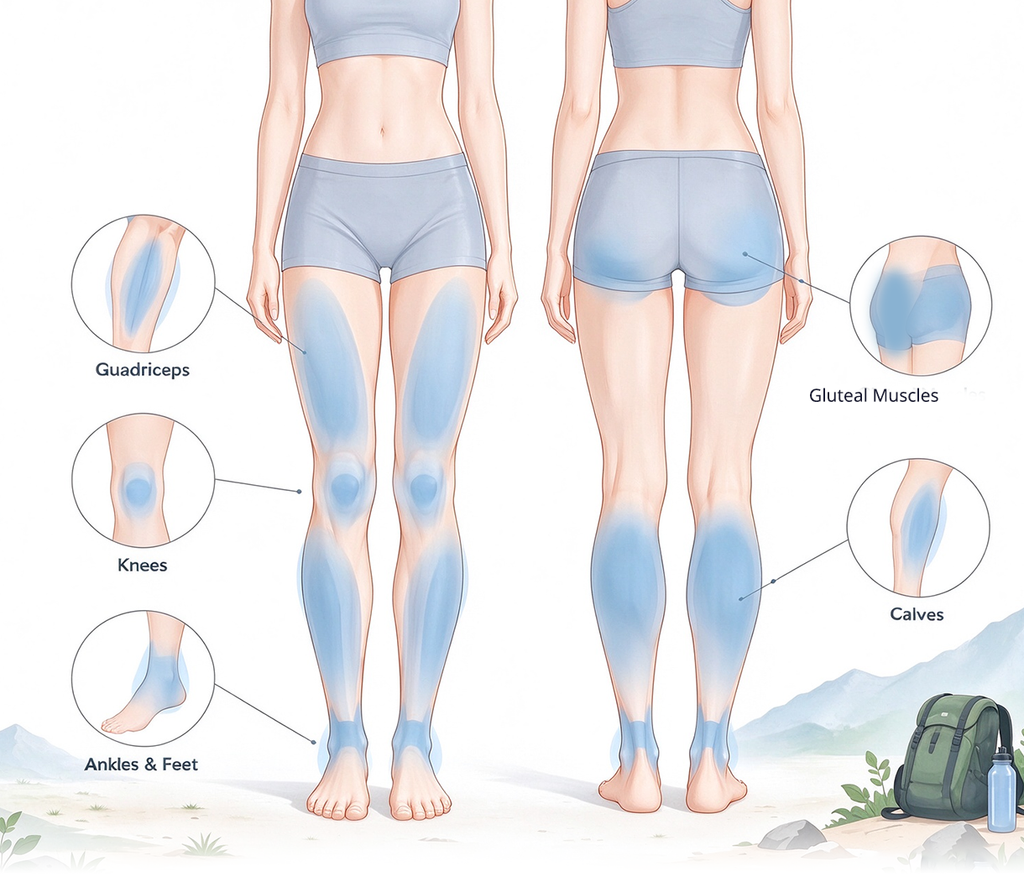
The quadriceps and calves often experience substantial loading during both climbing and descending. The hamstrings and gluteal muscles also contribute to hip and knee control, particularly when hikers navigate uneven ground.
Localized CO₂ cryotherapy can focus on these larger muscle groups when they feel particularly fatigued after a hike. Rapid cooling can temporarily influence sensory nerve activity and local vascular responses, which may make the treated area feel more comfortable.
This localized approach can be especially relevant after routes that involve significant elevation changes, because the mechanical demands differ considerably from ordinary flat-surface walking.
3.2 Knees, Ankles, and Feet
Hiking also places repeated mechanical stress on the joints and soft tissues of the lower extremities. Uneven trails require continuous adjustments in ankle position and foot placement, while downhill movement increases the forces associated with braking and impact control.
Localized cooling can provide a way to focus on these specific regions without subjecting the entire body to cold exposure. The LocalCryotherapy device uses a red laser for pinpoint targeting and includes real-time temperature monitoring, features designed to support controlled localized application.
For hikers, this targeted design can be relevant when soreness or discomfort remains concentrated around one particular anatomical region rather than affecting the whole body.
3.3 Supporting Comfort During the Recovery Window
The hours following a demanding hike represent a transition from physical exertion toward normal activity. Muscle temperature gradually returns to baseline, circulation adjusts, and tissues continue their normal recovery processes.
Cold exposure can influence pain perception through temporary changes in sensory nerve conduction. It may also affect vascular tone and local tissue metabolism. These physiological effects help explain why cryotherapy remains a common component of recovery strategies.
However, post-exercise inflammation also serves normal biological functions. Therefore, cold therapy should be viewed as a tool for managing comfort rather than an approach intended to eliminate every inflammatory response associated with exercise.
4. Why Targeted CO₂ Cryotherapy Can Suit Hikers
Hikers do not necessarily need the same recovery strategy after every outing. A short local trail, a steep mountain route, and a multi-hour hike can create very different physical demands.
4.1 Precision Matters After Uneven-Terrain Activity
Uneven trails distribute mechanical loads differently across the body. A hiker may place more stress on one side while navigating rocks, roots, slopes, or narrow paths. This can leave one muscle group or joint feeling more fatigued than others.
Targeted CO₂ cryotherapy makes it possible to focus cooling on a defined region instead of applying the same cold exposure everywhere. LocalCryotherapy’s system incorporates a red laser targeting function and temperature monitoring, supporting more controlled positioning of the cold stream.
This precision complements the localized nature of many post-hike complaints. The goal is not to cool the entire body but to provide focused cold stimulation where temporary discomfort is most noticeable.
4.2 A Compact Alternative to Traditional Cold Packs
Traditional ice packs remain familiar because they are simple and accessible, but they cool gradually and can become less consistent as the temperature changes. CO₂ cryotherapy uses rapidly expanding gas to create a dry, concentrated cooling stream.
The LocalCryotherapy device is designed as a compact system with a rechargeable 3400 mAh battery, a 1.44-inch display, automatic standby after two minutes, and a specified treatment distance of 150 ± 5 mm. These design features support portability and controlled application in professional and wellness settings.
For people who regularly hike, the appeal lies in the ability to focus on individual areas rather than relying on large quantities of ice or whole-body cold exposure.
4.3 CO₂ Cryotherapy and the Nervous System
Cold does more than change tissue temperature. Strong cooling stimulates thermoreceptors in the skin and influences peripheral sensory nerves. As nerve conduction slows, the brain may receive fewer or altered pain-related signals from the cooled region.
This temporary analgesic effect can make an area feel less sensitive during the immediate recovery period. The response does not necessarily indicate that an underlying cause has disappeared. Instead, it reflects the interaction between cold stimulation and the peripheral nervous system.
For post-hike soreness, this distinction matters. CO₂ cryotherapy may support comfort while the body continues its normal recovery process.
5. Making Localized Cooling Part of a Complete Hiking Recovery Strategy
Cold therapy works best when viewed as one part of a broader recovery framework. Hiking recovery also depends on hydration, nutrition, sleep, gradual movement, and allowing fatigued tissues enough time to adapt.
5.1 Movement Still Matters After CO₂ Cryotherapy
After a long hike, complete inactivity may not always be the most comfortable approach. Gentle movement can help maintain mobility and prevent the stiffness associated with remaining in one position for too long.
Localized CO₂ cryotherapy can complement this approach by focusing on areas that feel particularly sore or fatigued. The cooling stimulus may temporarily improve comfort, while normal movement supports overall mobility.
This combination also helps distinguish recovery support from simply masking discomfort. The purpose of localized cold therapy is not to encourage a person to ignore significant pain and immediately return to strenuous activity.
5.2 Recognizing the Difference Between Soreness and Injury
Normal post-hike soreness often develops gradually and may affect multiple muscles that experienced unfamiliar or prolonged loading. In contrast, sharp pain, significant swelling, instability, sudden loss of function, or symptoms that continue to worsen may require professional evaluation.
CO₂ cryotherapy should not become a substitute for understanding the source of persistent or severe symptoms. Its most appropriate role within a hiking recovery routine involves supporting temporary localized comfort while allowing the body adequate time to recover.
For hikers who regularly participate in demanding routes, paying attention to recurring pain patterns can also help identify when training volume, terrain, footwear, or recovery habits may need closer attention.
Frequently Asked Questions
Is CO₂ cryotherapy useful after hiking?
It may support localized comfort after strenuous activity, particularly when soreness or fatigue remains concentrated in specific muscle or joint areas.
Why use localized CO₂ cryotherapy instead of whole-body cryotherapy?
Localized CO₂ cryotherapy focuses the cold stimulus on selected areas rather than exposing the entire body to extreme cold.
How cold does CO₂ cryotherapy get?
The LocalCryotherapy system uses pressurized CO₂ that can reach approximately −78°C at the source, producing rapid localized cooling.
Which areas may hikers focus on?
Common areas include the quadriceps, calves, hamstrings, gluteal muscles, knees, ankles, and feet, depending on where post-hike discomfort occurs.
Does cold therapy affect pain signals?
Yes. Cooling can temporarily slow peripheral nerve conduction and alter the transmission and perception of pain-related signals.
Can CO₂ cryotherapy replace rest after hiking?
No. Rest, adequate hydration, nutrition, sleep, and appropriate movement remain important components of recovery.
Is colder always better?
No. Controlled exposure matters more than simply increasing cold intensity. Excessive cold can place unnecessary stress on the skin and superficial tissues.
Заключение
Hiking challenges the body through elevation changes, repetitive steps, uneven terrain, eccentric muscle contractions, and prolonged lower-body loading, making post-hike soreness a familiar part of active outdoor life. CO₂ cryotherapy provides a targeted form of cold therapy that can focus on specific areas such as the quadriceps, calves, knees, ankles, or feet rather than cooling the entire body. LocalCryotherapy’s CO₂ system uses pressurized carbon dioxide at approximately −78°C, along with red laser targeting and real-time temperature monitoring, to support controlled localized cooling. By influencing sensory nerve activity and vascular responses, this approach may help improve temporary comfort during the recovery period. When combined with sensible movement, rest, hydration, and attention to persistent symptoms, localized CO₂ cryotherapy can serve as a focused addition to a well-rounded post-hike recovery routine.
Ссылки
Cryotherapy: Mechanisms and Applications
https://www.ncbi.nlm.nih.gov/pmc/articles/PMC7025961
Cryotherapy for Treating Soft Tissue Injuries: A Systematic Review
https://pubmed.ncbi.nlm.nih.gov/18246168
The Use of Cryotherapy in Sports Injury Management
https://pubmed.ncbi.nlm.nih.gov/20509273
Effects of Cold Water Immersion on Recovery From Exercise-Induced Muscle Damage
https://pubmed.ncbi.nlm.nih.gov/20006249
The Effects of Localized Cooling on Neuromuscular Function and Exercise Recovery