
Введение
Canine agility sports place extraordinary physical demands on dogs, requiring rapid acceleration, tight directional changes, jumping, and sudden deceleration. These high-impact movements significantly increase stress on ligaments, tendons, and joint stabilizing structures. Ligament strain is one of the most common soft tissue concerns in agility dogs, often affecting performance consistency and long-term mobility. As veterinary rehabilitation continues to evolve, CO₂ cryotherapy has gained attention as a localized cold therapy technology that delivers rapid thermal reduction through pressurized carbon dioxide gas. By targeting affected soft tissue regions, it is increasingly being integrated into performance recovery protocols in veterinary and sports medicine environments as a non-invasive supportive modality for ligament-related stress conditions.
1. Why Agility Dogs Are Highly Prone to Ligament Strain
Understanding the biomechanical stress patterns in agility sports helps explain why ligament injuries are so prevalent in working and competition dogs.
1.1 High-Impact Directional Changes and Joint Load Stress
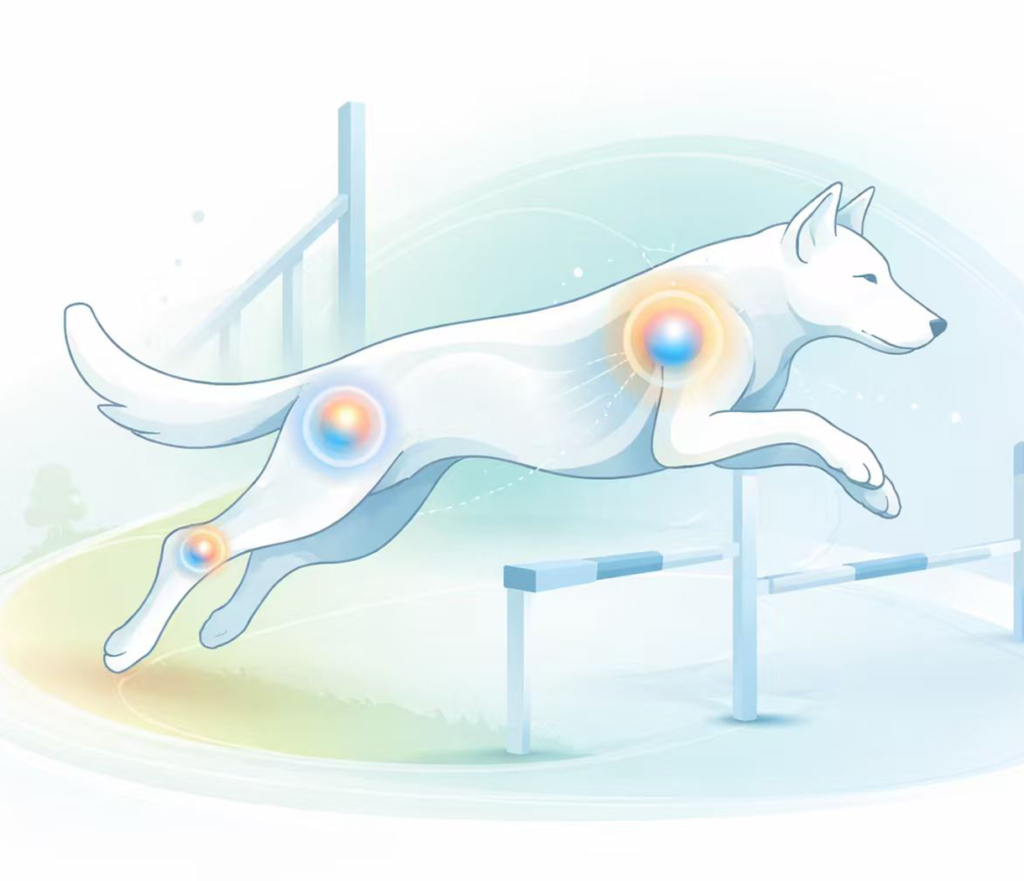
Agility training requires dogs to perform rapid turns, jumps, and directional shifts at high speed. These movements place repetitive shear forces on ligament structures that stabilize joints such as the stifle (knee), carpal (wrist), and hock (ankle). Unlike steady-state movement such as walking or jogging, agility sports involve sudden deceleration and explosive propulsion. These biomechanical demands increase tensile load on ligament fibers, which can lead to microtrauma accumulation over time. When this stress exceeds tissue tolerance thresholds, localized inflammation and strain patterns may develop, particularly in highly competitive or frequently trained dogs.
1.2 Repetitive Training Cycles Without Full Recovery Windows
Agility dogs often follow structured training schedules that include frequent repetition of jumps, weave poles, and obstacle sequences. While conditioning improves performance, insufficient recovery time between sessions can contribute to cumulative ligament fatigue. Repetitive strain without adequate tissue recovery may alter collagen fiber alignment and reduce overall ligament resilience. This chronic overload environment increases susceptibility to strain-related discomfort, particularly in younger dogs undergoing intensive training programs or older dogs with reduced connective tissue elasticity.
1.3 Surface Impact and Environmental Training Conditions
Training surfaces such as artificial turf, sand arenas, or mixed terrain environments also influence ligament loading patterns. Harder surfaces may increase impact forces during landing phases, while uneven terrain can introduce unpredictable joint angles during movement transitions. These external factors contribute additional stress to stabilizing ligament structures. Over time, repeated exposure to high-impact environments may lead to localized soft tissue irritation and reduced joint stability in agility-performing dogs.
2. Why Veterinary Clinics Are Exploring CO₂ Cryotherapy for Canine Ligament Support
As veterinary sports medicine advances, practitioners are increasingly integrating non-invasive modalities to support soft tissue recovery in working dogs.
2.1 Demand for Non-Invasive Performance Recovery Tools
Veterinary rehabilitation increasingly prioritizes recovery solutions that avoid pharmacological dependency and surgical intervention when possible. CO₂ cryotherapy is being explored as a non-invasive modality that delivers localized thermal reduction through controlled gas emission. This approach aligns with modern veterinary trends emphasizing supportive care for musculoskeletal conditions without introducing systemic medication effects. Its application in soft tissue recovery contexts makes it relevant for agility dogs experiencing ligament strain.
2.2 Localized Thermal Shock Response in Soft Tissue Structures
CO₂ cryotherapy delivers rapid cooling effects that interact with superficial and deeper tissue layers. This localized thermal shift influences microcirculation and neuromuscular response in targeted anatomical regions. In veterinary rehabilitation settings, practitioners often use this type of controlled cold exposure to support soft tissue comfort and reduce inflammatory response patterns associated with overuse injuries. Because ligament structures are sensitive to mechanical and thermal changes, veterinarians frequently consider localized cooling modalities in performance recovery protocols.
2.3 Integration Into Veterinary Rehabilitation Workflows
Modern veterinary rehabilitation clinics often combine multiple modalities such as therapeutic exercise, manual therapy, and electrotherapies. CO₂ cryotherapy is being incorporated as a preparatory or supportive modality within these multi-modal recovery frameworks. Its rapid application time and localized targeting capability make it suitable for high-throughput clinical environments where efficiency and consistency are important for treating multiple canine patients with musculoskeletal conditions.
3. How CO₂ Cryotherapy Interacts With Ligament Strain in Agility Dogs
Understanding tissue-level interaction helps explain why this modality is increasingly referenced in veterinary sports recovery.
3.1 Rapid Vasoconstriction Response in Affected Areas
When CO₂ gas is applied to targeted regions, it produces a rapid cooling effect that induces localized vasoconstriction. This physiological response reduces blood flow in superficial capillary networks, which may help manage localized swelling associated with soft tissue strain. In ligament-related conditions, controlling inflammatory response dynamics is an important aspect of maintaining joint comfort and supporting functional mobility during recovery phases.
3.2 Neuromuscular Signal Modulation in Pain Pathways
Cold exposure influences sensory nerve conduction velocity, particularly in peripheral nociceptor pathways. This modulation may reduce the intensity of pain signaling associated with ligament strain. In agility dogs, improved comfort during movement transitions can contribute to better biomechanical function and reduce compensatory movement patterns that often occur when a joint is experiencing discomfort.
3.3 Support for Soft Tissue Recovery Environments
Ligament structures rely on gradual collagen remodeling during recovery processes. While CO₂ cryotherapy does not directly repair tissue, it is used in veterinary settings to support an environment conducive to natural healing processes by managing localized stress responses. This supportive role is particularly relevant in working dogs where maintaining performance levels while recovering from strain is often a clinical priority.
4. Why Agility Dogs Benefit From Localized Recovery Approaches
Agility dogs differ from general companion animals due to their high-performance musculoskeletal demands.
4.1 Precision Targeting of High-Stress Joint Regions
Ligament strain in agility dogs is often localized to specific joints such as the stifle or shoulder complex. CO₂ cryotherapy devices allow targeted application to precise anatomical regions, making it suitable for addressing isolated soft tissue stress points rather than whole-body systemic approaches. This precision is particularly valuable in veterinary sports medicine where localized performance issues must be addressed efficiently.
4.2 Compatibility With Active Training Schedules
Agility dogs often remain active throughout training cycles, making extended recovery downtime less practical. Practitioners can integrate CO₂ cryotherapy into routine clinical visits or post-training recovery sessions without significantly disrupting training schedules. This compatibility allows veterinary professionals and trainers to support soft tissue recovery while maintaining conditioning programs.
4.3 Role in Performance Maintenance Strategies
Veterinary professionals increasingly discuss CO₂ cryotherapy in the context of performance maintenance, beyond injury management. By supporting soft tissue recovery and managing localized stress responses, it may contribute to maintaining joint function in dogs subjected to repeated high-intensity athletic activity. This positions it as part of broader performance longevity strategies in canine sports medicine.
5. When Veterinary Professionals Consider CO₂ Cryotherapy for Agility Dogs
Clinical application typically depends on injury stage, activity level, and performance demands.
5.1 Early-Stage Ligament Strain Management
When veterinary professionals identify ligament strain in early stages, they often focus on reducing progression risk and supporting soft tissue comfort. In this context, they frequently discuss CO₂ cryotherapy as part of early intervention strategies within non-invasive care frameworks.
5.2 Post-Training Recovery in Competitive Dogs
In high-performance agility dogs, recovery between training sessions is essential for long-term joint health. Veterinary professionals commonly explore CO₂ cryotherapy as part of post-training recovery protocols to support soft tissue relaxation and reduce accumulated strain effects.
5.3 Ongoing Maintenance in High-Performance Canine Athletes
For dogs engaged in continuous competitive activity, long-term joint health management becomes a priority. Veterinary professionals may incorporate CO₂ cryotherapy into maintenance programs designed to support musculoskeletal balance and reduce repetitive stress accumulation over time.
ЧАСТО ЗАДАВАЕМЫЕ ВОПРОСЫ
What is CO₂ cryotherapy used for in dogs?
It is used in veterinary settings to support soft tissue recovery and manage localized inflammation in musculoskeletal conditions.
Can agility dogs benefit from cryotherapy?
Yes, agility dogs are often exposed to repetitive joint stress, making cryotherapy a supportive recovery option.
Is CO₂ cryotherapy invasive for animals?
No, it is a non-invasive localized cold therapy using controlled CO₂ gas.
How does it differ from ice packs?
It delivers rapid, targeted cooling with more precise application compared to traditional ice methods.
Can it be used during training cycles?
Yes, it is often integrated into recovery and maintenance routines in active canine athletes.
Заключение
Agility dogs are highly susceptible to ligament strain due to repetitive high-impact movement patterns, environmental stress factors, and continuous training cycles. As veterinary sports medicine advances, CO₂ cryotherapy has emerged as a localized, non-invasive modality that supports soft tissue recovery through rapid thermal modulation and neuromuscular response regulation. Within veterinary rehabilitation and canine performance management contexts, practitioners increasingly consider it part of comprehensive recovery strategies that maintain joint function, support athletic longevity, and optimize overall musculoskeletal health in working and competitive dogs.
Ссылки
1. Hyperbaric gaseous cryotherapy for postoperative rehabilitation enhances functional recovery of canine stifle joint
Journal of Veterinary Science
https://pubmed.ncbi.nlm.nih.gov/34854265
2. Cryotherapy Improves Limb Use But Delays Normothermia Early After Stifle Joint Surgery in Dogs
Frontiers in Veterinary Science
https://www.frontiersin.org/articles/10.3389/fvets.2020.00381/full
3. Thermographic Evaluation of the Duration of Skin Cooling After Cryotherapy in Dogs Following TPLO Surgery
Frontiers in Veterinary Science
https://www.frontiersin.org/articles/10.3389/fvets.2022.784327/full
4. Cryotherapy mediates histopathological and microstructural changes during treatment of skin and subcutaneous tumors in dogs
Cryobiology (Elsevier)
https://doi.org/10.1016/j.cryobiol.2020.11.006
5. CO₂ topical vapocoolant spray for reducing needle-related pain in dogs
Frontiers in Veterinary Science
https://www.frontiersin.org/articles/10.3389/fvets.2026.1754998/full
6. Carbon dioxide laser surgery in veterinary dermatologic and oncologic applications (CO₂ laser-related comparative reference)
Journal of Veterinary Dermatology / PubMed indexed research