Introdução
Flight attendants spend hours on their feet in pressurized cabins, cross multiple time zones, and fight gravity with every step. Over time, this routine leads to chronic leg swelling, visible varicose veins, and a disrupted internal clock that makes restful sleep elusive. CO₂ cryotherapy—a targeted, non‑invasive cold treatment—offers a science‑backed way to address these occupational hazards without medication or downtime. This article explores how CO₂ cryotherapy helps flight attendants reduce leg edema, manage venous symptoms, and recover faster after long‑haul flights.
1. Why Flight Attendants Are Prone to Leg Vein Problems
1.1 The Perfect Storm: Gravity, Cabin Pressure, and Prolonged Standing
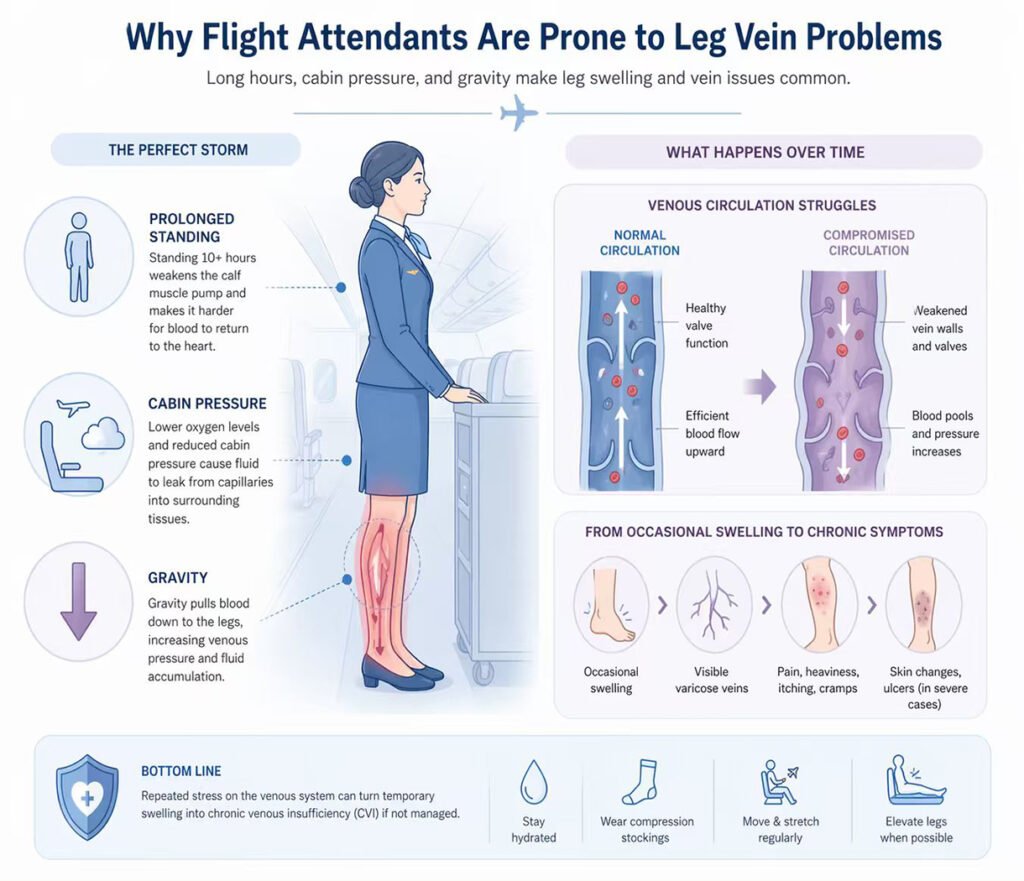
Standing for 10 or more hours forces the venous system to work relentlessly against gravity. The calf muscle pump, which normally pushes blood upward toward the heart, becomes less effective when muscles fatigue. At the same time, reduced cabin oxygen levels impair blood flow and cause fluid to leak from capillaries into surrounding tissues. This combination makes leg swelling nearly inevitable after a long shift.
1.2 From Occasional Swelling to Chronic Venous Symptoms
Repeated episodes of edema gradually weaken vein walls and valves. The term chronic venous insufficiency (CVI) covers symptoms such as heaviness, itching, tingling, cramps, pain, edema, varicose veins, skin pigmentation, and even ulceration. What begins as “heavy legs” can progress to bulging veins and persistent discomfort. Flight attendants face this progression because prolonged standing and cabin pressure changes create a challenging environment for circulation.
2. How CO₂ Cryotherapy Works on Leg Circulation
2.1 The Biphasic Vascular Response
CO₂ cryotherapy applies pressurized, ultra‑cold carbon dioxide directly to the skin. This extreme cold triggers an immediate vasoconstriction, narrowing blood vessels rapidly. Following this initial constriction, the body initiates a compensatory vasodilation that increases blood flow significantly above baseline levels. This biphasic sequence—constriction followed by dilation—helps clear pooled blood and metabolic waste from congested leg tissues.
2.2 Why CO₂ Differs from Plain Ice
Standard ice packs only cool the skin superficially and produce a slow, shallow vasoconstriction. Hyperbaric gaseous cryotherapy decreases skin temperature far more dramatically and also triggers a systemic skin vasoconstriction response. The rapid cooling stimulates cutaneous cold receptors that send signals to the central nervous system, activating both local and systemic physiological responses. This whole‑body engagement explains why CO₂ cryotherapy feels different from simply placing an ice pack on tired legs.
2.3 The Thermal Shock Mechanism
Pressurized CO₂ at -78°C forms dry ice microcrystals that sublimate instantly, drawing large amounts of heat from the tissue. This thermal shock reduces the number of inflammatory mediators responsible for edema and restores normal vascular permeability within minutes. Traditional cold therapy can take 20 minutes to achieve peak vasodilation, but CO₂ cryotherapy reaches a 117% vasodilation peak in just 20 seconds. This speed makes it valuable for flight attendants with limited recovery time.
3. Targeted Benefits for Flight Attendants
3.1 Rapid Reduction of Leg Swelling (Edema)
The anti‑edema effect of CO₂ cryotherapy appears within minutes of application. By restoring normal vascular permeability, it helps the body quickly reabsorb excess interstitial fluid accumulated during a long flight. A randomized clinical trial found that throbbing, aching, itching, and pain showed the greatest clinically meaningful improvements in response to cooling treatment applied to lower leg skin. Many flight attendants report lighter, less achy legs immediately after a 5‑minute session.
3.2 Managing Varicose Vein Symptoms Without Surgery
While CO₂ cryotherapy does not remove existing varicose veins, it significantly reduces associated pain, heaviness, and itching. The initial vasoconstriction decreases accumulation of inflammatory substances and excess fluid in cooled tissues, directly reducing discomfort. Improved circulation and reduced venous pressure also help prevent new veins from forming and slow progression of existing ones. Regular sessions can alleviate chronic inflammation in damaged tissues and improve long‑term circulation.
3.3 Supporting Circadian Reset and Reducing Jet Lag
Cold exposure modulates the hypothalamic‑pituitary‑adrenal (HPA) axis, which governs stress responses and circadian rhythms. Nocturnal cold exposure provokes a decrease in REM sleep with an activation of stress hormones, but previous acclimation can reduce this effect. When flight attendants apply CO₂ cryotherapy in the evening after a long‑haul flight, the treatment may help signal the body to transition into a rest state. This effect supports natural adjustment to new time zones.
4. Practical Use for Cabin Crew
4.1 Best Timing: After Landing or During Layovers
For maximum benefit, flight attendants should receive CO₂ cryotherapy within 2‑4 hours of landing, while legs remain acutely swollen. Even a session the next morning provides meaningful relief, but earlier intervention yields better results. A typical localized treatment lasts 5‑10 minutes per leg area, making it easy to fit into a layover schedule. There is no downtime afterward—flight attendants can return to normal activities immediately.
4.2 Frequency and Long‑Term Strategy
Flight attendants who fly long‑haul rotations often use CO₂ cryotherapy after every major trip. For those with established varicose veins or persistent leg discomfort, a maintenance session once a week or before particularly demanding duty tours keeps symptoms under control. The biphasic vasomotor response becomes more efficient with regular use, as the body adapts to cold exposure. Consistent sessions can improve baseline circulation and reduce symptom severity between treatments.
4.3 Combining with Basic Prevention Habits
CO₂ cryotherapy does not replace essential prevention practices. Flight attendants should continue wearing graduated compression stockings, which provide gentle pressure that keeps blood moving through the veins. Performing in‑seat ankle pumps and calf stretches during cruise, staying well‑hydrated, and elevating legs during layovers all remain critical. CO₂ cryotherapy adds a powerful recovery layer on top of these basics, creating a comprehensive approach to leg health.
5. Cautions, Contraindications, and When to See a Doctor
5.1 Who Should Not Use CO₂ Cryotherapy
Individuals with certain cold‑sensitive conditions must avoid CO₂ cryotherapy. Superficial cold should not apply to persons with cold urticaria (cold allergy), Raynaud‘s disease, or cryoglobulinemia. Pregnant flight attendants should consult their obstetrician before starting any cold therapy. Those with open wounds, active infections in the treatment area, or a history of frostbite should also avoid this modality. A thorough medical screening ensures safety.
5.2 When Professional Vein Treatment Is Still Needed
CO₂ cryotherapy effectively manages symptoms but does not cure advanced venous disease. Flight attendants with large, bulging varicose veins, skin ulcers, or a history of deep vein thrombosis require evaluation by a vascular specialist. Treatment modalities for varicose veins include surgery, thermal ablation, sclerotherapy, mechanochemical ablation, cyanoacrylate adhesive, and cryotherapy. After receiving appropriate medical treatment, flight attendants can use CO₂ cryotherapy as an adjunct to support recovery.
PERGUNTAS FREQUENTES
Q: Can I do CO₂ cryotherapy after every flight?
A: Yes, localized sessions are safe for frequent use. Those with cold‑sensitivity conditions should consult a doctor first.
Q: How soon after landing should I get treatment?
A: Ideally within 2‑4 hours, while swelling remains acute. The next day still works but results may be less dramatic.
Q: Does CO₂ cryotherapy hurt?
A: It feels intensely cold for a few seconds, but most people describe it as uncomfortable rather than painful. No downtime afterward.
Q: Will it make my varicose veins disappear?
A: No, it reduces pain and swelling but does not eliminate existing veins. For removal, other medical procedures are necessary.
Q: Can I use it if I have a history of blood clots?
A: Only after clearance from a vascular doctor. CO₂ cryotherapy affects circulation significantly, so underlying clotting risks need evaluation first.
Conclusão
Flight attendants face an unavoidable occupational risk of leg swelling, varicose veins, and jet lag. CO₂ cryotherapy provides a rapid, non‑invasive way to reduce edema, relieve venous symptoms, and help reset the body‘s internal clock after long‑haul flights. By triggering a unique biphasic vascular response that constricts blood vessels and then dilates them, it clears pooled blood from the legs and supports recovery without medication or downtime. When used alongside compression stockings, hydration, and regular movement—and with appropriate medical guidance for underlying vein disease—CO₂ cryotherapy becomes a practical secret weapon for any cabin crew member.
Referências
Center for Vein Restoration. (2017). Top 5 Riskiest Jobs for Vein Disease.
https://www.centerforvein.com/blog/top-5-riskiest-jobs-for-vein-disease
Kelechi, T. J., et al. (2018). Symptoms Associated With Chronic Venous Disease in Response to a Cooling Treatment Compared to Placebo: A Randomized Clinical Trial. Journal of Wound, Ostomy and Continence Nursing, 45(4), 301–309.
https://pubmed.ncbi.nlm.nih.gov/29846278/
Yoshimura, M., et al. (2020). Application of carbon dioxide to the skin and muscle oxygenation of human lower-limb muscle sites during cold water immersion. PeerJ, 8, e9785.
https://pubmed.ncbi.nlm.nih.gov/32884861/
Mourot, L., et al. (2007). Hyperbaric gaseous cryotherapy: effects on skin temperature and systemic vasoconstriction. Archives of Physical Medicine and Rehabilitation, 88(10), 1339–1343.
https://pubmed.ncbi.nlm.nih.gov/17908579/
Buguet, A., et al. (1998). Sleep and stress in man: an approach through exercise and exposure to extreme environments. Canadian Journal of Physiology and Pharmacology, 76(5), 553–561.
https://pubmed.ncbi.nlm.nih.gov/9839082/
Klonizakis, M., et al. (2012). Cryotherapy and ankle motion in chronic venous disorders. Open Journal of Nursing, 2(4), 379–387.