Einführung
Hand fatigue and wrist strain are increasingly recognized as occupational concerns among surgeons working in precision-dependent procedural environments where sustained fine motor control is essential for performance stability. Long operating sessions, repetitive instrument manipulation, and static positioning patterns create cumulative mechanical stress within the wrist complex and surrounding soft tissues. As healthcare systems continue expanding clinician wellness programs and preventive musculoskeletal support strategies, localized recovery technologies such as CO₂ cryotherapy are gaining attention for their ability to deliver rapid, controlled cooling to specific anatomical areas within rehabilitation settings. Unlike traditional surface ice applications, CO₂ cryotherapy provides targeted thermal stimulation that can be integrated alongside modalities such as photobiomodulation therapy (low-level laser therapy) to support structured occupational recovery environments designed for high-precision clinical professions.
1. Why Surgeons Frequently Experience Hand Fatigue and Wrist Strain
Surgeons perform complex procedures that depend heavily on neuromuscular precision and endurance within the upper extremities. Understanding how occupational movement patterns influence localized strain helps explain why targeted cooling technologies such as CO₂ cryotherapy are increasingly discussed in clinician recovery environments.
1.1 Repetitive Precision Movements in Surgical Procedures
Surgical performance relies on continuous micro-adjustments of wrist angle, grip pressure, and fingertip positioning during delicate procedural steps such as suturing, vessel manipulation, and laparoscopic instrument navigation. These movements activate stabilizing forearm muscle groups responsible for maintaining consistent tactile responsiveness across extended time intervals. Unlike larger muscle groups that alternate between contraction and relaxation cycles during gross motor activity, surgical precision tasks require sustained low-amplitude activation that gradually increases localized fatigue within tendon structures surrounding the radiocarpal joint. Because CO₂ cryotherapy delivers rapid localized cooling that interacts with peripheral circulation and neuromuscular signaling pathways, rehabilitation environments increasingly evaluate its relevance for supporting recovery strategies targeting repetitive precision movement exposure patterns common among surgeons.
1.2 Long Surgical Sessions with Limited Movement Variation
Extended surgical procedures frequently require maintaining stable wrist positioning for prolonged durations while controlling instruments under magnification or robotic interfaces. Limited opportunities for repositioning can reduce natural recovery intervals within stabilizing muscle groups, increasing localized mechanical load across ligament structures and tendon sheaths. Over time, this static exposure pattern may influence circulation dynamics and contribute to stiffness within the wrist complex. Localized CO₂ cryotherapy systems are designed to deliver short-duration thermal stimulation to specific anatomical regions, which makes them compatible with rehabilitation workflows focused on addressing localized exposure patterns associated with prolonged procedural positioning demands rather than generalized whole-limb fatigue conditions.
1.3 Increasing Use of Minimally Invasive Surgical Techniques
Minimally invasive surgical systems improve patient outcomes but often require surgeons to maintain controlled wrist deviations while manipulating long instruments through fixed entry points. These biomechanical constraints increase reliance on stabilizing forearm musculature responsible for maintaining instrument trajectory accuracy. Repeated exposure to these positioning requirements contributes to cumulative strain patterns that differ from traditional open surgical ergonomics. Within occupational rehabilitation environments supporting procedural specialists, localized CO₂ cryotherapy has attracted interest as a precision-focused modality capable of targeting anatomical regions affected by instrument interface mechanics while integrating with broader recovery strategies that include photobiomodulation therapy and ergonomic optimization programs.
2. Occupational Risk Factors Affecting Surgeons’ Upper Extremity Health
To understand why localized cryotherapy technologies are becoming increasingly relevant within clinician wellness frameworks, it is important to consider the structural occupational factors contributing to upper-extremity fatigue accumulation across surgical careers.
2.1 High Frequency of Repetitive Instrument Handling
Precision surgical instruments require sustained stabilization forces that activate both flexor and extensor muscle groups simultaneously to maintain tactile responsiveness and movement accuracy. This co-activation pattern increases localized tension near tendon attachment sites such as the medial and lateral epicondyles and influences neuromuscular endurance during long procedural sessions. Rehabilitation professionals increasingly recognize that targeted cooling technologies capable of interacting with superficial circulation and peripheral nerve signaling pathways may support structured recovery strategies addressing these localized exposure zones. CO₂ cryotherapy systems are therefore being explored within occupational recovery environments as part of broader musculoskeletal resilience programs designed for high-precision professions requiring sustained instrument interaction.
2.2 Static Operating Room Ergonomics
Operating room environments often limit opportunities for posture variation because surgical accuracy depends on maintaining stable alignment relative to visualization systems and instrument entry points. Even small deviations in table height or monitor positioning can influence wrist extension angles throughout procedures lasting several hours. Over time, compensatory posture adjustments may increase localized mechanical stress within the carpal region. Localized CO₂ cryotherapy systems are particularly compatible with rehabilitation programs designed to support anatomical regions affected by sustained ergonomic loading patterns, as their targeted delivery characteristics allow clinicians to focus thermal stimulation within defined wrist and forearm zones associated with occupational exposure rather than relying on generalized cooling approaches.
2.3 Long-Term Exposure Across Surgical Careers
Upper-extremity fatigue patterns among surgeons typically reflect cumulative occupational exposure rather than isolated events. As procedural complexity increases over time and workloads expand across clinical schedules, connective tissue recovery intervals may gradually shorten. Preventive clinician wellness programs therefore increasingly incorporate localized recovery technologies capable of supporting structured musculoskeletal resilience strategies. CO₂ cryotherapy has gained attention within these frameworks because its rapid thermal response characteristics allow integration into rehabilitation sessions designed to complement additional modalities such as neuromuscular stimulation and photobiomodulation therapy within coordinated occupational support environments.
3. Growing Awareness of Surgeon Wellness and Preventive Musculoskeletal Support
Healthcare institutions are increasingly recognizing that maintaining clinician performance stability requires structured attention to occupational recovery strategies addressing precision-dependent workload exposure patterns.
This shift has contributed to expanding interest in localized cryotherapy systems within rehabilitation programs supporting procedural specialists.
3.1 Expansion of Hospital-Based Clinician Wellness Programs
Clinician wellness programs now go beyond ergonomic education to include recovery technologies that support musculoskeletal endurance. They use assessment tools to detect early wrist and forearm fatigue. In this context, CO₂ cryotherapy offers rapid localized cooling for areas stressed by repetitive precision work. Its compatibility with clinic workflows makes it well suited for multidisciplinary rehab departments supporting procedural professionals.
3.2 Increasing Attention to Workforce Sustainability in Healthcare Systems
Sustaining long-term workforce health in high-precision medical fields requires proactive strategies that address strain before it leads to persistent discomfort. Healthcare administrators now recognize that clinician endurance affects both efficiency and career stability. Therefore, recovery technologies that support localized muscle resilience are becoming part of institutional wellness plans. CO₂ cryotherapy is often discussed in these frameworks because it delivers rapid localized cooling that fits structured rehabilitation schedules.
3.3 Shift Toward Non-Pharmacological Recovery Technologies in Clinical Settings
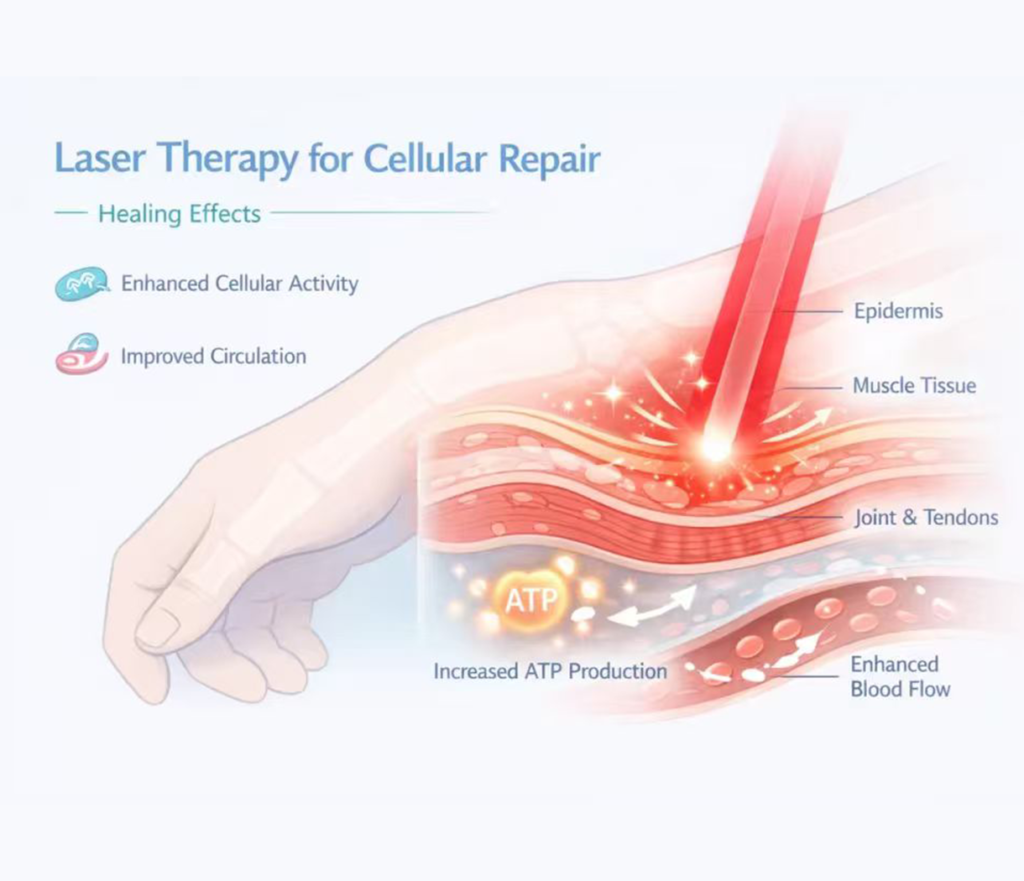
Non-drug recovery methods are gaining importance in clinician support, as they fit preventive health strategies that reduce medication use. Photobiomodulation (low‑level laser) affects cellular metabolism, while CO₂ cryotherapy delivers controlled cooling to influence circulation and nerve response. Together, they serve as complementary tools in multidisciplinary rehab programs that support sustainable performance in precision‑based professions.
4. What Makes Localized CO₂ Cryotherapy Relevant in Clinical Recovery Environments
Localized cryotherapy technologies differ significantly from traditional cooling approaches used in general musculoskeletal support contexts.
Understanding these distinctions helps explain why CO₂ cryotherapy systems are increasingly integrated into clinician recovery environments designed for targeted occupational support.
4.1 Precision Cooling Compared with Traditional Surface Ice Methods
Traditional ice applies broad cooling without precise control. CO₂ cryotherapy delivers high-velocity micro‑jets that create rapid temperature changes within defined zones. This targets wrist and forearm areas stressed by repetitive surgical work, avoiding unnecessary cooling of surrounding tissues. Because surgeons’ occupational strain is often localized, precision cooling fits well with rehabilitation workflows designed for profession‑specific biomechanical stress patterns.
4.2 Rapid Cooling Response and Short Application Duration Characteristics
CO₂ cryotherapy produces rapid surface temperature changes that distinguish it from conventional gel-based or ice-pack cooling strategies requiring extended exposure intervals. These rapid responses make the modality suitable for integration into structured rehabilitation appointments scheduled around demanding clinical responsibilities. Short-duration application characteristics allow clinicians to incorporate localized cryotherapy into coordinated recovery sessions alongside photobiomodulation therapy and ergonomic evaluation procedures without disrupting workflow continuity. As rehabilitation departments continue expanding technology-supported clinician wellness initiatives, efficiency-compatible modalities are becoming increasingly valuable components of occupational recovery environments.
4.3 Compatibility with Multidisciplinary Rehabilitation Programs
Modern clinician recovery programs combine multiple therapies to support musculoskeletal resilience. CO₂ cryotherapy fits well because its localized stimulation complements laser therapy, electrical stimulation, and ergonomic training. This compatibility allows flexible rehabilitation planning for precision-based roles, addressing both local exposure patterns and long-term endurance.
5. Why Surgeon-Specific Recovery Needs Differ from Other Healthcare Professions
Although many clinical roles involve physical workload exposure, surgical practice presents uniquely concentrated demands on wrist stability and fine motor coordination.
These profession-specific requirements help explain why localized cryotherapy technologies are increasingly evaluated within recovery environments supporting procedural specialists.
5.1 Dependence on Fine Motor Stability and Precision Performance
Surgical accuracy relies on steady neuromuscular coordination for stable instrument positioning. Small changes in wrist alignment can affect touch sensitivity during delicate tasks. Localized CO₂ cryotherapy delivers focused cooling to key precision-related areas, so rehabilitation professionals are exploring its use in occupational support for clinicians who need sustained fine motor reliability during long procedures.
5.2 Impact of Wrist Comfort on Long-Duration Surgical Performance
Maintaining wrist comfort helps sustain concentration during long procedures requiring steady hand-eye coordination. Fatigue in stabilizing muscles can reduce endurance and affect pacing. Recovery tools that support localized muscle resilience are therefore important for long-duration performance. CO₂ cryotherapy is especially relevant because its targeted stimulation matches the muscle demands of prolonged instrument control.
5.3 Role of Preventive Recovery Technologies in Supporting Long-Term Surgical Careers
Preventive recovery strategies are essential for long-term clinician performance in precision-based fields. Localized cryotherapy is now used proactively—not just after discomfort appears—to support musculoskeletal endurance. Its compatibility with wellness, ergonomic, and photobiomodulation programs makes CO₂ cryotherapy a key part of multidisciplinary recovery strategies for surgical career resilience.
Schlussfolgerung
As surgery demands greater precision and longer performance, wrist resilience is becoming key to clinician wellness. Healthcare programs now use targeted technologies that support precision workloads without disrupting workflow. In these settings, localized CO₂ cryotherapy is gaining recognition as a complementary tool for long-term stability, ergonomics, and recovery in high-precision specialties.
Referenzen
Ergonomic Challenges in the Operating Room
https://pubmed.ncbi.nlm.nih.gov/24412251
Prevalence of Musculoskeletal Disorders Among Surgeons
https://pubmed.ncbi.nlm.nih.gov/31033881
Cryotherapy in Sports Medicine and Rehabilitation
https://pubmed.ncbi.nlm.nih.gov/31222099
Photobiomodulation Therapy Mechanisms and Applications
https://pubmed.ncbi.nlm.nih.gov/30549010
Localized Cryotherapy Effects on Pain and Inflammation
https://pubmed.ncbi.nlm.nih.gov/26609287
Low-Level Laser Therapy in Musculoskeletal Rehabilitation